

Table of Contents
From an Early 30 Million to a 40 Million Era
In its 2026 second-half work plan announced on August 5, the Ministry of Culture, Sports and Tourism said it would hit its target of 30 million foreign visitors ahead of schedule and begin preparing for the next stage: an era of 40 million. The plan goes beyond expanding airports, ports and lodging — it calls for parallel improvements to visas, transportation, payment systems and regional tourism products. The core premise behind the higher target is converting global interest in K-pop, dramas and film into actual visits and spending inside Korea.
Thirty million is not a figure Korea has already reached — it’s a policy target the government is trying to hit early. According to figures the ministry released, 10.71 million foreign tourists visited Korea in the first half of 2026, up 21.3% from the same period a year earlier. The government’s plan is to keep that momentum going, pull forward the timeline for reaching 30 million, and start building the tourism infrastructure a 40-million-visitor country would need.
What matters in this work plan isn’t simply that the visitor target rose by 10 million. The government bundled together policies that lower entry barriers, products that turn K-culture into a reason to visit, and regional strategies that spread tourists beyond Seoul into one continuous flow. In effect, it’s treating the entire journey — from foreigners discovering Korea, to deciding to visit, to staying in multiple regions after arrival — as a single policy target.
Lowering the Entry Barrier With Multiple-Entry Visas and Visa-Free Group Tours
The most direct lever is simplifying the process of entering Korea. The ministry plans to work with related agencies to expand multiple-entry visas and visa-free group tourism, while improving immigration convenience more broadly. A multiple-entry visa allows repeated entries within a validity period, which could reduce the application burden and wait times for foreigners who visit Korea repeatedly for concerts, festivals, shopping, or medical and beauty services.
Expanding visa-free group tourism means allowing tour groups that meet designated conditions to enter without a separate visa. For overseas travel agencies designing Korea packages, this could cut the time and uncertainty tied to visa issuance, making it easier to attract group demand. Still, which countries qualify, how long the policy will run, and how travel agencies will be managed are matters that require further coordination among relevant ministries — the actual scope will only become clear in follow-up announcements.
Changing visas alone won’t erase every inconvenience across a trip. As visitor numbers rise sharply, immigration screening, baggage handling at airports and ports, and transportation from airports into city centers all come under added strain. Multilingual guidance, transit information for foreign visitors, and payment environments that accept overseas payment methods are also needed. That’s why the ministry paired visa changes with plans to expand airport and port infrastructure and improve transportation and payments.

Turning K-Culture Interest Into Actual Travel Demand
If entry policy lowers the barrier to visiting, K-culture is the engine that makes people decide to go. The ministry plans to expand tourism products that link K-pop concerts, drama and film filming locations, food, and beauty with Korean content and everyday culture. The strategy isn’t to stop at people consuming content online — it’s to build concrete travel itineraries that get them to visit the actual places on screen, or attend performances and exhibitions in person.
Simply using popular content for tourism promotion isn’t enough on its own. Flights and lodging need to be aligned with concert schedules, along with foreign-language booking guidance and transportation to filming locations. When a filming site is a residential neighborhood or a small shop, safeguards are also needed so that a surge of visitors doesn’t disrupt residents’ daily lives. Turning content popularity into sustainable tourism demand requires weighing how much a given location can actually absorb.
One piece of this vision is Fanomenon, a large-scale K-culture event the ministry is pushing to hold in December 2027. The ministry intends to use major K-culture hubs and events in cities overseas to widen Korean culture’s international footprint. To turn interest generated abroad into actual concert attendance and stays in Korea, event dates need to be locked in early, alongside multilingual guidance for ticket sales, lodging bookings and related tourism products.
A 40 Million Target That Has to Be Completed Outside Seoul
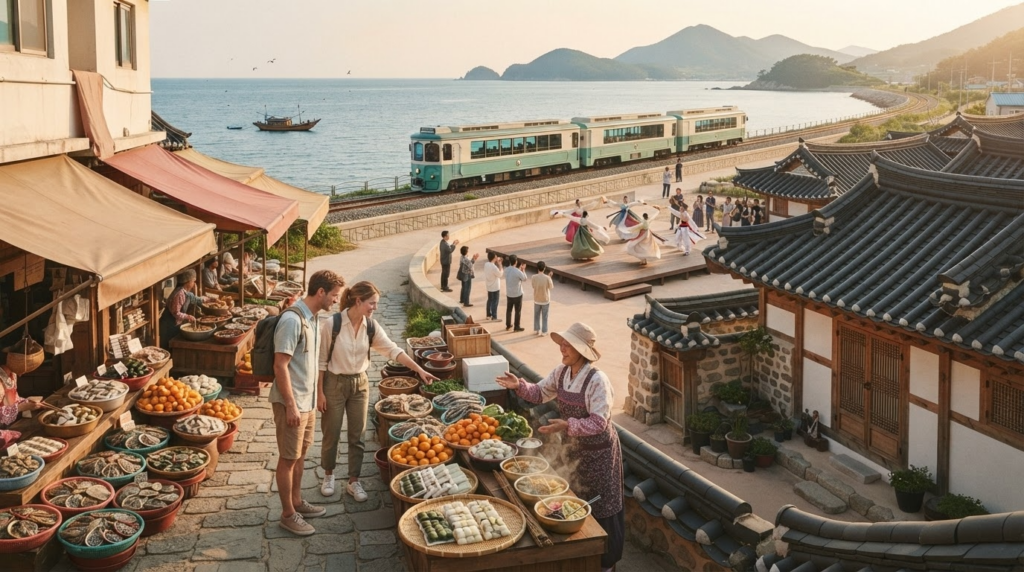
It’s difficult to concentrate 40 million visitors on Seoul’s existing tourist spots alone. The ministry said it would build a “Golden Route” for inbound tourism centered on five regional airports — connecting arrival, lodging and experiences — while strengthening region-specific marketing. The idea is to steer visitors who enter through regional airports toward a chain of nearby cities and attractions, rather than the familiar path of landing at Incheon and only seeing Seoul.
Expanding regional tourism matters not just for visitor counts but for how long people stay and how widely they spend. If tourists stay longer in one region, their spending on lodging, food, transportation, performances and experiences can grow accordingly. But if international routes are scarce or public transit from regional airports to attractions is inconvenient, simply spreading out entry points won’t be enough on its own. That’s why air routes and regional transportation need to be designed together.
To encourage regional visits, the ministry plans to expand support programs such as discounted travel and vacation packages, while supplementing regional airports, ports and lodging facilities. It also intends to focus on sectors with high per-visitor spending, such as medical and beauty tourism and luxury travel. This is an approach that pursues a quantitative goal — more visitors — and a qualitative one — longer stays and higher spending — at the same time.
Three Conditions That Would Turn the Target Into Results
The first condition is closing the gap between the target and the means of achieving it. Expanding multiple-entry visas and visa-free group tourism only becomes something travel agencies and tourists can actually plan around once the eligible countries, timing and conditions are spelled out. Expanding regional airport routes and tourism infrastructure also requires budgets and project timelines attached. If the government presents a number like 40 million without following through quickly, it becomes hard to convert market expectations into real demand.
The second is managing the congestion and local strain that comes with more visitors. When crowds concentrate around popular concerts and filming locations, it can drive up lodging costs, worsen traffic, generate waste, and intrude on residents’ living spaces. Policies that redirect tourists from Seoul to the regions also need to be designed so that real income reaches local residents and small business owners. A rising visitor count alone doesn’t guarantee that the quality of tourism has improved.
The third is converting K-culture’s popularity into repeat visits rather than one-off trips. This is where expanding multiple-entry visas matters. A first trip might center on a concert or filming location; a second could open up regional food, festivals, medical and beauty services, or nature tourism. Whether the government’s 40-million scenario succeeds ultimately depends on how convenient and varied a travel experience it can build out of the interest K-culture generates.
Source: Ministry of Culture, Sports and Tourism press release, August 5, 2026; Money Today and Newspim, August 5, 2026.