
Table of Contents
Autumn from a monorail window and on a reservoir’s surface
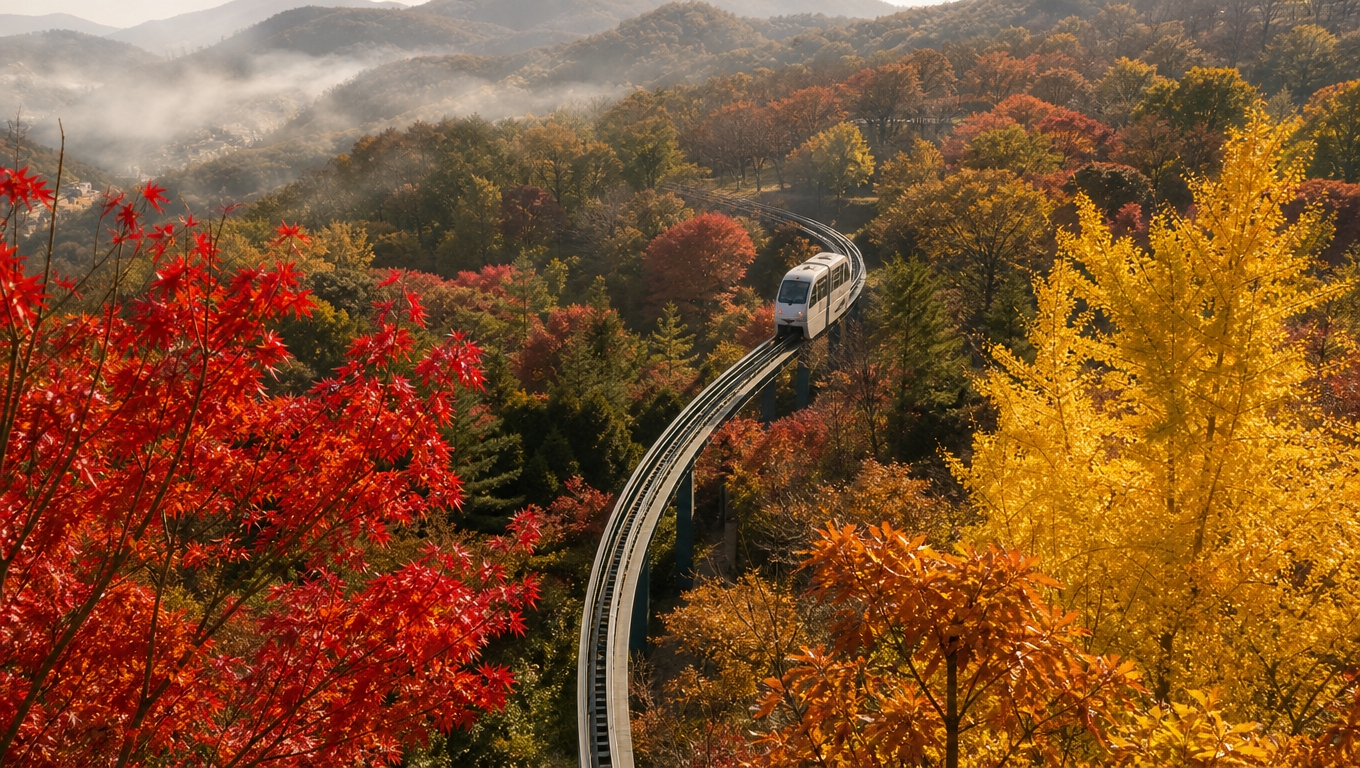
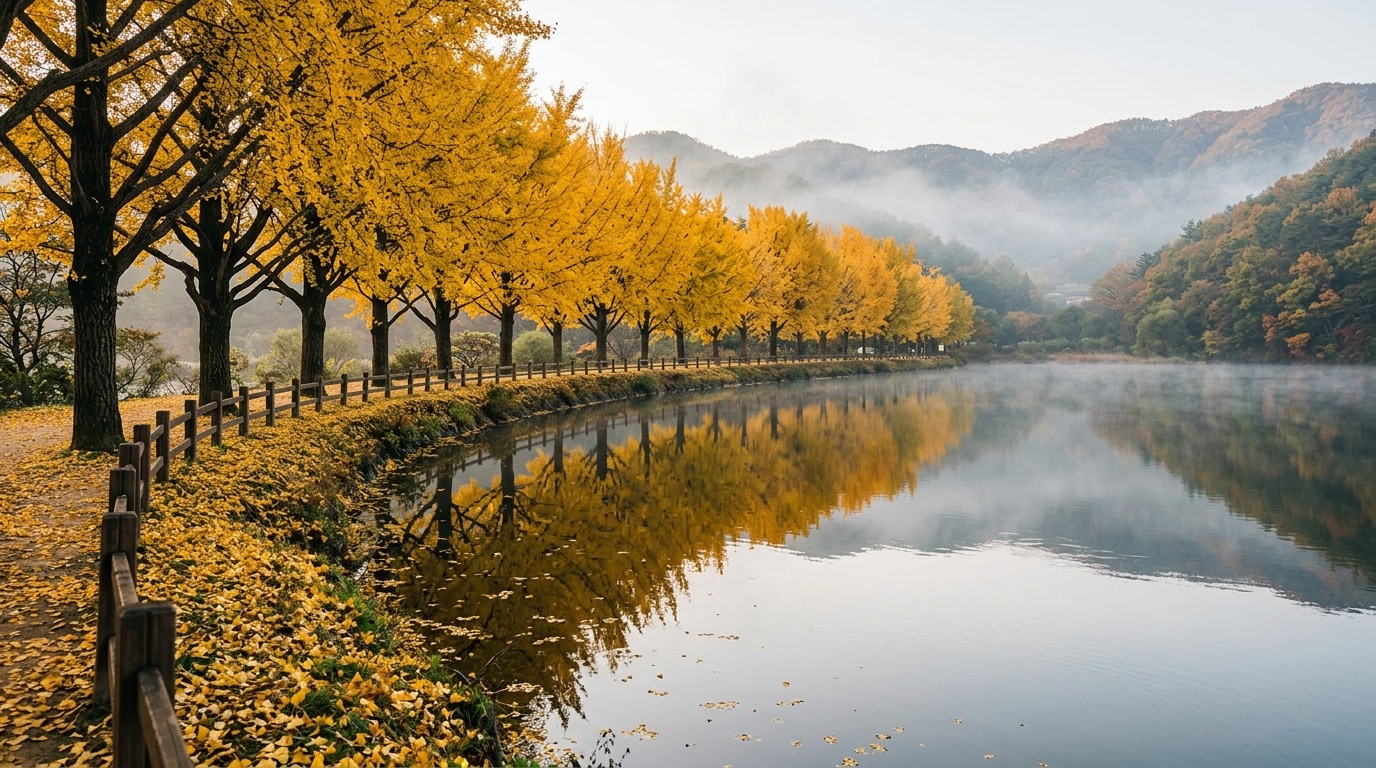
At Hwadam Botanic Garden in Gwangju, Gyeonggi Province, a monorail carries visitors through a forest of autumn leaves. At Mungwang Reservoir in Goesan, North Chungcheong Province, yellow ginkgo trees are reflected in the water. Both are recommended spots on the 2026 Foliage Map published by the Korea Tourism Organization and the Korea National Arboretum, which is run by the Korea Forest Service. Riding through a forest and watching trees from the water’s edge are two different ways to see the same season, and the right destination depends on which one a traveler wants.
Choosing a place does not settle when to go, though. Travelers who don’t know Korea’s geography may wonder how the timing in the Seoul area lines up with the south. The type of tree matters too. Red maples and yellow ginkgoes in the same region can have different predicted peak dates on the map.
This year’s map handles that by giving dates for each observation site and each type of tree. At the Korea National Arboretum, the reference site for the Seoul capital area, maples are forecast to peak on October 29. At Halla Arboretum, the reference site for Jeju, maples are forecast to peak on November 19. The other regions and tree types fall between those two dates. Travelers can set their dates first and then choose a region and the trees they want to see.
Observation sites and recommended spots do different jobs
The Korea Tourism Organization and the Korea National Arboretum released the foliage map on October 8 on VisitKorea, the tourism organization’s Korean-language travel portal. It divides the country into six regions and recommends six places in each, 36 in total. Peak timing is given separately for designated observation sites and is split into three groups of trees: maples, oaks and ginkgoes. The same map tells you where to go and predicts how the season will move.
The Korea National Arboretum, for example, is the observation site that sets the peak dates for the capital area. The recommended spots in that region include Hwadam Botanic Garden, Incheon Grand Park and Seoul Grand Park. A date calculated at an observation site is a guide to when the region will be at its best. It is not a confirmed peak date for each recommended spot. Knowing which role a place plays on the map makes it easier to match dates with destinations.
On the map, “peak” means the point when more than 50% of the leaves on the main tree species have turned. It does not name a single day when every tree is in full color. It is a consistent yardstick for comparing how the season progresses from place to place. When planning, look first at the forecast dates for the observation sites that overlap with your stay, then pick the scenery you want from the recommended spots in that region.
Late October in the capital area and Gangwon, when ginkgoes and maples split
At the Korea National Arboretum, the capital-area reference site, maples are forecast to peak on October 29, ginkgoes on October 31 and oaks on November 2. In Gangwon Province, the reference site is the Gangwon State Arboretum, where ginkgoes are forecast to peak on October 27, maples on October 28 and oaks on October 31. Both sites give different dates for different trees, so even a simple plan for “late October leaves” depends on which trees you want to see.
In the capital area, travelers can choose between the monorail and maple forest at Hwadam Botanic Garden, the tunnel of multicolored trees at Incheon Grand Park, and the trail around Cheonggye Lake at Seoul Grand Park in Gwacheon. The choice is whether to ride through the forest, walk under the trees or circle a lake. Visitors staying in Seoul can check the regional forecast first, then narrow it down by where they are staying and how they like to sightsee.
The Gangwon recommendations include the Goseokjeong National Tourist Site in Cheorwon, the Wondae-ri birch forest in Inje and Mindungsan Mountain in Jeongseon. Goseokjeong is known for the Hantan River canyon framed by autumn leaves, and the birch forest for white trunks against fall color. At Mindungsan, the draw is fields of silver grass. A canyon, a forest and a grassland make three quite different trips within one province.
Chungcheong has two observation sites to check
The Chungcheong region has two observation sites, Midongsan Arboretum and Geumgang Arboretum. At Midongsan, maples are forecast to peak on October 27, ginkgoes on October 29 and oaks on October 31. At Geumgang, maples are forecast for November 2, oaks for November 3 and ginkgoes for November 4. Within a single region, the timing runs from late October into early November depending on the site and the tree.
Among the recommended spots, Mungwang Reservoir in Goesan is known for yellow ginkgoes reflected in the water, and Sapgyoho Lake in Dangjin for sunsets behind the ships moored there. Gapcheon Ecological Lake Park in Daejeon offers fall color along a lake in the middle of the city. All three are by the water, but you can choose among them by what you most want to see: tree color, an evening sky or an easy lakeside walk.
Chungcheong also shows why heading south is not enough to set your travel dates. Checking the dates for each site and tree type alongside your direction of travel makes the plan more specific. You might decide whether to add a waterside stop on the way to another region or to stay put and see the ginkgoes. Picking a purpose for each stop is more useful than picking region names.
In November, Jeolla and Gyeongsang run on different schedules by tree type
In the Jeolla region, Daea Arboretum forecasts maples to peak on November 1, ginkgoes on November 2 and oaks on November 4. At Wando Arboretum, the same three peaks fall on November 9, November 12 and November 16. Comparing the two sites, rather than treating Jeolla as a single date, lets you split a trip between early and mid-November. That helps when you are comparing dates for a longer stay.
In the Gyeongsang region, Daegu Arboretum forecasts ginkgoes to peak on November 4, maples on November 6 and oaks on November 14. At Gyeongsangnam-do Arboretum, ginkgoes are forecast for November 5, maples for November 8 and oaks for November 16. At both sites, ginkgoes turn before maples and oaks come last. Even in the south, a trip built around yellow ginkgoes will fall on different days from one built around other trees.
Among the recommended spots, Meta Provence in Damyang pairs an orange avenue of metasequoia trees with its village streets, and Geochang Changpowon, a waterside eco-garden, combines reeds and fall leaves. Taehwagang National Garden in Ulsan is also on the Gyeongsang list. If the earlier part of your trip took you through forests or canyons, the south offers tree-lined avenues and riverside gardens, so the scenery changes as you move.
Jeju’s November 19 is the maple date at Halla Arboretum
At Halla Arboretum, the Jeju reference site, maples are forecast to peak on November 19, and oaks and ginkgoes on November 16. So “November 19 in Jeju” should be read as the maple date at Halla Arboretum. Halla Arboretum is also on Jeju’s list of recommended spots. Unlike the Korea National Arboretum, which appears only as an observation site, it serves as both an observation site and a place to visit.
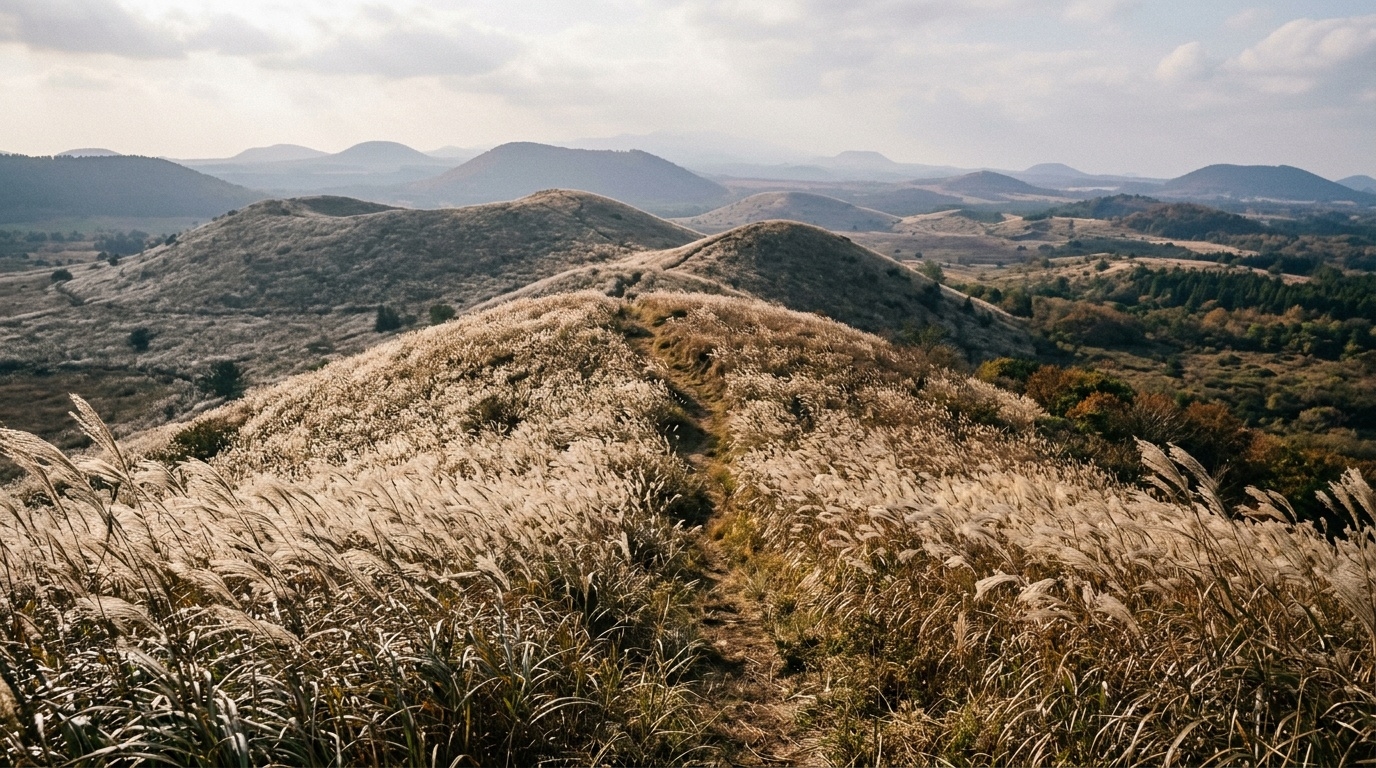
Jeju’s recommended scenery goes beyond leaves. Saebyeol Oreum is listed for its golden silver grass, Ttarabi Oreum for its silvery silver grass, and Songaksan for a coastal trail lined with silver grass. An oreum is one of the small volcanic hills found across the island. The maple peak date and the silver grass recommendations are separate pieces of information, so in Jeju it helps to decide first whether you want woodland or open grassland.
The forecasts draw on the Plant Phenology Observation Project, a citizen science program run by the Korea National Arboretum. The official guide says the map is based on records from last year’s “2025 Danpung Yeonga” project, in which members of the public observed and logged autumn foliage across the country. Seoul Shinmun reported that 829 citizen scientists took part. Behind each simple date on the map are records of seasonal change kept by ordinary people.
Turning observation records into your own itinerary
Citizen science is when members of the public take part in scientific work such as observation and data collection. On the foliage map, their records form the basis of the forecasts, and the tourism information points to places worth visiting at that time. Recording nature and choosing where to travel end up in the same guide, and knowing where the dates come from makes the map more useful than a plain list of attractions.
To build an itinerary, start with how long you will be in Korea, then compare the forecast dates by tree type at the observation sites that overlap with your stay. Then choose the scenery you want from the recommended spots. On a short trip, you could split your time between a forest and a waterside within one region. On a longer one, you could save a different region for later in the trip. There is no need to chase every peak across the country.
Think back to the view from the monorail at Hwadam and the still water at Mungwang Reservoir. The foliage map works better as a set of starting points than as one correct route. You still get to decide between forest and water, and which trees you want to watch change. Match the season’s timetable, recorded by citizen observers, with your own dates, and the dates on the map become autumn scenery you can go and see.
Sources: Korea Tourism Organization, VisitKorea “2026 Foliage Map,” published October 8, 2026; Seoul Shinmun, October 8, 2026.