
Table of Contents
Festival Nights Lit Up by Smartphone Screens
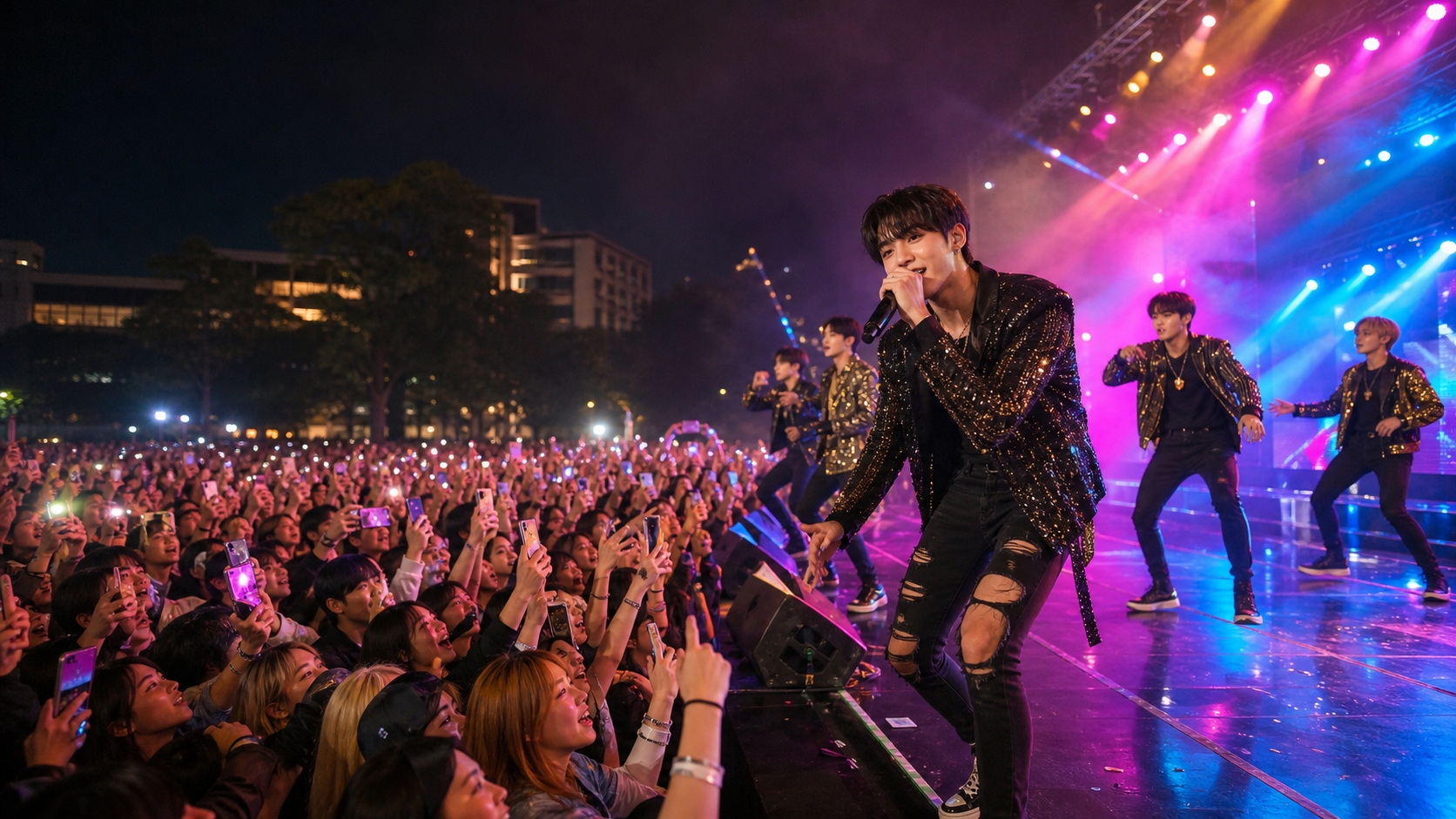
On a September university festival night, when an idol group takes the stage, the audience’s gaze and their smartphone screens move in unison. Spectators don’t just listen to the music; they absorb the texture of the live vocals, the banter between tracks, the massive singalongs, and the fan service directed at the crowd, each in their own way. In this scene, the stage is both a performance prepared by the idols and a live event completed by the audience’s reactions. The impression of the exact same song can change entirely depending on where the cheers erupt and how the idols respond. This unpredictable interaction is exactly what sets university festivals apart from standard music broadcasts.
Watching a performance at a university festival means more than just appreciating polished vocals and choreography. The roars that erupt as a track begins, the spontaneous singalongs sustained by the crowd, and the immediate vocal feedback to the idols’ banter all flow naturally into the rhythm of the stage. Idols have to execute their planned setlist while constantly reading the energy of the crowd gathered that night. If the audience’s response swells or happens at an unexpected moment, the pacing of the live vocals and banter might shift. This dynamic turns the university festival into a stage where rehearsed performances and impromptu reactions unfold simultaneously.
While music broadcasts focus heavily on the polished outcome of a song and its choreography, university festivals reveal the raw, on-the-ground flow leading up to that result. The focus isn’t just on how the idols handle the live singing, but also on how they bridge the mood between songs with their words. Brief moments,waiting for the crowd to sing along or reacting to louder-than-expected cheers,become memorable parts of the show. Fan service, too, goes beyond pre-planned gestures; it is felt as a genuine effort to close the distance across a massive outdoor venue. The interactive communication process, which is relatively muted on music shows, becomes the defining element of the festival stage.
Expanding the Stage Beyond Music Shows and Solo Concerts
According to a May 11, 2026 report by The Korea Herald, K-pop idols are broadening their scope beyond music broadcasts and solo concerts to headline university festivals. These festivals are meaningful as direct touchpoints where idols can engage with audiences in their twenties. The crowd here isn’t a monolith of dedicated fans with the same level of interest. A single audience might consist of hardcore fans who actively follow the group, casual listeners who only know the hit songs, and enrolled students just there to enjoy the campus vibe. As a result, the festival serves as a space to both acknowledge an existing fandom and present a show to a much broader public.
This varying level of audience interest actively shapes how the performance operates. At a solo concert, there’s a strong assumption that the audience fully understands the songs and the context of the group’s activities. At a university festival, idols need to deliver the charm of their stage in a short amount of time, even to those who don’t share that background knowledge. They face the dual task of satisfying the expectations of loyal fans while capturing the attention of newcomers or casual viewers. This makes not only the live singing and dancing crucial, but also the setlist flow, the delivery of their banter, and their real-time responses to the crowd’s energy.
Banter, in particular, becomes much more than just filler between tracks. It is the vital process through which idols read the crowd’s vibe, speak directly to the audience, and transition seamlessly into the next stage. Fan service is also perceived less as exclusive interactions meant for a few front-row fans, and more as inclusive communication that makes the entire venue feel involved. When the crowd reacts instantly to these gestures, a fresh current is generated between the expressions on stage and the voices in the audience. University festivals effectively expand an idol’s operational range by simultaneously showcasing prepared performances and authentic, on-site exchanges.
The Live Energy Forged by Vocals and Singalongs
At a university festival, live vocals are rarely isolated and judged as a standalone element. Audiences also notice whether the singers can maintain the flow of the song over massive crowd singalongs, or how they transition to the next verse when cheers run long. When the voices of the idols and the audience overlap, the performance stops being a one-way delivery of a song and transforms into a space of mutual reaction. Here, the true meaning of a live performance encompasses both the technical ability to reproduce a track and the adaptability to lead a show through real-time environmental shifts. When people say university festivals put live skills to the test, they are referring to this complex, adaptive process.
Massive singalongs prove that the audience is actively participating rather than passively consuming the show. Spectators enter the rhythm of the stage by belting out familiar phrases or adding their voices to repetitive hooks. When idols hear these voices and hand the mic over to the crowd, or playfully reflect the energy back, familiar songs take on an entirely new dynamic. A track once heard purely through a music broadcast morphs into a collective experience fused with the crowd’s voices. Rather than judging the value of a performance just by the sheer volume of the singalong, it is far more insightful to observe how the breathing between the stage and the seats synchronizes.
Framing university festivals merely as a binary testing ground for vocal success or failure misses a large part of what makes the live atmosphere so special. The deeper question is how the idols deliver a rehearsed show while navigating the shifting currents of crowd reactions. Banter draws out the crowd’s cheers, and those cheers, in turn, set the mood for the following song. Moments when a singalong or roar lasts longer than anticipated act as variables in the show’s progression, offering idols a chance to showcase their stage presence and adaptability. The hallmark of a university festival stage is that this lively back-and-forth takes precedence over a rigidly controlled outcome.
Fancams Bridge the Live Show to the Online World
A performance that ends on the ground often lives on in the digital space through fan-shot videos, commonly known as fancams. The Korea Herald noted that videos recorded by festival-goers are vital in generating online buzz. Unlike official, polished performance cuts, fancams selectively capture what the recording audience member deemed most important. A standout vocal run, an unexpected witty remark, a massive singalong, or targeted fan service can each become the focal point of an independent video. Various fleeting moments from the live event are essentially reassembled online through the diverse perspectives of the audience.
The raw intimacy of a fancam comes precisely from the fact that it doesn’t capture the whole show from a static, uniform distance. One spectator might zoom in entirely on an idol’s vocal delivery and facial expressions, while another might capture the dynamic exchange between the stage and the crowd in a single wide frame. Yet another video might highlight moments outside the official choreography, like casual chatter between songs or fleeting bursts of fan service. As these distinct viewpoints accumulate, even those who weren’t physically present can experience a single performance from countless angles. While the physical university festival ends at the venue, the process of interpreting and enjoying that stage extends much further online.
This online virality extends the impact of an idol connecting with a twenty-something audience far beyond the campus grounds. Viewers of these videos get to experience not only the completed vocals and dance moves, but also the roar of the crowd, the raw texture of the live audio, and the idols’ real-time improvisations. However, a fancam is a specific record of moments and angles chosen by the person filming, not the entirety of the show. Assuming that a brief clip encapsulates the entire atmosphere of the live event can oversimplify the actual flow of the performance. Fancams are best understood as both windows into the festival’s live energy and collaborative spaces where multiple, fragmented audience perspectives converge.
The Viewing Rights Debate Between Enrolled Students and Outside Fans
As idol performances and their subsequent fancams draw wider attention to university festivals, tensions naturally rise over who actually gets to watch the shows in person. For outside fans, a university festival represents a rare opportunity to see a different, more relaxed side of their favorite artists compared to traditional music shows or solo concerts. There is a strong desire to be in the same space to experience the live vocals, the playful banter, the massive singalongs, and the localized fan service. On the other hand, for enrolled students, the festival is fundamentally an event organized for their own university community. The concern that surging outside interest might physically prevent students from watching the shows is the starting point of the viewing rights debate.
According to a May 23, 2026 report by Dailian, universities can manage this by physically dividing student and outsider zones or by implementing student ID checks. These measures are practical responses designed to balance the students’ right to enjoy their festival with the safety requirements of managing a massive, crowded venue. Even if a university festival looks like a public concert generating widespread online buzz, these operational choices reflect the reality that the primary stakeholders of the event are the students. By separating the zones, organizers can secure space for enrolled students first while defining the accessible areas for outside visitors. Checking IDs serves as a mechanism to ensure that the dedicated student spaces are actually maintained during the event.
Yet, from the perspective of an outside fan, these exact measures can feel like distinct barriers to entry. As festival fancams are widely shared online and the unique appeal of these live stages is highlighted, the urge to see them in person naturally intensifies. When zones are restricted or ID checks are enforced, the vantage points and viewing options available to outside fans are heavily limited. Operations aimed at prioritizing student viewing rights and crowd safety can be experienced as exclusionary by external fans. The reason this dynamic is hard to resolve based on the demands of just one side is that the original intent of the festival and the massive public reach of the performances operate on vastly different scales.
Looking at Live Energy and Accessibility Together
Reducing the perspectives of enrolled students and outside fans to a simple binary of openness versus control fails to capture the complex reality of university festivals. Student viewing rights and campus safety are non-negotiable conditions that universities must prioritize, while the enthusiasm of outside fans is the very engine that brings these festival stages into the broader public eye. The separation of student and outsider zones can be seen as an operational compromise designed to address both needs simultaneously. What is equally crucial, however, is clear communication regarding who is allowed where and exactly how ID checks will be enforced. Tensions on the ground can be significantly minimized as long as expectations regarding access align closely with the actual on-site operations.
At its core, a university festival is not a mere replacement for a music broadcast; it is a space that reveals entirely different facets of K-pop performances. Live vocals, banter, singalongs, and fan service take on fresh meaning amidst the immediate, unfiltered reactions of the crowd, while fancams deliver those exact moments to online audiences. At the same time, as the online hype grows, the boundary between the enrolled students,the core hosts of the festival,and the outside fans looking to experience the live energy becomes starker. Understanding the September university festival season requires looking beyond just the vibrant live energy of the idols to also consider who gets to watch these stages and under what conditions. The ongoing challenge for university festivals is striking a delicate balance between preserving the raw vitality of the performance, protecting student viewing rights and safety, and managing the expectations of outside fans.
Sources: The Korea Herald, May 11, 2026; Dailian, May 23, 2026.