

A Middle East conflict disrupting oil supplies doesn’t sound like it should have anything to do with whether Korean grandmothers ride the subway for free. But in March, it did. President Lee Jae Myung suggested temporarily restricting free subway rides for seniors during peak commuting hours, framing it as a side effect of rotation-based limits on private car use brought on by the energy shock — and reignited a debate that’s been simmering for years.
It’s worth being precise about what was actually proposed. Lee specified the target was “those going out for leisure, not seniors commuting to work,” and the presidential office later said the comment wouldn’t lead to immediate policy change, according to The Korea Herald (April 5, 2026). But the comment was enough to pull a 44-year-old welfare program — introduced when Korean life expectancy averaged 65 — back into the spotlight, at a moment when Korea is, by contrast, a super-aged society.
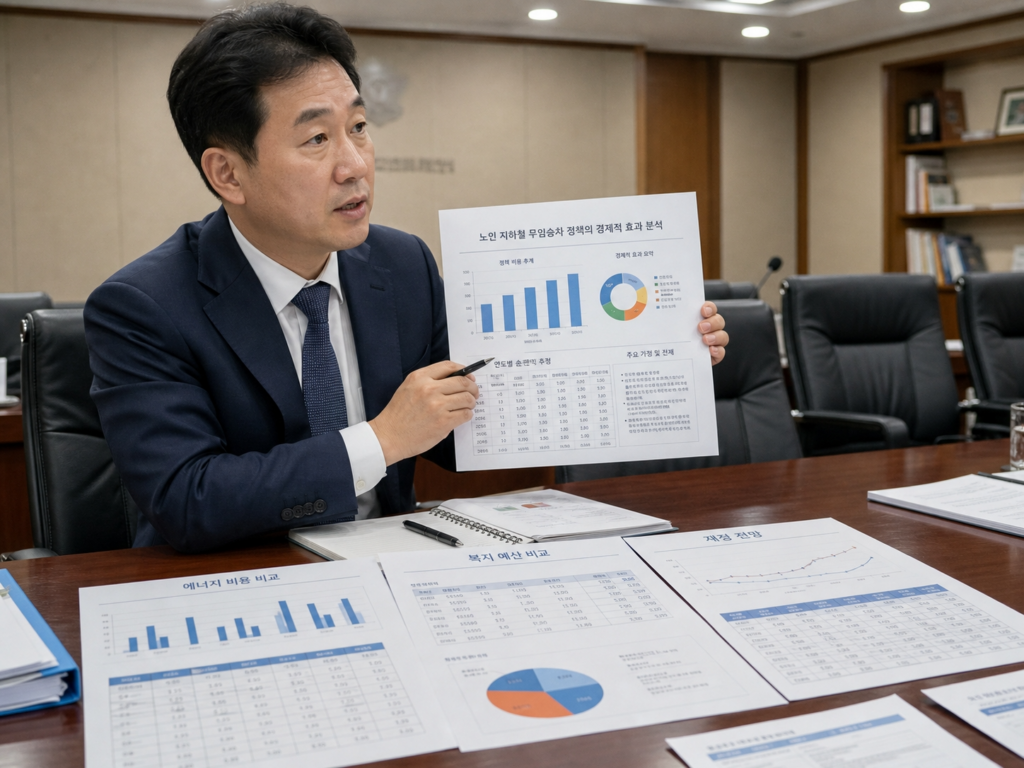
The case for restricting it rests mostly on subway finances, not congestion. According to a fiscal policy institute report cited by The Korea Herald, six major urban rail operators nationwide are projected to incur a combined 5.36 trillion won ($3.55 billion) in losses from free senior rides between 2017 and 2025. Seoul Metro alone lost 448.8 billion won last year, the vast majority attributable to the program. From that angle, restricting peak-hour access — or floated alternatives like raising the eligibility age, limiting free rides to off-peak hours, or income-testing the benefit — reads as basic fiscal triage for transit systems already bleeding money.
The case against doesn’t dispute the losses — it disputes whether restricting seniors would actually fix the problem the policy is nominally about: peak-hour crowding. Seoul Metro data shows seniors using free rides made up just 8.3 percent of all passengers during morning and evening peak hours last year. Kim Sang-cheol, head of a public transit advocacy network, did the arithmetic for The Korea Herald: a typical rush-hour subway car carries around 240 people, often exceeding 150 percent of rated capacity, so 8.3 percent works out to roughly 19 seniors per car. “Removing them would not meaningfully ease congestion,” he said — and added it’s unclear whether anyone would actually leave a car at home just because the train got marginally less packed.
Advocacy groups push back harder on who’s actually riding. The Korean Senior Citizens Association says it has already advised members to voluntarily avoid rush hour, but warned that a government-mandated restriction risks stigmatizing older people rather than just managing capacity. Labor and civic groups, at a rally covered by The Korea Herald, called the proposed limits “a clear violation of mobility rights for a transit-dependent population” — pointing out that many seniors riding during peak hours aren’t leisure travelers at all, but workers in low-wage senior employment programs, or grandparents commuting to provide child care.
Neither side is arguing in bad faith, which is what makes this a genuinely unresolved question rather than an easy call. The financial pressure on transit operators is real and getting worse. So is the demographic reality that a policy designed for a 65-year life expectancy is operating in a country where that’s now closer to a starting point than an endpoint. Local governments, for their part, argue the central government should absorb more of the cost if transit is treated as a public good — which sidesteps the congestion question entirely and reframes this as a fight over which level of government pays, not whether seniors should ride free.
What seems clear is that “restrict peak-hour senior rides” and “fix subway operating losses” are two different problems wearing the same headline. The congestion math doesn’t support the first justification very well. The financial case for the second is solid — but solving it by means-testing or age-shifting a mobility entitlement is a much bigger, slower-moving policy fight than an energy-crisis news cycle is built to resolve.
Sources: The Korea Herald, “What does Mideast conflict have to do with Korean seniors?” (Choi Jeong-yoon, April 5, 2026), citing Seoul Metro ridership data and a March 2026 fiscal policy institute report on urban rail operator losses.