
Table of Contents
From 3 Million Movie Viewers to a 3% TV Debut
At 9:10 p.m. on July 18, 2026, tvN’s new Saturday-Sunday drama Osaghan Yeonae (Spooky in Love) went live, and the numbers told an uncomfortable story. The premiere pulled a nationwide average of 3.0%, with 3.2% in the greater Seoul metropolitan area. Its peak moment reached 4.2% nationwide and 4.6% in Seoul. Those figures were enough to make Osaghan Yeonae the top-rated show among cable and general programming channels airing in the same slot that night. But top-rated is not the phrase anyone attached to this project was hoping to lead with.
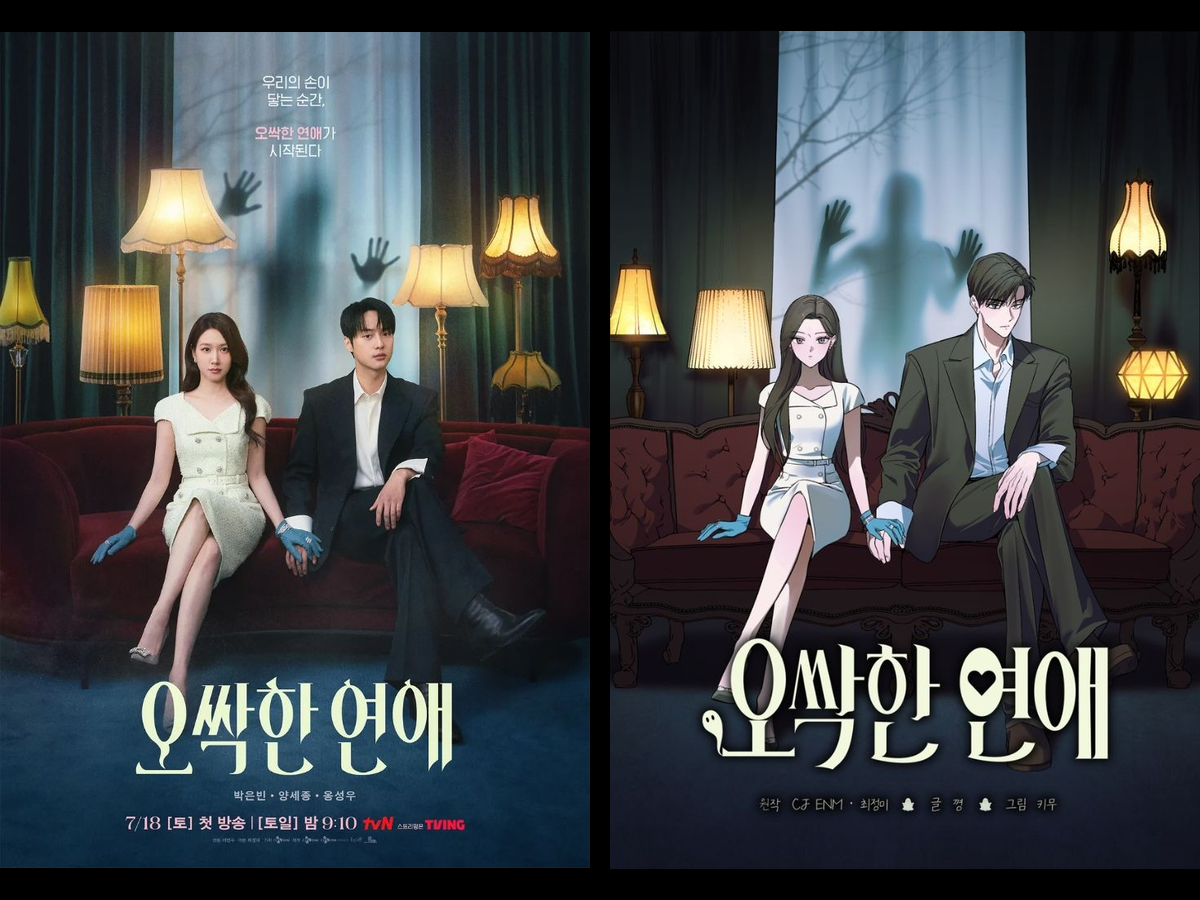
Fifteen years ago, the film sharing this title and premise was a certified hit. The 2011 movie, starring Son Ye-jin and Lee Min-ki and directed by Hwang In-ho, drew more than 3 million ticket sales, a benchmark still cited whenever the industry discusses successful romance-horror hybrids. So when tvN announced a television remake led by Park Eun-bin, Yang Se-jong, and Ong Seong-wu, the comparison was obvious. Could a beloved decade-old IP translate its theatrical pull into weekly ratings?
The answer, at least after one episode, is complicated. A 3% premiere is not a disaster by any measure, but it sits well below what a cast of this caliber usually delivers, and it lands far under the ambitions the production team stated publicly before launch. That gap between a cinema hit’s legacy and a drama’s opening-night reality is the story worth unpacking here.
The Chemistry of Three: Park Eun-bin, Yang Se-jong, and the Casting Gamble
Park Eun-bin plays Cheon Yeo-ri, an heiress to a hotel conglomerate who, in a twist introduced in the first episode, can see ghosts. Yang Se-jong plays Ma Kang-wook, a hot-blooded prosecutor whose storyline is expected to intersect with Cheon Yeo-ri’s supernatural entanglements. Ong Seong-wu rounds out the main trio as Kang Min-hwan, the heir apparent to the same hotel group, setting up a love triangle layered on top of the ghost-hunting mystery. It is, on paper, a loaded ensemble.
Coverage from Herald Muse praised the chemistry between Park Eun-bin and Yang Se-jong, crediting their performances for the show’s first-place finish among same-timeslot cable and general channels — the kind of data point producers lean on when a slow-burn premiere still shows promise.
But casting alone does not explain everything. Reports ahead of the broadcast noted that the drama’s setting departs from the original film by “more than sixfold,” according to Park Eun-bin’s own comments distinguishing her take from Son Ye-jin’s. That is a notable admission. Rather than leaning on nostalgia, the production reportedly rebuilt much of the world, the hotel-heir backdrop chief among the changes. Whether that reinvention helps or hurts audience recall of the beloved original remains an open question after just one episode. The first episode ended on the two lead characters meeting for the first time in a hotel lobby, a scene clearly designed to plant the season’s central will-they-won’t-they tension.
Why a Complex Genre Can’t Win in the Streaming Age
Here is where the premiere number becomes less about any single actor’s drawing power and more about genre math. Osaghan Yeonae is simultaneously a romance, a ghost-mystery, and a legal-workplace drama built around a prosecutor character. Combining that many tonal registers into one hour is a tall order, and it may be exactly the kind of ambitious blend that struggles in 2026’s fragmented viewing landscape.
As one report on the ratings competition noted, industry watchers increasingly argue that ratings battles are no longer decided by star power alone. With OTT platforms multiplying viewer options by the week, audiences have near-limitless alternatives competing for the same Saturday night, and the shows that win tend to be the ones that establish a clear emotional hook inside the first episode.
A drama juggling three genres at once risks diluting that hook. Viewers scrolling their options may not immediately grasp what kind of show they are being asked to invest in — is it a corporate melodrama, a horror-tinged mystery, or a courtroom procedural? That ambiguity is a real cost in an environment where a single tap can send a viewer to a competing platform entirely.
Does that mean genre-blending dramas are doomed from the start? Not necessarily, but the 3% opening suggests Osaghan Yeonae will need its second and third episodes to sharpen exactly what kind of story it is telling, and quickly, before casual viewers move on for good.
tvN’s Saturday-Sunday Battleground
Zoom out to the broader tvN weekend slate, and the picture gets more sobering. Earlier in 2026, the network’s own Undercover Miss Hong posted a 13.1% rating in the same Saturday-Sunday window, a number Osaghan Yeonae is nowhere near matching out of the gate. Meanwhile, over on SBS, the competing weekend drama Kim Bu-jang has been running at 15.7%, underlining just how far behind Osaghan Yeonae started relative to its direct rivals across the broadcast landscape.
This context makes the production team’s pre-launch remarks sting in hindsight. At the press conference, the director played on the drama’s own title, noting the premiere fell on the 18th and joking that, fittingly for a show called Spooky in Love, “we’d like to start at 5% and end at 18%.” Instead, the show opened at 3.0%, undershooting even that modest target.
To be fair, a 3% opening in today’s tvN weekend environment is not automatically a death sentence — many dramas climb steadily once word of mouth kicks in. But the size of the gap to Undercover Miss Hong’s 13.1%, let alone Kim Bu-jang’s 15.7%, means Osaghan Yeonae has real ground to make up if it wants to be remembered as anything more than a modest also-ran in this particular ratings cycle.
Can Second-Episode Recovery Happen?
None of this erases what Osaghan Yeonae has going for it. Topping the cable and general-channel rankings on debut night is not nothing, and a cast this experienced rarely produces genuinely bad television. The question is whether the show can convert curiosity into appointment viewing over its remaining eleven episodes.
The broader trend worth watching is what this premiere says about adapting theatrical hits for the small screen. Osaghan Yeonae is one of a growing number of Korean productions mining beloved films for episodic IP, betting that name recognition alone can jump-start a new audience. A soft 3% opening for a story with a 3-million-admission pedigree suggests that bet is riskier than it looks, especially when the adaptation reshapes so much of the source material that longtime fans of the film may not immediately recognize what they are watching.
So what should readers watch for next? The clearest signal will come from episodes two and three — does Osaghan Yeonae hold steady near 3%, slip further, or start climbing toward the double digits its director once floated? Just as important is whether the show tightens its genre identity, leaning harder into either the ghost-mystery or the romance rather than splitting attention three ways. For a story this reliant on its own title’s pun, ending anywhere near that hoped-for 18% would be a fitting twist. Whether it gets there is now a matter of the next few Saturday nights.