Table of Contents
A First Profit Is an Achievement, Not a Complete Answer
Esports organizations have long struggled with profitability despite commanding global fandoms and marquee tournaments. Player salaries, coaching staff, content production, international travel, and venue operating costs have kept climbing, while broadcast rights and ticket sales alone have rarely been enough to cover them. That’s why T1’s return to profit in 2025 was more than a corporate earnings story — it was an event worth watching for Korea’s entire esports industry.
According to Sports Seoul, T1’s consolidated 2025 revenue came to roughly 90.567 billion won, up 77.7% from the previous year, with operating profit of about 2.0724 billion won. Operating revenue and operating profit figures based on audit reports can be presented differently depending on accounting classification, but the core fact stays the same: T1 posted its first-ever operating profit since its founding. It’s reasonable to read this as the combined result of international tournament performance, global sponsorships, and merchandise and content businesses all working together.
But a profit is a result, not a blanket endorsement of how the whole operation is run. The fact that a company made money doesn’t automatically explain where that revenue came from, how costs and fees were distributed, or whether the burden placed on players and staff was appropriate. The string of Sports Seoul reports and fan pushback in late July aimed squarely at that blank space. The debate at the center of this isn’t “did T1 turn a profit” — it’s “was the contract structure that produced that profit adequately explained.”
102 Days on the Calendar, and Fans Who Started Asking Questions
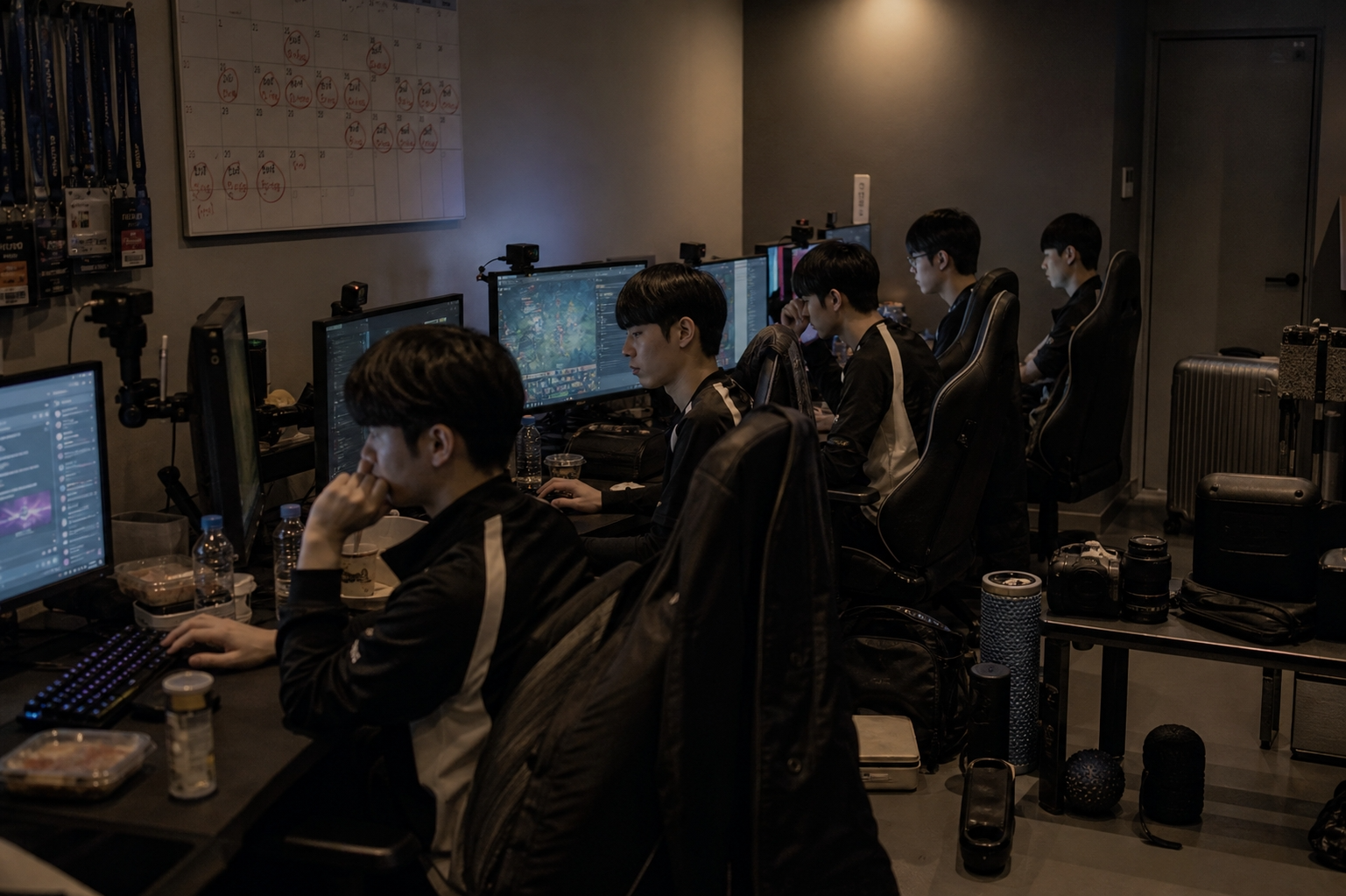
In a July 23 report, Sports Seoul said T1’s roster spent 102 days of the year on commercial commitments, combining the regular season, international tournaments, and sponsor schedules in 2025. According to the report, players juggled domestic and international commitments between training and matches, and fans raised concerns along the way about performance, rest, and player welfare. Funeral wreaths and truck protests became the visible, symbolic expression of that frustration.
There’s a distinction worth making here. A heavy sponsor schedule alone doesn’t establish that the operation is unfair. Players on global esports teams can be contractually obligated to do ad shoots, brand events, fan meetings, and content appearances. Commercial activity by star athletes is common in American professional sports, too. The real question is whether the frequency, travel time, rest days, conflicts with the match schedule, and the compensation flowing back to players were managed reasonably.
Fans in particular emphasize that T1’s competitiveness comes from its roster’s in-game performance. The logic is that as the brand grows, partnerships multiply, but if commercial activity eats into match preparation, the brand’s own value could erode over the long run. This isn’t a problem unique to T1. In a league where international tournaments are getting denser and content demand keeps growing, every organization has to redraw the line between player welfare and monetization.
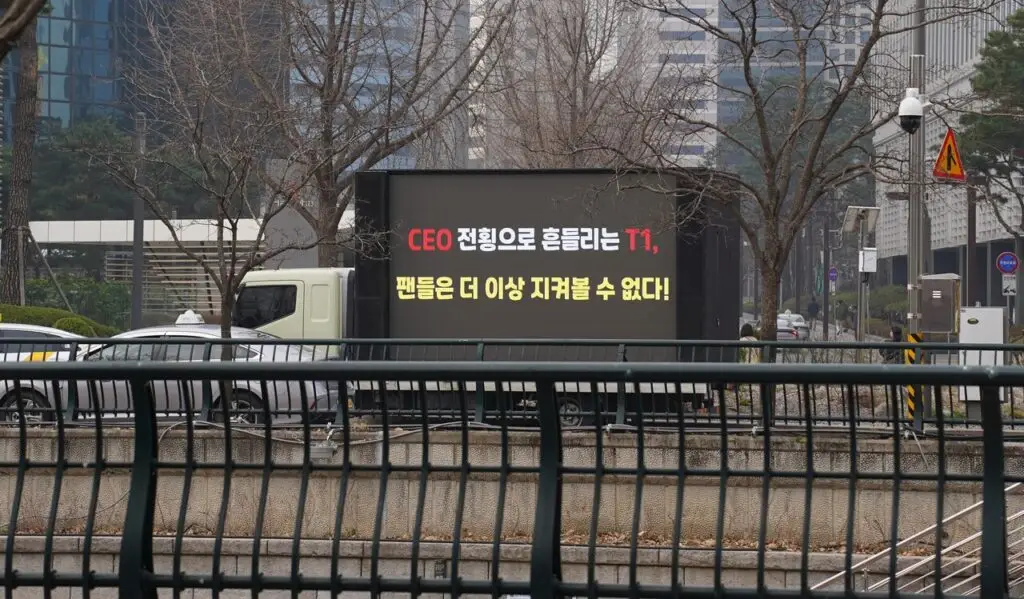
A U.S. Agency and Its Fees: What’s Confirmed, and What Isn’t
On July 26, Sports Seoul reported that part of T1’s sponsorship business is structured to run through an outside, U.S.-headquartered agency, referred to as Agency A. The report said Agency A was found to have ties to CEO Joe Marsh, and also raised claims that a number of employees who had handled sponsorship work inside T1 had left the company. The report questioned the transparency of how some contracts were processed through this agency structure, and how the resulting fees and performance credit were allocated.
This is also exactly where the most caution is warranted. Sports Seoul noted that industry-standard agency fees can typically run around 10-15% of a contract’s value, but explicitly stated that Agency A’s actual fee rate and the amount T1 paid were not confirmed. So the “typical fee” figure is offered only as a point of comparison — it is not a confirmed amount that T1 actually paid. Treating it as an actual loss figure, whether in reporting or fan discussion, goes beyond what’s been established.
Using an outside agency is also not, in itself, evidence of wrongdoing or breach of duty. Contracts with overseas brands, global rights sales, and multinational negotiations can genuinely require specialized agencies. The real question isn’t whether an agency was used, but how thoroughly the selection process, contract terms, conflict-of-interest management, and the handling of deals originated internally were reviewed and disclosed to the board, shareholders, and staff.
CEO Joe Marsh’s Response Addressed Some, Not All, of the Issues
CEO Joe Marsh contacted Sports Seoul through T1 on July 30 to request a correction to language that could be read as suggesting he had unilaterally decided the sponsorship agency contract. According to Sports Seoul’s July 31 report, Marsh said the CAA contract received written board approval from SK Square’s CEO on October 3, 2025, and that the relevant details were shared with every member of T1’s board. By his account, the contract went through a board approval process rather than being a CEO’s sole decision.
Marsh also asked that the name of T1’s U.S.-side shareholder be correctly rendered as “Comcast Spectacor,” not simply “Comcast.” Sports Seoul, however, reported that it did not receive a specific explanation to its questions about whether sponsorship deals sourced directly by T1 employees were also executed and credited through CAA Singapore, or how the exclusive agency arrangement actually operated in practice. SK Square responded to the effect that it was difficult to confirm matters related to the board.
So what’s been confirmed so far is limited. T1 posted its first operating profit. Questions were raised about the outside agency contract. CEO Joe Marsh pushed back, saying there was a board approval process. But no externally verifiable material has been disclosed on the actual fee rate, the scope of the agency’s role in individual contracts, or how work was divided between in-house sales staff and the outside agency. That’s why the allegations can’t be treated as established fact — and why calls for further explanation continue.

The Standard Esports Must Meet in the Age of Profitability
The T1 controversy is hard to read as simply a fandom dispute centered on one CEO or one agency. Sponsorships and global brand business are essential if esports organizations are going to escape a structural deficit. But fans don’t see these organizations purely as ordinary consumer-goods companies. Player performance and health, competitive fairness, and fan trust are all bound up with the value of the product itself. The more a decision is aimed at growing revenue, the greater the accountability it demands.
Compared with American sports franchises, Korea’s esports industry has a thinner layer of public disclosure. Unlike sports with listed-company filings, league-wide salary cap rules, players’ unions, and long-accumulated regional franchise structures, a large share of esports organizations’ contracts and internal operations remain undisclosed. That doesn’t mean non-disclosure is inherently a problem. But when the possibility of a conflict of interest is raised, independent approval processes and a baseline standard of disclosure matter more.
Three indicators are worth watching going forward. First, what principles T1 uses to manage the balance between players’ commercial schedules and rest and training time. Second, how much it’s willing to disclose about the approval and conflict-of-interest management around agency contracts. Third, whether the return to profitability turns into a sustainable business model that keeps the trust of players, staff, and fans, rather than a one-time result. T1’s first profit is an achievement worth celebrating. But the ledger of trust doesn’t close with an operating-profit statement alone.
Source: Sports Seoul, July 23, July 26, and July 31, 2026; disclosures and reporting related to T1’s 2025 audit report.