
Table of Contents
A 19-Year-Old Title Reappears on the Chart
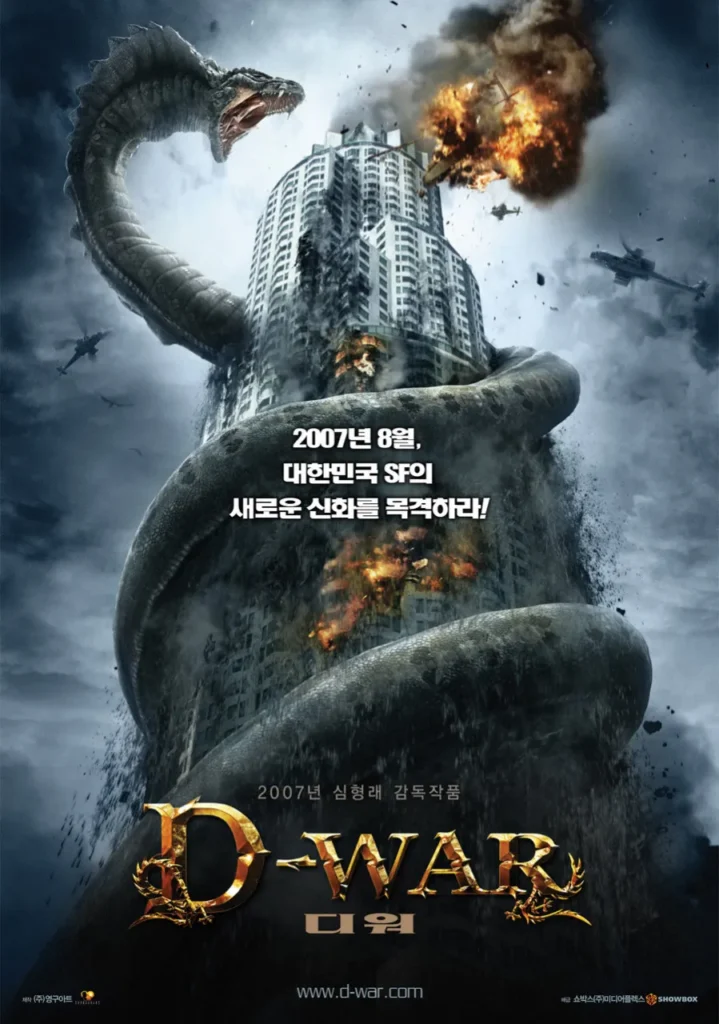
On August 10, 2026, an unfamiliar title landed at No. 6 on FlixPatrol’s global Netflix movie chart. It was “D-War,” a Korean film that opened in 2007. Not a new release, not a remake — a 19-year-old movie.
The ranking gets stranger once you know how “D-War” has been remembered in Korea. For years, it’s been cited as the textbook example of a Korean film where box office success and critical reception went in exactly opposite directions.
A Comedian’s Hollywood-Scale Monster Movie
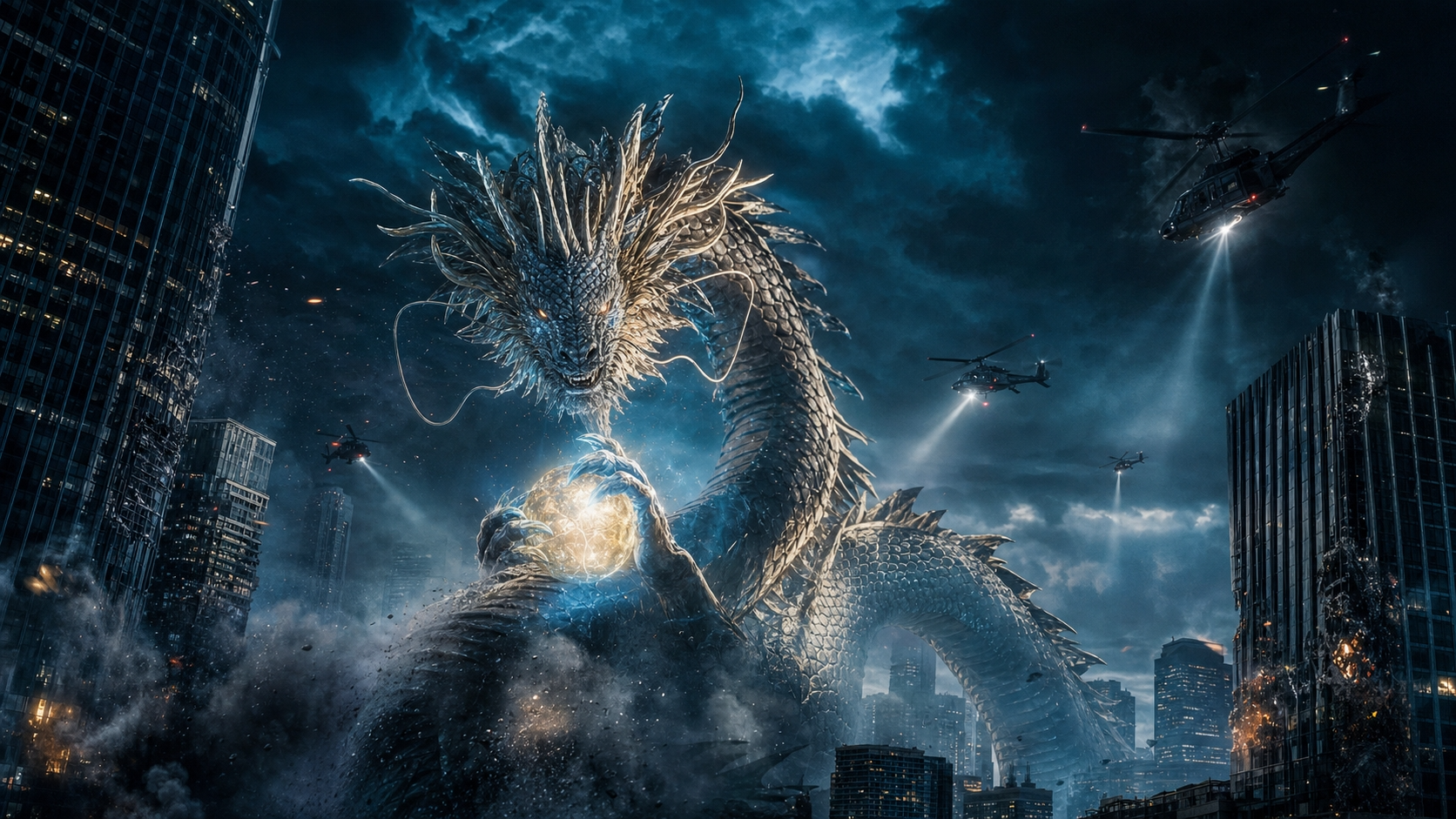
“D-War” is a monster movie about imugi — serpentine creatures from Korean folklore that wait centuries for the chance to become dragons — descending on downtown Los Angeles to fight over a yeouiju, a mythical orb an imugi needs to complete its ascension into a dragon. Both concepts are rooted in Korean folk tradition, distinct from the Western fantasy dragon.
The film was directed by Shim Hyung-rae, a comedian-turned-filmmaker. He debuted in 1982 and became a nationally beloved figure in the 1980s and ’90s for playing Yeonggu, a bumbling but lovable character — one of Korea’s first-generation comedy stars. He moved into directing in 1993 with “Yeonggu and Dinosaur Zzu Zzu,” and a career built around special effects and monster films eventually led to “D-War.”
That combination was unusual in itself at the time. A beloved national comedian directing a big-budget CGI film had no real precedent in Korean cinema. The production put large-scale CGI and monster battle sequences — a scale rarely attempted in Korean film at the time — front and center.
The Film Succeeded at the Box Office. The Reviews Said the Opposite.
The film opened strong. “D-War” drew 7.85 million admissions in Korea, one of the top results among 2007 releases — by box office alone, one of the defining films of that year.
But the critical reception was harsh. The thin script, direction, and stilted dialogue drew concentrated criticism. Even critics who acknowledged the technical achievement argued the story couldn’t carry it. It was rare, even by Korean film industry standards at the time, for audience turnout and critical opinion to diverge this sharply.
The Criticism Turned Into a Nationalism Debate
The debate spilled beyond the film itself. A marketing tagline — that Korean technical prowess was taking on Hollywood blockbusters head-on — became tangled up with the film’s reception, creating a climate where criticizing the movie could be read as dismissing the ambition behind it.
The debate around “D-War” shifted from a conversation about craft to one about nationalism. Supporters framed themselves as cheering on homegrown technology, critics framed themselves as offering clear-eyed criticism, and the film itself got pushed out of the center of its own discussion. For a long time afterward in Korea, the movie was remembered first for that argument, and only second for what was actually in it.
August 2026: The Comeback Starts in Europe
Nineteen years later, on August 6 and 7, 2026, “D-War” became available on Netflix in a number of countries. The response showed up within days. It reached No. 6 on FlixPatrol’s global Netflix movie chart as of August 10, and stayed in the global top 10 at No. 9 on August 12.
The country-by-country numbers were even more striking. In major European markets like France, Germany, and Italy, the film climbed as high as No. 2 on the national Netflix movie chart, and it appeared on the chart in 20 countries in total. A film that was the subject of a heated debate in Korea found its first strong response in markets that share none of that debate’s context.
The U.S. entertainment outlet ScreenRant pointed to the film’s giant-monster, dragon-driven spectacle as the reason for its popularity. That’s the outlet’s own interpretation, though — not an explanation Netflix itself has officially offered.
The Open Question Isn’t About the Film. It’s About Context.
It’s premature to read this comeback as a reassessment of “D-War”’s quality. FlixPatrol doesn’t have access to Netflix’s actual viewing-hours or viewer-count data. Its global ranking is built by scoring each country’s daily chart position — 10 points for first place, 9 for second, and so on — and summing those scores. That metric alone can’t tell you how many people watched to the end, or whether they were satisfied once they did.
Still, what this case shows is clear enough. In 2007, “D-War” was consumed inside the narrow gravity of a debate specific to Korea, where both the CGI’s achievements and the story’s flaws became material for an argument about nationalism. In 2026, overseas viewers are meeting the same film with none of that background, simply as a monster movie about imugi and a mythical orb. Strip the context away, and the same movie becomes a different product.
Cases like this are likely to keep appearing as platforms like Netflix redistribute older titles. What kind of second life films that were panned or turned into controversies in Korea might find in other markets is an open question, and “D-War”’s current ranking may end up as an early test case. Shim Hyung-rae’s most recent film as director was 2010’s “The Last Godfather”; he has not directed a new film since.
Source: JoongAng Ilbo, August 12, 2026; Korea JoongAng Daily, August 12, 2026; FlixPatrol.