
Table of Contents
A Single Number Quietly Crossed a Line
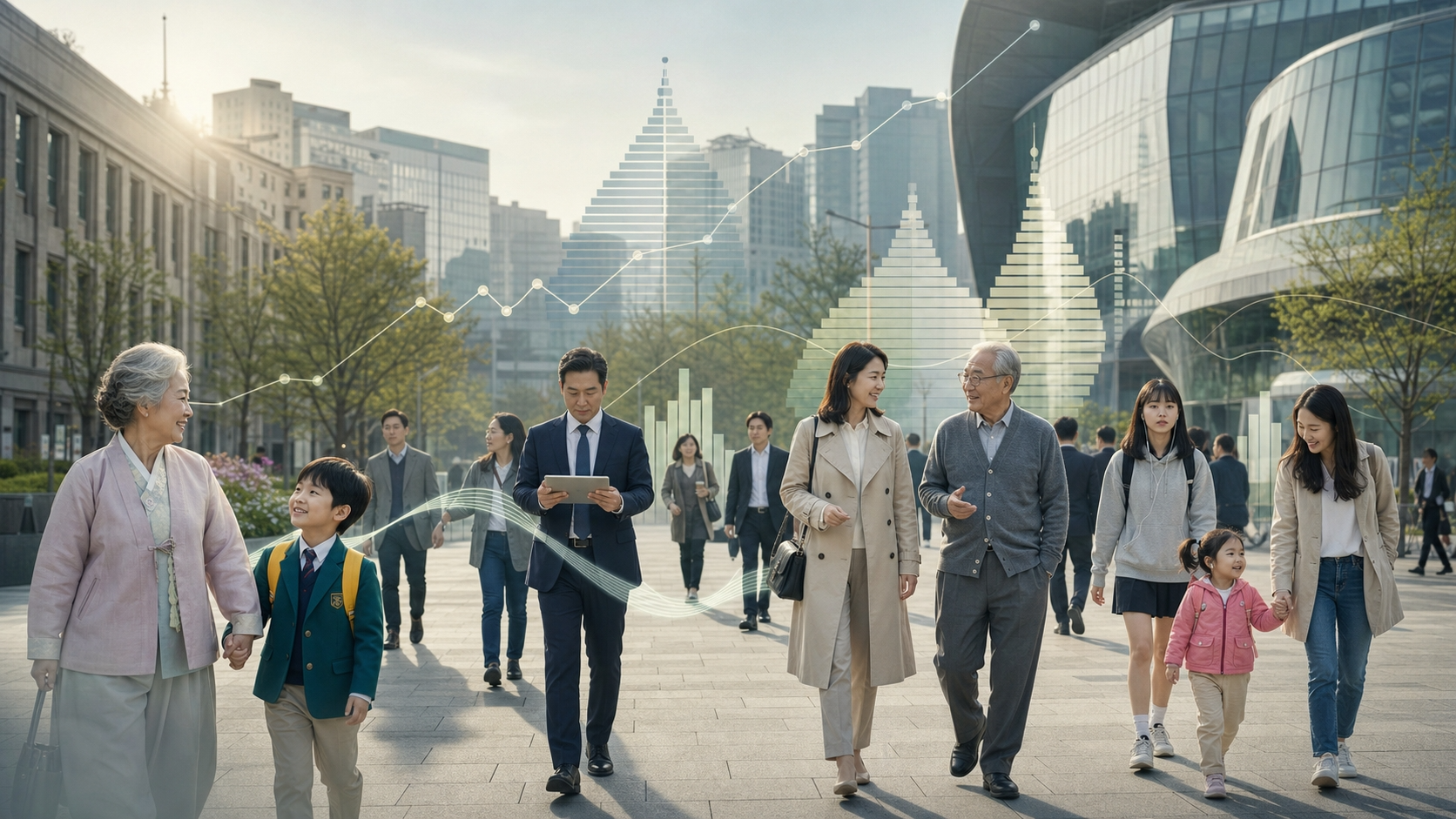
On July 28, 2026, Korea’s National Data Agency released the results of the 2025 Population and Housing Census, and one figure stood out. The working-age population — ages 15 to 64 — came in at 69.2% of the total population. What makes this notable is that it’s the first time this share has dropped below 70% since the relevant statistics began being compiled in 2015. The working-age population now numbers 35.87 million, out of a total population of 51.817 million — roughly 69.2%.
The census uses November 1 of last year as its reference point. That distinguishes it from an earlier report from earlier this year — based on Ministry of the Interior and Safety resident registration data — which announced that “1 in 5 Koreans is now elderly.” That figure came from registered residents; this one comes from a full census built around the concept of an actual resident population.
A Super-Aged Society, Now Officially Confirmed by the Data
The population aged 65 and older stood at 10.723 million, or 20.7% of the total — up 5.9% year-on-year. Under United Nations criteria, a country is classified as a “super-aged society” once the elderly share of its population exceeds 20%. With this census, Korea has crossed that threshold. Resident registration data had already shown Korea crossing 20% by the end of 2024, but the National Data Agency notes that the census, built on the concept of a resident population, offers the more accurate figure.
Over the same period, the population aged 0 to 14 fell to 5.22 million, or just 10.1% of the total. The aging index — the number of elderly people per 100 children — reached 205.2, up 18.5 points from the previous year. The elderly population is now more than double the child population. The census also confirmed that in 224 of the country’s 229 cities, counties, and districts — 97.8% — the elderly population has already overtaken the child population.
What Kept the Total Population From Shrinking Wasn’t Korean Nationals
A more revealing point lies in what’s actually driving total population growth. The Korean national population came to 49.708 million, down 54,000, or 0.1%, from the previous year — the fifth consecutive year of decline as the effects of low birthrates accumulate. The foreign resident population, by contrast, rose to 2.109 million, up 66,000, or 3.2%. As a result, the total population reached 51.817 million, up just 12,000, or 0.02%, from a year earlier — a razor-thin increase, but an increase nonetheless.
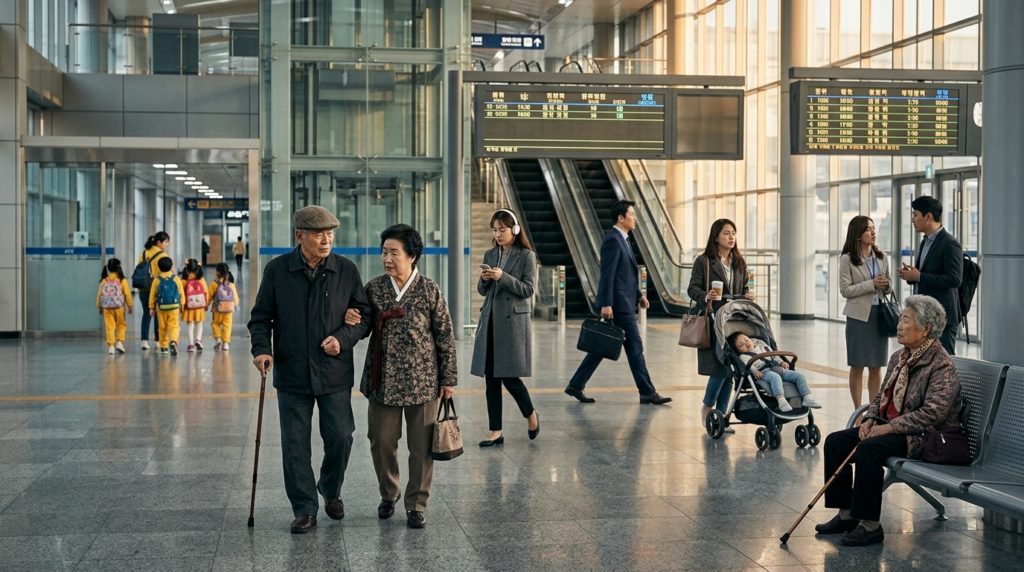
A National Data Agency official explained that “total population is on a declining trend due to the natural decrease of Korean nationals, but it grew by roughly 70,000 due to increases in foreign students, trainees, and seasonal workers, among other factors.” In other words, the population decline already underway among Korean nationals alone is being narrowly offset by an inflow of foreign residents. This is the same dynamic that explains why the total population actually fell in 2021 and 2022 before returning to growth in 2023.
What This Means for the Labor Market
The elderly dependency ratio — meaning how many elderly people every three working-age Koreans must support — rose to 29.9, up 2.0 points from the previous year. This is not merely a shift in demographic composition; it’s a figure that bears directly on the labor market and the structure of public finances. As the working-age population shrinks, the tax base narrows, even as demand for welfare spending aimed at the elderly continues to grow.
This trend connects directly to the debate over Korea’s potential growth rate. The working-age population already peaked in 2018 and has been declining steadily ever since. What was 73.4% in 2015 has fallen to 69.2% over the past decade. If this decline continues, the key question going forward will be how much of that gap an inflow of foreign residents can realistically fill.
Regional Fault Lines Are Widening Too
The population of the Seoul Capital Area reached 26.38 million, or 50.9% of the national total, up 0.3% from a year earlier — while the Yeongnam and Honam regions each declined by 0.4%. Even in Gyeonggi Province towns adjacent to the capital, such as Osan, Gwacheon, and Siheung, the elderly population newly overtook the child population for the first time. It reads as a signal that aging is no longer a phenomenon confined to rural areas.
Median age reached 46.8, up 5.7 years from a decade earlier. The gap in the aging index between cities, counties, and districts reached as much as 19-fold — Gunwi County in Daegu recorded 1,358.5, versus 69.8 in Sejong City. Regional aging speeds, in other words, are pulling apart at a striking pace. How policymakers respond to the twin trends of a working-age population falling below 70% and a growing reliance on foreign inflows is a question the next census is likely to help answer.
Source: Money Today, “‘Economic Vitality Cools’ Working-Age Population Falls Below 70%, Elderly Population Tops 20% for First Time,” July 28, 2026; Gyeonggi Ilbo, “Elderly Population Now Double That of Children… As Working-Age Population Falls Below 70%, Even Osan, Gwacheon, and Siheung See a ‘Reversal,'” July 28, 2026.