Table of Contents
Rooms Where You Meet the Next Person Every Few Minutes
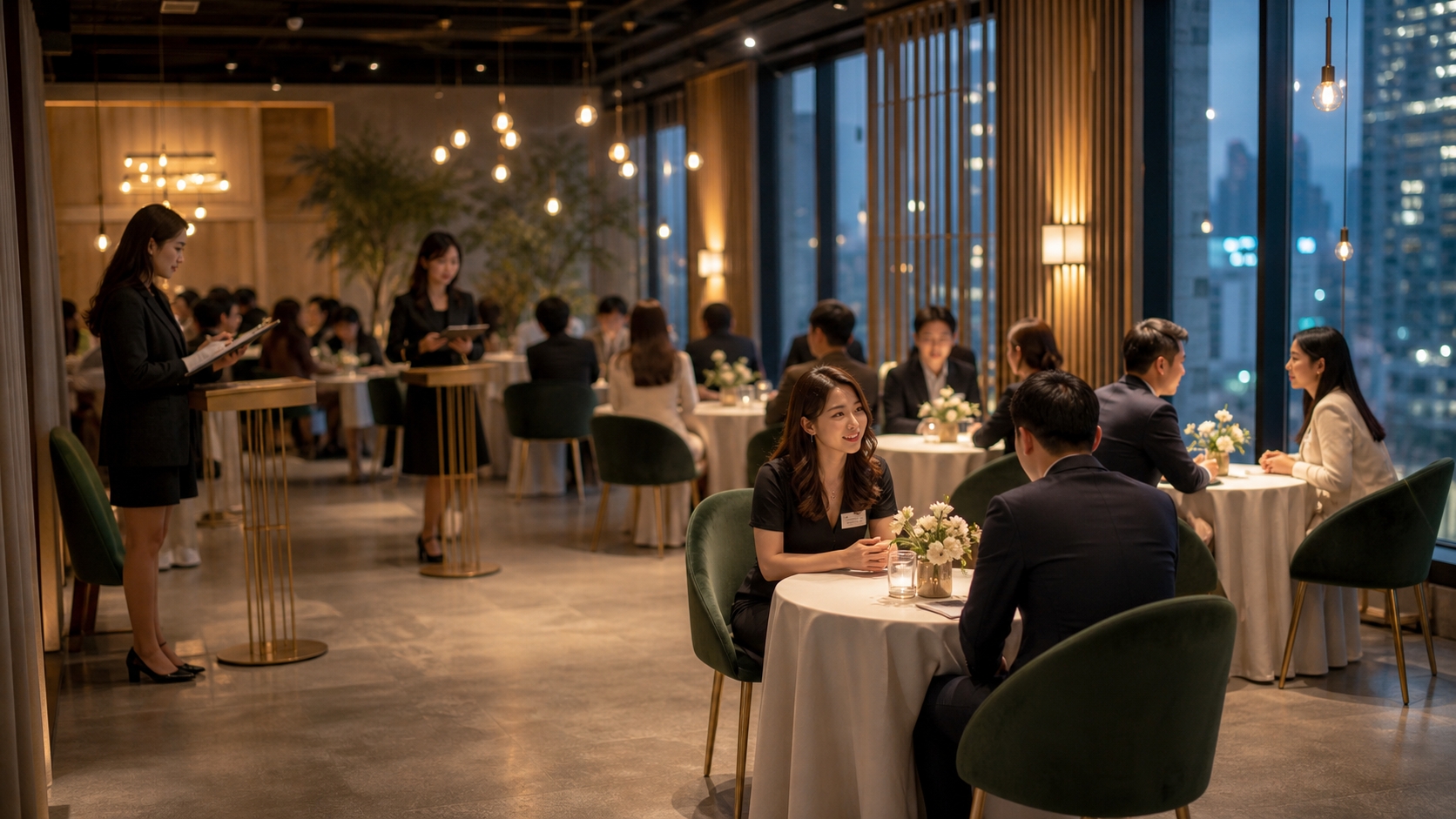
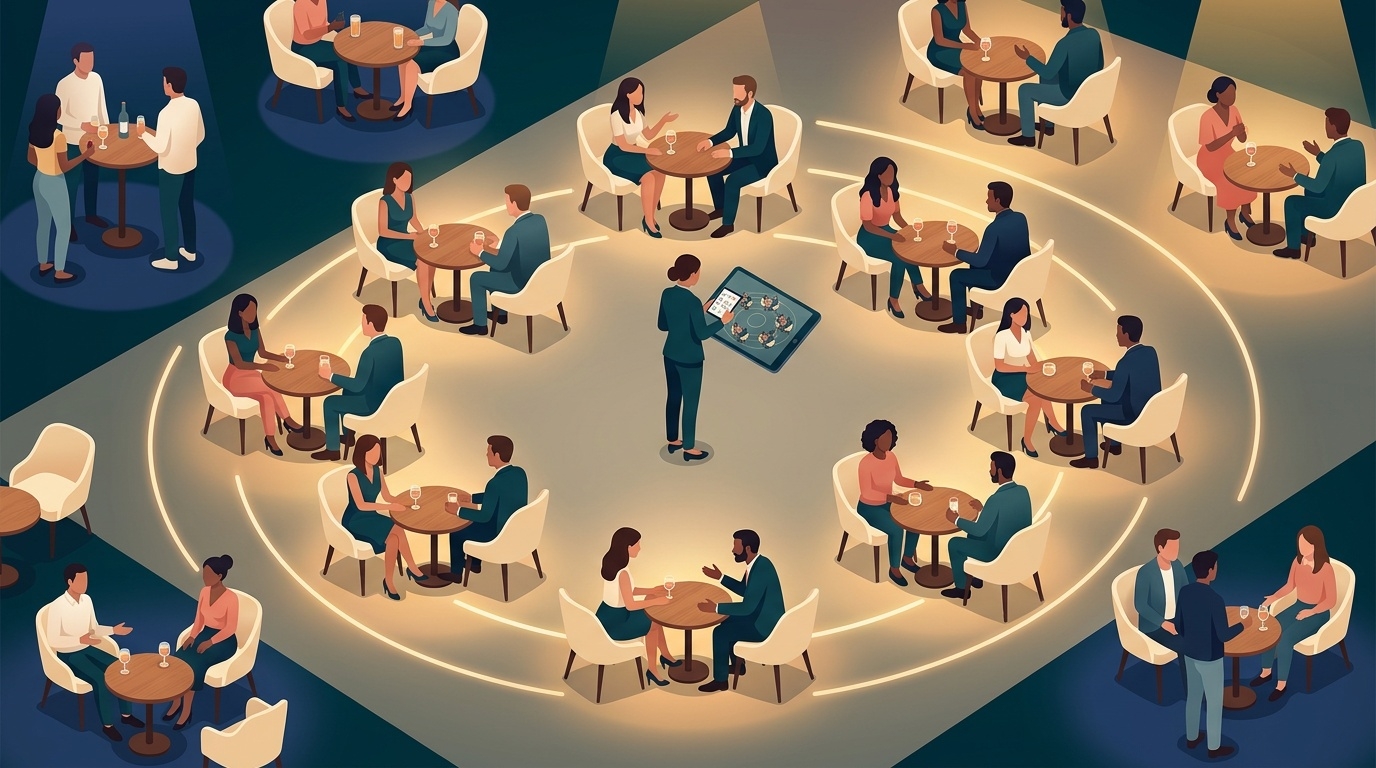
In a rotation blind date space in Seoul, groups of men and women sit facing each other in a set order. After two people converse one-on-one for a certain amount of time, a signal goes off, and one participant moves to the next seat. This process of re-introducing yourself to a new partner and checking each other’s interests and relationship goals is repeated throughout the event. The fact that a single participant can meet multiple potential partners in one gathering is what sets it apart from traditional blind dates.
Lately, the way these spaces are used has evolved. A new format has emerged where female participants are assigned to individual rooms, and male participants take turns rotating through the rooms for conversations. It’s a setup that isolates individual chats rather than having everyone swap seats in a single, shared space. As of September 2026, various rotation blind date events are actively taking place across Seoul in areas like Mapo, Gangnam, Konkuk University, and Hongdae. This specific style of dating, offering a series of brief encounters, seems to have firmly established itself as a part of the city’s modern dating culture.
The Efficiency of Meeting Multiple People at Once
The initial appeal of rotation blind dates is quite simple. Instead of waiting around for a friend to set you up or spending a lot of time on a single encounter, you can talk face-to-face with multiple people in one sitting. Unlike dating apps where you just scroll through online profiles, here you can gauge someone’s tone of voice, attitude, and the flow of conversation in person. Participants get the chance to chat with several partners, if only briefly, and figure out if they clicked with anyone.
In this setup, the organizer does much more than just provide a venue. They have to recruit equal numbers of men and women, scale the event appropriately, and map out the seating rotation to dictate who meets whom. For the event to run smoothly, they must manage the headcount to prevent any gender imbalances. Because it’s designed to gather a crowd for repeated one-on-one sessions, the rotation blind date is more structured than a private setup, though it was initially perceived as a relatively casual group gathering or social mixer. As the organizer’s involvement grows, what participants get isn’t just a place to hang out, but rather a curated dating opportunity designed around specific standards and procedures.
Where Blind Dates Turn Into Multi-Party Matchmaking
The recent shifts are most evident in the participant recruitment criteria. Some events restrict the age range to a typical marrying age or require proof of employment and academic credentials. Rather than just catering to a desire to meet new people, they are pre-verifying credentials, such as jobs and education, that people usually consider when choosing a partner. Promotional phrases like “gatherings with high marriage success rates” or “only for those serious about marriage” have started popping up. The core purpose of these events has moved away from simple socializing and closer to scoping out a spouse.
When you look at how these groups operate even after the event ends, the line between them and professional matchmaking agencies blurs even more. There are known cases where organizers reach out to past female participants when they are short on numbers, or even arrange separate, private dates outside the main event. Instead of just hosting a one-off gathering and calling it a day, they actively manage a roster of participants and continually set up new matches. Critics point out that while they might look like rotation blind dates or casual dating mixers on the surface, the actual service being provided is much closer to a multi-party matchmaking operation that screens for specific conditions.
Why the Government is Investigating Dating Apps for the First Time
To get a handle on these market shifts, the Ministry of Gender Equality and Family has launched the ‘2026 Survey on the Matchmaking Industry.’ This survey is conducted every three years, and the government kicked off the full-scale investigation in May after finalizing its research team. The most striking change this year is the inclusion of dating apps that host group meetings and blind dates as a primary subject of investigation for the very first time. This reflects a growing realization that exclusively auditing traditional matchmaking agencies makes it impossible to fully grasp how today’s dating service industry has expanded.
The government is also conducting in-person interviews with operators of select dating apps that haven’t officially registered as domestic matchmaking businesses. Rather than just looking at the technological format of an app or the label of a ‘blind date,’ the goal is to see exactly how they recruit participants and facilitate these meetings in reality. With the boundary between traditional matchmakers and dating apps becoming increasingly vague, authorities concluded they need to understand how the market actually operates before discussing regulatory applications and consumer protection. Thus, this survey focuses less on what the companies call themselves and more on the true nature of their services: their entry requirements, matching methods, and post-event client management.
The Same Service, Different Levels of Protection
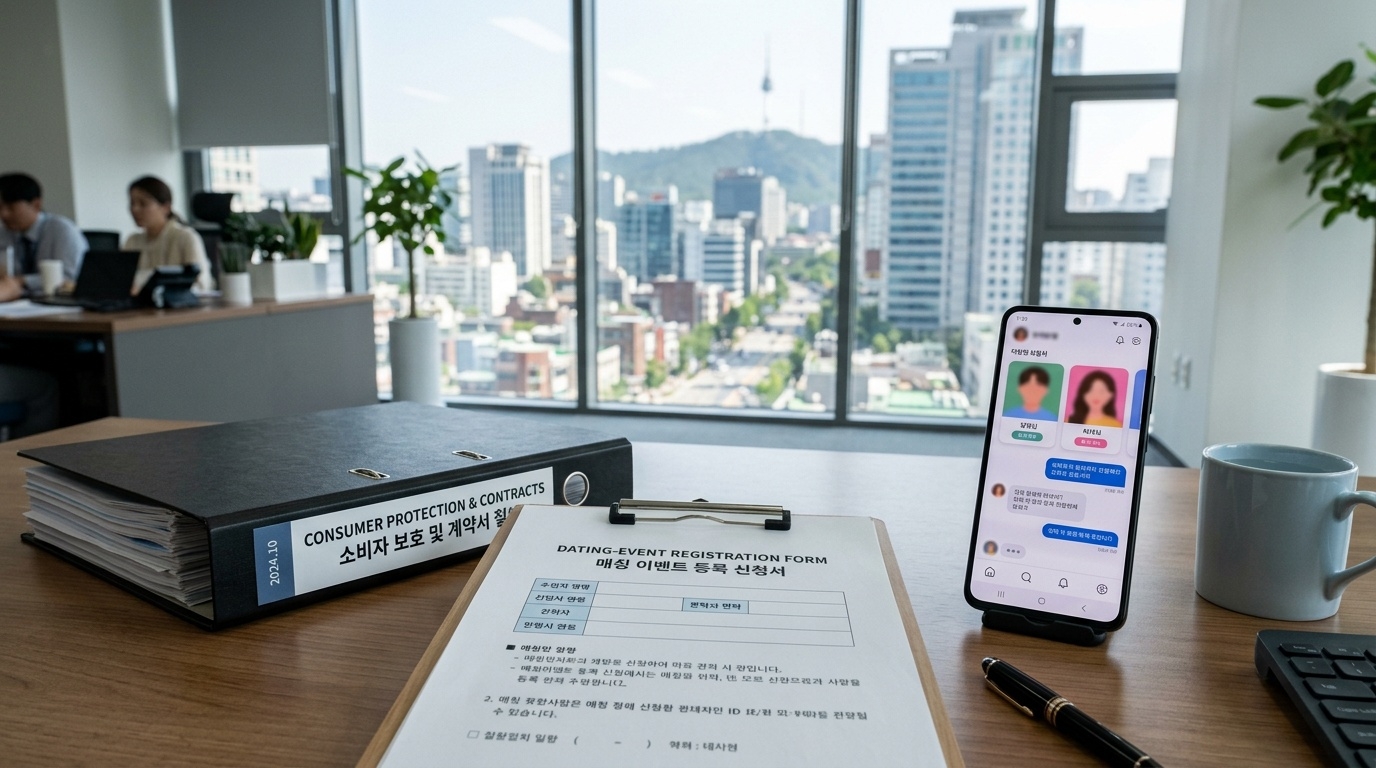
The current regulatory loophole is evident in the fact that the level of user protection depends not on the service provided, but on whether the business is officially registered. The ‘Marriage Brokerage Management Act’ strictly prohibits domestic matchmakers from providing false information, running exaggerated ads, or failing to draft formal contracts. It serves as a baseline safeguard, ensuring that individuals seeking a spouse can trust the explanations, partner profiles, and contract terms provided by the agency.
However, companies not registered as matchmaking businesses fly under the radar of these regulations. Even if they actively recruit people intent on marriage, verify jobs and degrees, and set up secondary dates after the main event, they might sidestep the protections of the Marriage Brokerage Act simply by operating under the guise of a dating app or social mixer. The experience for the user might feel identical to using a professional matchmaker, but the legal responsibilities demanded of the business can be vastly different. This gap is raising concerns about potential consumer harm stemming from false advertising or contractual disputes.
Looking Into Dual Operations Run by a Single Company
The survey isn’t stopping at dating apps. The government is also checking whether existing matchmaking agencies are quietly running group meetings or blind date services on the side. If a single company operates both, inspectors will look at whether they separately manage the metrics, like the number of successful matches, for their official matchmaking branch versus their group dating events. When the same operator runs services under different names, it can become murky as to which business the participant belongs to and which rules apply. Checking whether these operational metrics are kept separate will provide clues as to whether the matchmaking and blind date services are truly independent, or just two sides of the same coin managing the same pool of participants.
That being said, not all rotation blind dates can be instantly categorized as matchmaking businesses. There is a distinct difference between a casual meetup that merely provides a space and a rotation for conversations, and a service that verifies participant criteria with the explicit goal of marriage and continuously sets them up with suitable partners. The real issue is determining at exactly what point that distinction practically vanishes. Based on the survey findings, the government plans to review whether systemic improvements are needed or if the law should be amended to reflect these evolved service models.
The Questions That Linger After the Final Chat
Returning to the dating floor, what participants actually experience is a blur of short conversations and seat changes. Yet, if the organizer curated the guest list beforehand by checking ages, employment status, degrees, and marriage intentions, the nature of the event is a far cry from a simple social mixer. If they encourage repeat attendance after the event wraps or connect people offline, the organizer’s role shifts from a mere host to an ongoing matchmaker. The fine line dividing a casual blind date from professional matchmaking is essentially hidden in how the operation is run before and after the event itself.
Rotation blind dates may have flourished thanks to the sheer convenience of meeting multiple people at once, but the conversation has now moved beyond just dating efficiency. It matters now who is verifying the participants’ backgrounds, how the prospect of marriage is being advertised, how deeply the organizers intervene post-event, and what rules protect users when things go wrong. While the participant just changes seats to meet the next person a few minutes later, the organizer is actively managing the parameters and the matchmaking process. The 2026 survey is set to be the first step in uncovering the true face of this rapidly booming dating industry and defining the regulatory boundaries that have been missing until now.
Source: Money Today, May 20, 2026; Frip event listings, checked in September 2026.