

Table of Contents
It’s past midnight in a studio in Mapo-gu, and the lights are still on. A junior animator — three years out of school, résumé full of in-between frames for shows most viewers will never trace back to her desk — is finishing a batch due before the Netflix client wakes up in Los Angeles. Her monthly pay slip, after taxes and retirement contributions, comes out lower than she’d make waiting tables in Gangnam. That’s the paradox at the center of Korea’s animation industry: a sector celebrated internationally, a workforce quietly falling behind.
The Export Success That Hides a Wage Crisis
On paper, 2026 looks like a banner year for Korean animation. A $1 billion government investment announced in 2025, the global visibility of titles like Solo Leveling, and a steady stream of international co-production deals have positioned Korea alongside Japan and the United States. The government’s 2026 animation support budget alone runs to ₩30.9 billion — about $24 million — up from prior years.
Scratch beneath the numbers, though, and the picture gets less flattering. Entry-level animators earn an average of ₩30.99 million a year, roughly $24,000 USD, a salary that hasn’t kept pace with the industry’s growth. Production output has climbed 23% since 2020, yet total animator employment has declined 8% over the same stretch — output growth increasingly decoupled from local jobs.
Park Jin-soo, director of production at a mid-tier Seoul animation studio, put it plainly. “Young reporters I met recently told me that among their friends, ‘eating healthy food is a trend these days,’ but they wouldn’t dream of becoming an animator. The pay is simply too low for skilled work.” So who is actually benefiting from Korea’s animation boom, if not the animators themselves?
Studios report average budget shortfalls of 20% or more per project — gaps absorbed not by clients or distributors, but by staff, through unpaid overtime and stagnant wages. Individual facilities report a chronic shortage of about 10 technicians each, meaning existing staff take on more work with no corresponding raise.
Entry-Level Trap: Why ₩30.99 Million Isn’t Enough
Even animators who stick around and climb the ladder don’t find much daylight. Senior animators with eight or more years of experience earn ₩47.01 million annually — still 35% below Korea’s median wage for college graduates in comparable fields. For a profession requiring years of specialized training, that gap is hard to justify.
The take-home reality is worse than the headline figure suggests. After taxes and retirement contributions, animators’ effective pay often runs 15–20% below their stated salary, pushing hourly earnings below ₩12,500 in many cases. A 2015 academic study found 88% of Korean animation workers logged more than 40 hours a week — well past the legal maximum — and 14.3% earned less than ₩1.1 million a month, or about $880 USD, below international poverty thresholds for skilled labor.
There’s a gender gap layered on top of an already thin paycheck: women animators earn 6% less than male counterparts with equivalent experience. And “passion pay” — the industry euphemism for compensation that assumes workers should accept below-market wages out of love for the craft — shows up in 47% of animation job postings analyzed in 2025–2026.
Cost of living in Seoul is lower than in Los Angeles, and ₩30.99 million stretches further here than $24,000 would there. But that argument only goes so far when the real comparison is other skilled Korean professions, not international ones — and by that measure, animation still lags.
The Outsourcing Echo: A 1990s Business Model Becomes a Wage Ceiling
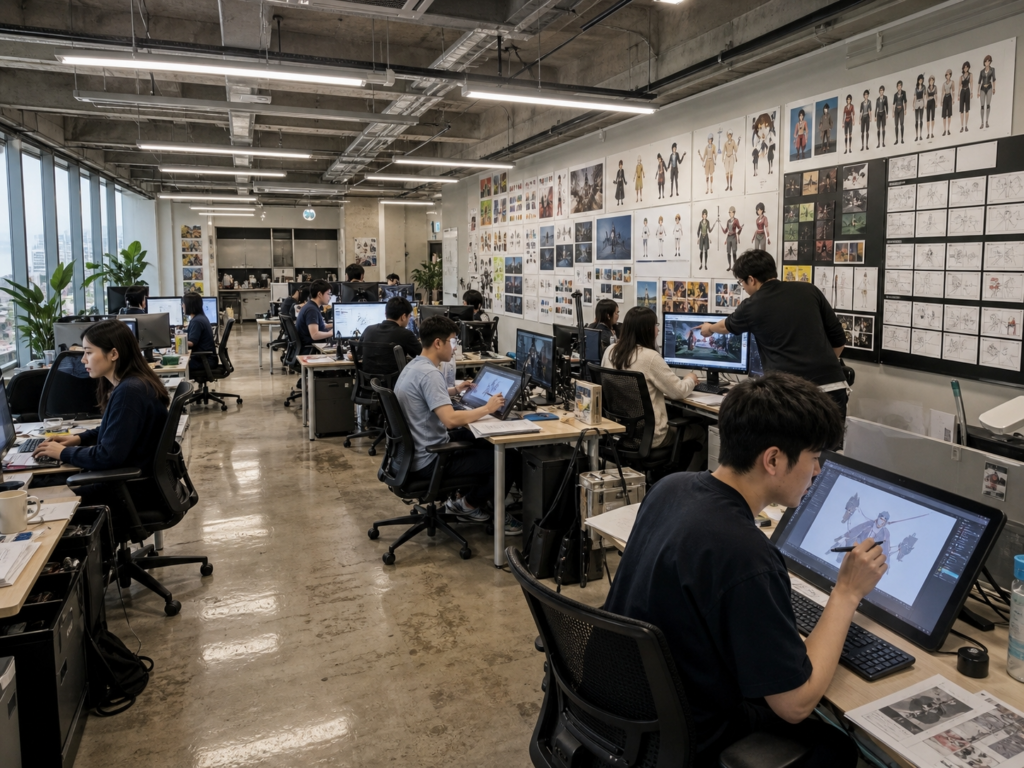
To understand why wages haven’t moved, it helps to look at where the industry came from. Korea’s animation sector took shape in the 1990s and 2000s as an outsourcing hub — a cheaper alternative for American and Japanese studios needing in-between frames and cel work done fast and inexpensively. That low-cost, high-volume model became the industry’s operating logic, and it never fully went away.
Even now, with Korean studios holding creative control over global IP rather than executing someone else’s storyboards, the payroll structure underneath hasn’t been rebuilt. Studios landing international co-production contracts — Netflix deals among them — often re-export labor-intensive work to subcontractors in Vietnam or the Philippines rather than hiring more Korean animators, keeping domestic headcount flat even as revenue grows.
Government cash-rebate schemes meant to attract co-productions don’t help much either. They apply equally to foreign producers and domestic studios, but wages for Korean animators on these projects are effectively capped at entry-level rates — a structural disincentive baked into the incentive design itself.
The Talent Drain: Where Animators Go When They Leave
Unsurprisingly, people leave. The average studio tenure for junior animators is just 2.3 years, the lowest of any major Korean creative profession. A 2024 industry survey found 67% of animation professionals cited “insufficient income” as their reason for considering an exit. It’s not that they’re giving up on their skills — they’re taking them elsewhere.
A 2025 government report acknowledges the “talent drain” directly, pointing to gaming, VFX, and advertising — fields paying 30–50% more for comparable work. That’s a brutal calculus for someone who trained for years specifically in animation.
The pipeline problem starts earlier. The Korea Animation High School, the industry’s main feeder institution, trains more than 150 students a year, but 34% of graduates leave the field within five years, citing low pay. Of Korea’s 155 university animation programs, only 12 partner with profitable studios for internships — most students graduate having never worked inside a functioning, paying pipeline. Why would a system built to funnel young talent into an industry also push them out within half a decade?
Can Government Money Fix Private-Sector Wage Stagnation?
Seoul’s policymakers aren’t ignoring the industry — they’re pouring money in. But support for independent animators comes with strings critics say make it nearly unusable for the people who need it most. Choi Mi-kyung, an independent animator and union representative with the Korean Animation Workers Association, described the disconnect. “Government support programs sound good in press releases, but the conditions are designed for large studios. If you’re an independent animator, you must already have a registered company—which costs money and creates tax liability. Most freelancers simply can’t meet these requirements.”
Some studio executives push back on the idea that wages are the problem. They argue Korea’s animation business is fundamentally competing against Vietnam and the Philippines on cost, and that raising domestic wages significantly would price Korean studios out of the outsourcing contracts that still make up a meaningful share of the business. Premium studios like Studio Mir and Orange Studio pay above-average rates, proving it’s possible — but they remain the exception, not the rule.
The ₩30.9 billion allocated for 2026 has gone largely toward production incentives and facility grants, not staff salaries. Until subsidy design shifts from funding output to funding the people who create it, the gap between Korea’s animation success stories and its animators’ paychecks looks likely to persist. Whether next year’s budget cycle finally attaches wage conditions to public funding — or whether the industry keeps growing while its workforce keeps shrinking — is the number worth watching.
Source: Mina Cho, koreaupclose.com, July 21, 2026.