
Table of Contents
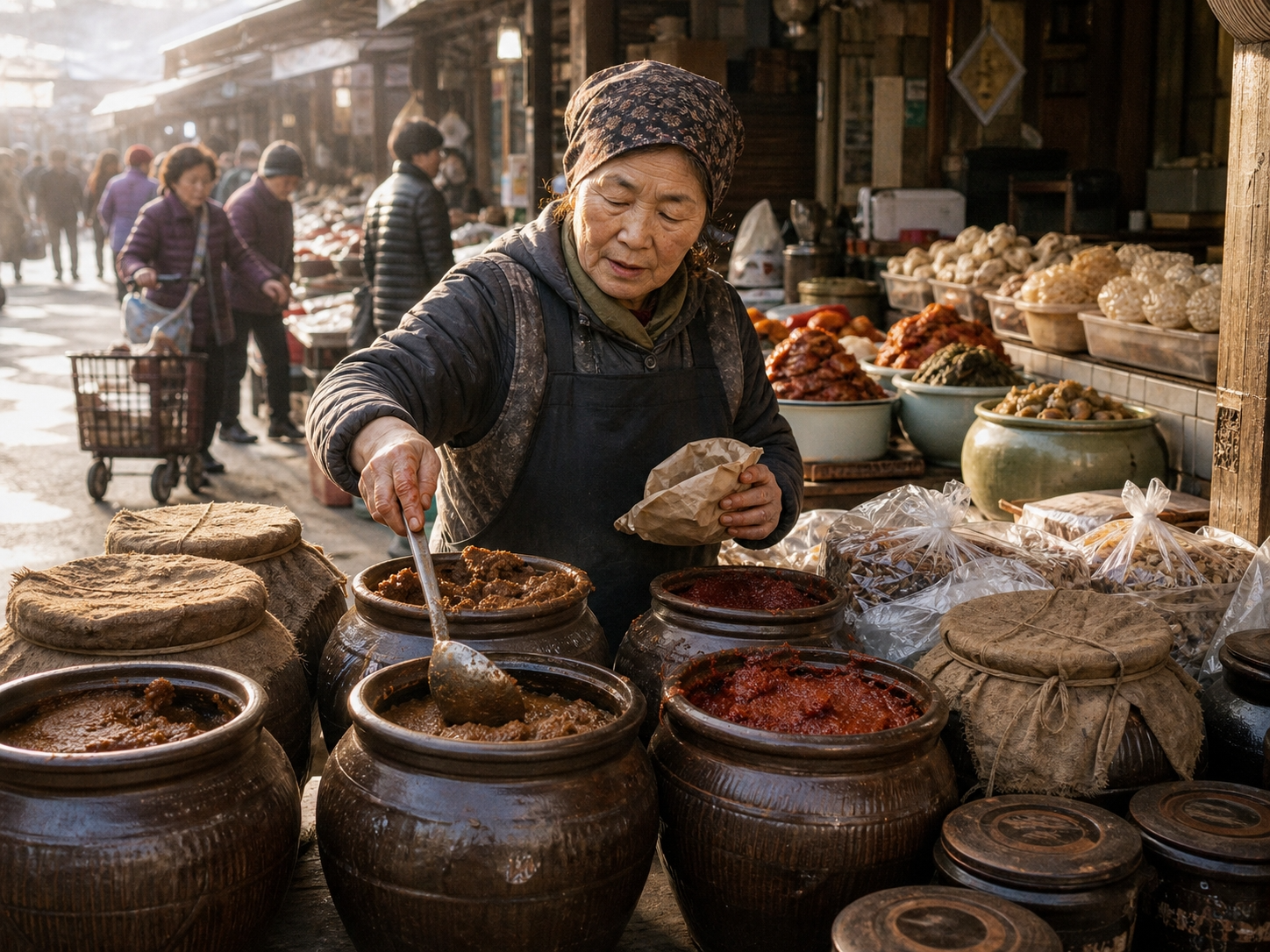
Walk through a traditional market on a humid morning and the smell hits you before anything else does — salted cabbage, garlic, and something deeper and muskier drifting from rows of clay jars stacked along the back wall. A vendor is ladling doenjang into plastic tubs for the lunch rush. A couple of tourists are filming the fermenting jars like museum pieces. In a strange way, they kind of are now.
In December 2024, UNESCO added Korea’s jang-making tradition — the slow, patient process behind doenjang, gochujang, and ganjang — to its Intangible Cultural Heritage list. It’s Korea’s second food-culture honor, after kimchi-making earned the same recognition back in 2013. Good news, I figured. Then I started looking at the trade numbers, and the story got a lot messier.
UNESCO Recognition Meets Trade Deficit: The Jang Paradox of 2024–2025
Here’s the part nobody put on the celebratory press release. The same jang tradition UNESCO just honored is losing ground at home. Korea’s jang exports did climb an impressive 160 percent over the past decade, and kimchi exports hit $163.57 million in 2024 — double what they were in 2017. Those are real wins.
But zoom out to the fuller kimchi picture and the mood shifts fast. Korea posted a kimchi trade deficit of $22.07 million through the first ten months of 2025, the second year running in the red. That means Korea is now buying more kimchi from abroad, mostly China, than it’s selling to the world. I sat with that number for a while. A country that just got its fermentation heritage stamped by UNESCO is simultaneously importing more of its own national dish than it exports.
It’s not a contradiction anyone planned. UNESCO recognition is a cultural designation — it doesn’t come with tariffs, quotas, or any kind of trade protection attached. It tells the world jang-making matters. It does nothing to stop a cheaper jar of kimchi from landing on a Seoul supermarket shelf next to the domestic brand and simply winning on price.
The Price War China Can’t Lose
I asked around about why Chinese kimchi keeps gaining ground, and the answer keeps coming back to two things: labor and time. Chinese producers ferment kimchi in two to four weeks. Traditional Korean production takes three to six months. Shorter fermentation plus cheaper labor adds up to retail prices 30 to 45 percent below domestic Korean kimchi, according to industry figures.
Timing made it worse. In 2023, extreme weather sent Korean cabbage prices up 40 percent, and a bad Chinese cabbage harvest that same year briefly gave Korean exporters an opening. It didn’t last. Chinese production normalized by 2024, and Chinese kimchi imports hit a record $189.86 million that year — for the first time actually surpassing Korean-made kimchi exports.
None of this means Chinese kimchi is bad. Some Korean industry voices concede the flavor is acceptable and that undercutting on price is just how markets work. But Korean producers, who’ve built their reputation on months-long fermentation and small-batch quality, are now competing against an industrial model built for speed.
A Supermarket Inventory Crisis: 4 in 10 Kimchi Containers Are Now Chinese-Made
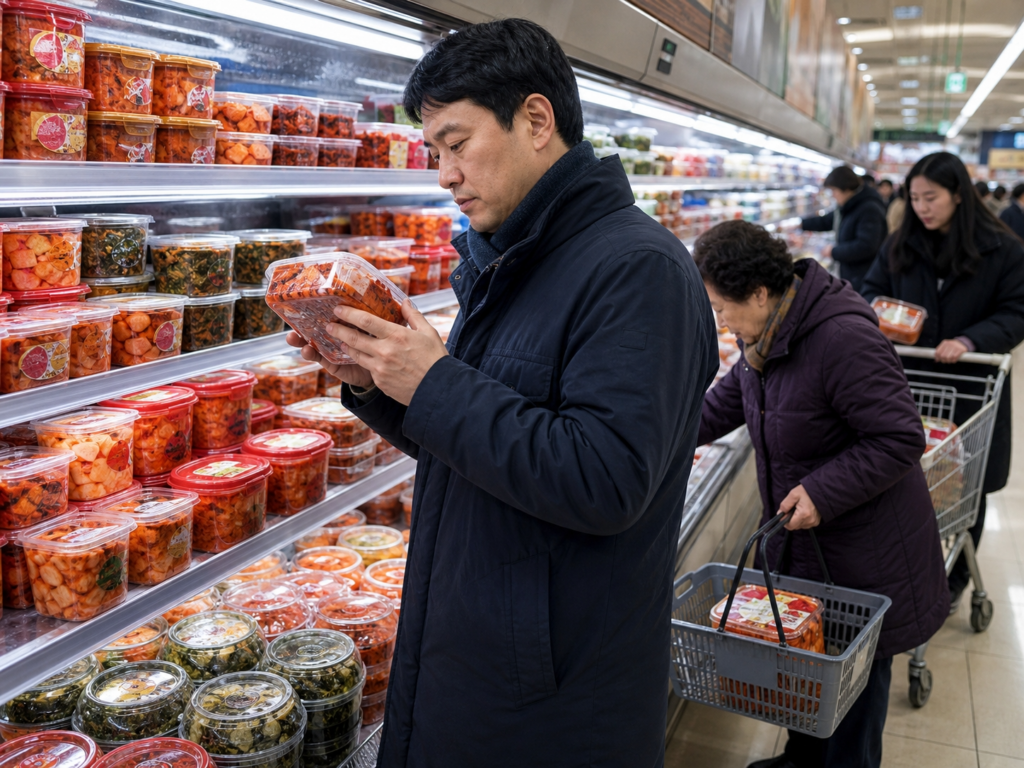
This is the part that actually changed how I shop. As of 2025, 38.9 percent of all kimchi sold in Korean supermarkets is imported — mostly from China. Roughly four out of every ten kimchi containers on a Korean grocery shelf right now are foreign-made. I started actually flipping containers over to check the origin label after learning that, and I’d guess most shoppers don’t.
It’s not only the domestic market feeling the shift. Japan, historically Korea’s biggest kimchi buyer, has been diversifying toward cheaper Chinese alternatives — Korean kimchi exports there fell to $47.55 million in 2025 year-to-date. U.S. imports of Korean kimchi dropped 5.8 percent year-over-year over the same period, the first sustained decline since 2019. Even the Netherlands pulled back slightly, though Canada and Australia picked up some of the slack.
Adding another wrinkle: trade data suggests 15 to 22 percent of officially recorded “Korean” kimchi in bilateral trade is actually Chinese-origin product re-exported or relabeled through Korean ports. So the line between what’s genuinely domestic and what’s just passing through gets blurrier the closer you look. Korea’s Customs Service also flagged 254 tons of kimchi containing foreign matter in 2024, which hasn’t helped consumer trust either.
The Authenticity Question: Can UNESCO Recognition Survive Market Realities?
Korea’s government isn’t ignoring any of this. In 2025 it rolled out a “Kimchi Voucher” program, offering restaurants partial subsidies if they switch from imported to Korean kimchi for at least six months. When I mentioned the program to a few restaurant owners, the reaction was polite shrugging more than enthusiasm — uptake has stayed limited, and a subsidy only goes so far against a 30-to-45-percent price gap.
There’s a bigger structural fix in the works, too: a “Kimchi Traceability Standard,” planned to launch in 2027, that would require full supply-chain transparency from farm to jar. It’s a direct response to the relabeling problem and the contamination scare. Whether it actually gets enforced, or becomes another rule easy to sidestep, is the real question.
What strikes me is the gap between cultural prestige and commercial protection. UNESCO’s heritage list was never built to referee trade wars — it’s a recognition of practice and meaning, not a quality mark or a tariff shield. Korea can keep winning UNESCO designations and keep losing shelf space at the same time, and neither fact cancels the other out. That’s an uncomfortable thing to sit with if you grew up thinking of kimchi as untouchably, obviously Korean.
Jang Masters, Ghost Kitchens, and the Future of Fermented-Food Heritage
Behind all the trade figures are 88 officially designated Korean food masters, the people UNESCO’s recognition is really supposed to protect. Hong Moon-pyo, head of Korea’s aT Corporation, called fermented foods the “second K-Food wave” this July, and he’s not wrong about the global appetite. But those same masters earn an average government stipend of about ₩12 million a year — roughly $9,500 — which isn’t enough to live on from the craft alone.
Meanwhile, domestic consumption of traditional jang actually dropped 3.2 percent in 2025, as younger Koreans increasingly reach for instant seasoning packets instead of aging their own doenjang. Korea did add fermented foods to its official dietary guidelines in January 2026, which helps the health case. It doesn’t necessarily help anyone actually make jang the old way at home.
So here’s my one suggestion, and it costs about as much as a subway ride. Next time you’re at a Korean grocery store, flip the kimchi container over and read the origin label before you buy. It takes five seconds, and it’s the one piece of this whole story you can actually act on.
Source: Ulgyeongje Seo, Seoul Economic Daily, July 9, 2026; Song Seung-hyun, Korea Herald, November 24, 2025.