Table of Contents
The Statistical Milestone: 20% and Climbing
South Korea has officially entered a “super-aged society.” On December 23, 2024, the population aged 65 and older reached 10.244 million—surpassing 20 percent of the total for the first time. By January 4, 2026, when the Ministry of the Interior and Safety released the “2025 Resident Registration Statistics Analysis,” that figure had climbed to 21 percent. The 65-plus population now stands at 10.84 million—a gain of 584,040 in just one year. More than one in five Koreans is now elderly.
The Speed Problem: Compressed Timelines Strain Social Systems
Speed is the crisis. France took 115 years to transition from an aging society (7 percent elderly) to an aged society (14 percent); the United States took 73 years. South Korea did it in 18. The passage to super-aged status took just seven more years. Society’s institutions haven’t had time to adapt; the demographic structure alone has already shifted. Annual debates over retirement age extension stall due to labor-management disagreements precisely because of this temporal gap.
Aging-Tech Emerges to Fill the Care Void
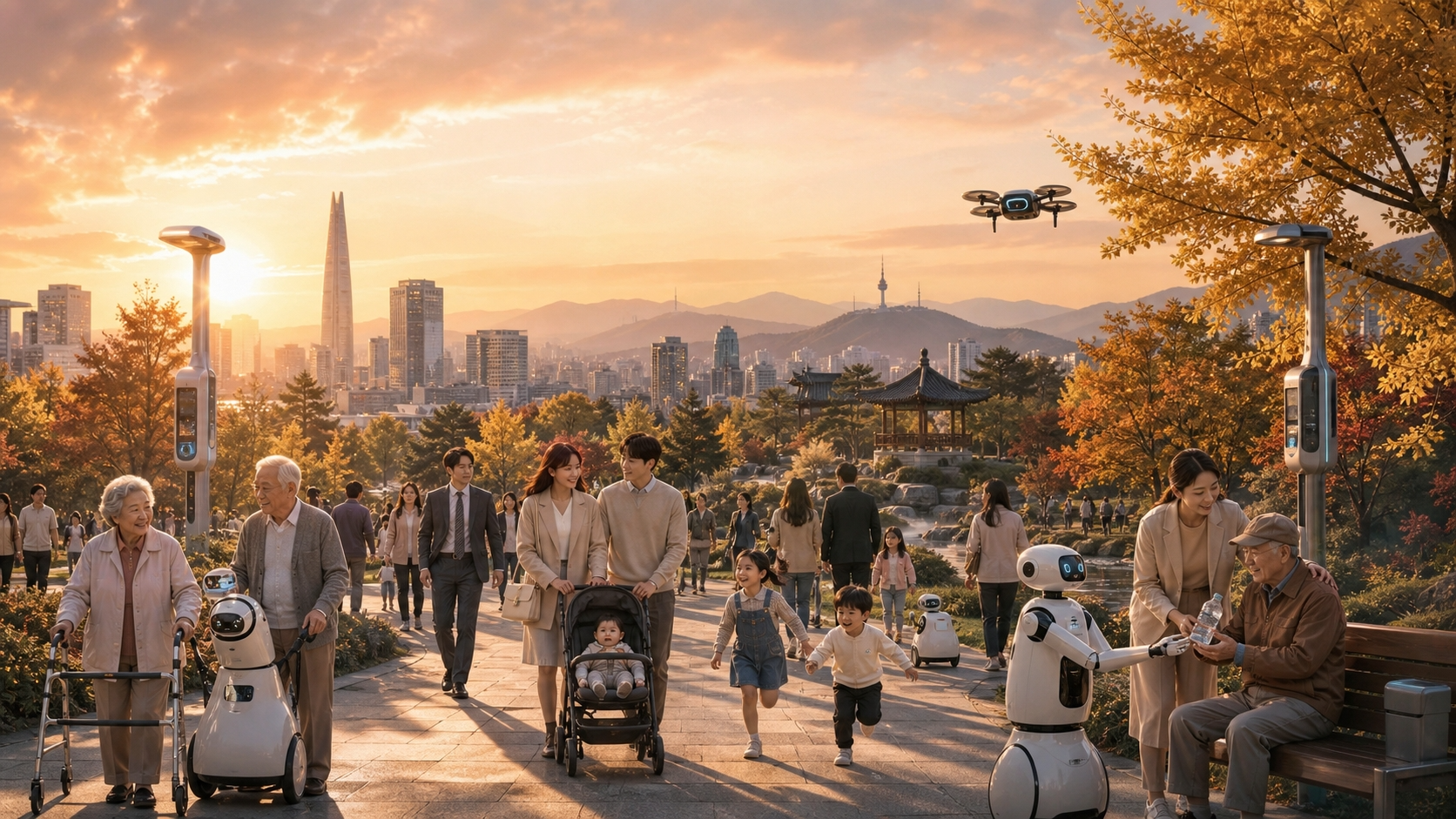
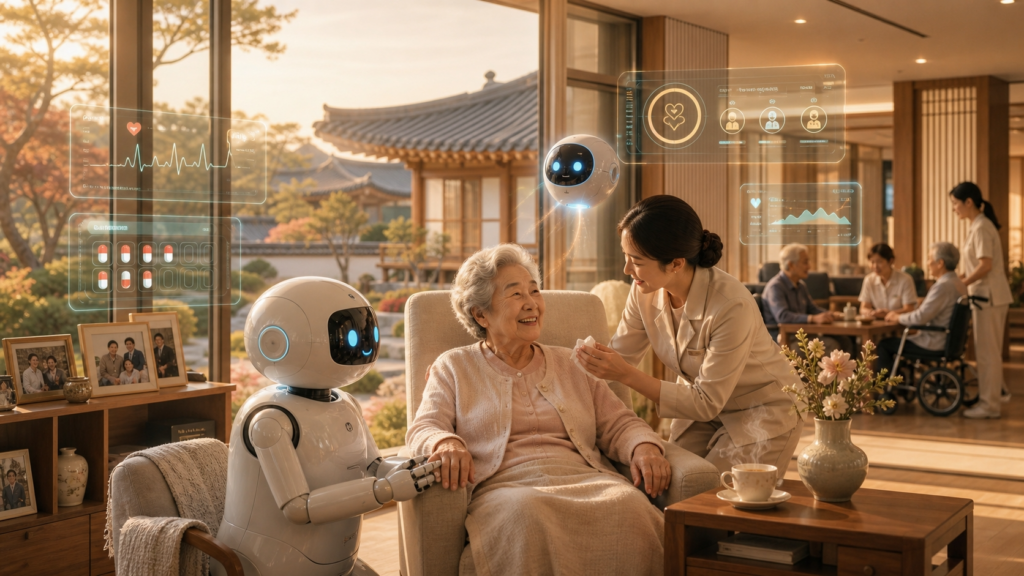
The so-called “aging-tech” or senior-tech market has stepped in to bridge the gap. With the elderly population growing rapidly and caregiving labor critically scarce, the approach is technological compensation. Care robots like “Hyoddol” handle both emotional engagement and medication reminders. AI speakers check on welfare and detect emergencies. Chatbot-based scheduling assistance is already deployed through municipal programs. Major firms—SK Telecom, KT—have entered the senior business with integrated solutions spanning telecom, healthcare, finance, and real estate. Cross-industry convergence defines the market’s core trend.
A Cautionary Voice from the Field
Practitioners offer a sobering counterpoint: AI cannot fully replace human caregiving. Its role should remain observational and data-collection—freeing human resources to focus where they’re truly needed. The moment technology becomes an alibi for insufficient staffing, care quality deteriorates.
Wellness Redefined: Recovery Over Optimization
Consumer wellness itself is being redefined. The 2026 wellness trend’s keyword is not “optimization” but “recovery and longevity.” The shift moves from short-term body sculpting to long-term healthspan management, from self-care to emotional well-being and relational quality. Even amid economic headwinds, wellness consumption remains stable because health is now seen not as a medical domain but as a life-stability mechanism. Slow-aging, low-stimulant drinks, sleep-and-recovery-centered routines reflect the same logic.
An Agenda for Every Generation
Ultimately, super-aged society is not a senior-only issue. The question has shifted from “how long to live” to “how long to live healthily”—and that question addresses all generations.
Source: Ministry of the Interior and Safety / Statistics Korea, January 2026