Table of Contents
The Highest-Scoring Conflict Wasn’t Generational or Regional. It Was Ideological.
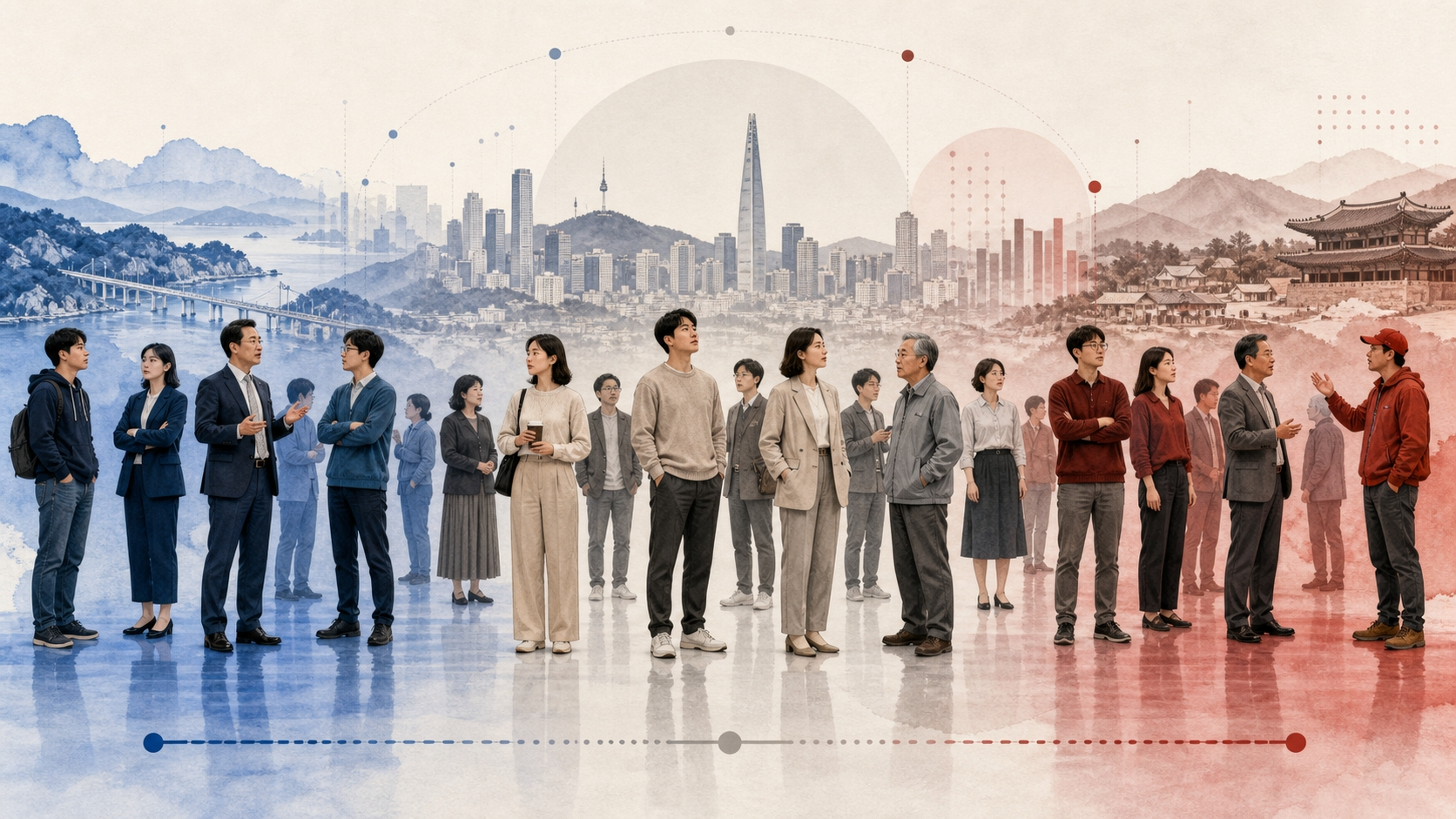
Discussions of division in Korean society tend to reach first for generation, gender, or the gap between Seoul and everywhere else. But in the country’s most recent nationwide survey, the conflict that scored highest wasn’t any of those. It was the divide between conservatives and progressives. The Korea Institute of Public Administration’s “2025 Social Integration Survey” put ideological conflict at 3.2 out of a possible 4 points — up 0.1 point from the previous year, and the highest of any category measured. The survey ran from August to September 2025 and covered 8,305 respondents nationwide, aged 19 and older.
Behind it came class conflict between the upper-middle class and the poor, at 2.9. Labor-management conflict between workers and employers scored 2.8. Regional conflict between the capital area and the rest of the country, values conflict between development and environmental protection, and generational conflict between older and younger Koreans each came in at 2.7. Religious conflict, conflict between men and women, and conflict between Korean nationals and foreign residents each scored 2.6. None of these numbers is low by any reasonable standard. But the data is clear that respondents feel the conservative-progressive divide more sharply than any other fault line in the country.
The Center Is the Largest Group, But It Didn’t Grow This Year
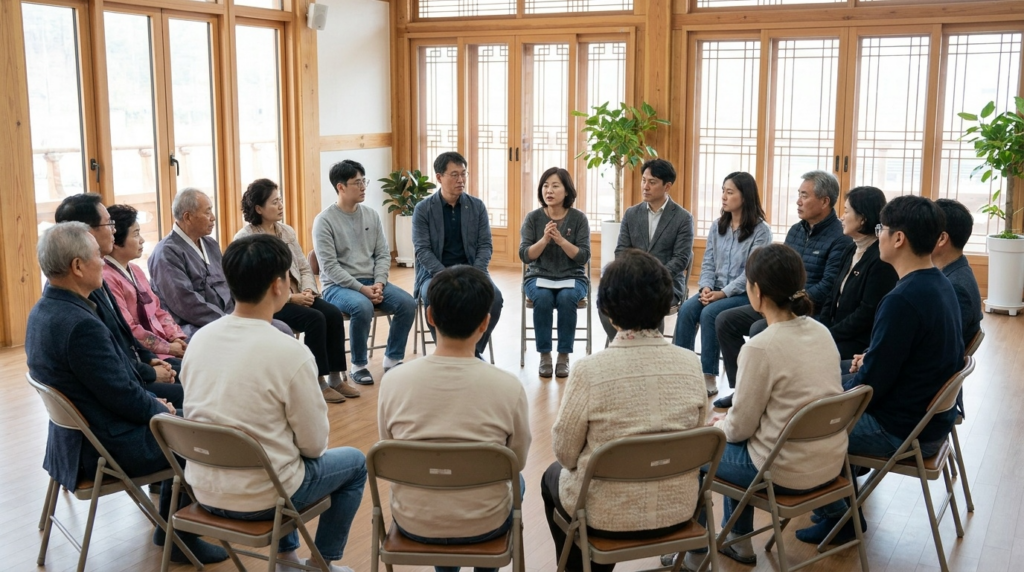
The fact that ideological conflict scored highest doesn’t mean every respondent places themselves firmly on one side or the other. Those who identified as politically centrist made up 43.4% of respondents — the single largest group. Self-identified progressives came in at 27.1%, and conservatives at 29.6%. That’s part of why it’s difficult to describe Korea’s ideological landscape as a contest between two evenly matched camps. More people place themselves in the center than in either wing, which suggests that regardless of how people actually vote, a substantial share of citizens aren’t locking themselves into one fixed political identity.
Still, this year’s data shouldn’t be read as evidence that the center is expanding. The centrist share actually fell 1.8 percentage points from the year before. Progressive identification rose 2.7 points, while conservative identification dipped 0.6 points. Both things are true at once: the center remains the largest single group, and its share shrank compared to last year. Reading a poll by highlighting only one of those two facts means missing the actual shift. The center is still the broadest category, but the direction of movement this year wasn’t toward it.
Perceiving Conflict and Self-Identifying Aren’t the Same Question
The 3.2 score for ideological conflict measures how seriously respondents view the conservative-progressive divide in Korean society as a whole. The centrist/progressive/conservative breakdown, by contrast, measures where respondents place themselves. The two are related, but they aren’t the same metric. Someone who identifies as centrist can still view ideological conflict as severe, and someone who identifies as progressive or conservative can just as easily conclude that the intensity of the conflict has gone too far. This survey alone doesn’t support the conclusion that any single group is driving the division.
The survey’s question on the roots of conflict calls for the same caution. Respondents most often pointed to stakeholders prioritizing their own interests, at 26.3%, followed by a lack of mutual understanding at 21.8%, the wealth gap at 19.0%, and differences in values at 18.5%. Concentration of power came in at 10.1%. Those figures suggest that ideological conflict in Korea can’t be fully explained through the language of elections, parties, and politicians alone. Economic disparity, competing interests, differing values, and a basic sense of not understanding the other side all appear to be operating together.
The Growth-vs-Redistribution Numbers Were More Complicated Than a Simple Trade-off
On economic policy, preference for growth rose while preference for redistribution fell. Respondents who said “growth is important” made up 30.3%, up 2.8 percentage points from the year before. Those who said “redistribution is important” made up 31.2%, down 5.4 points. Redistribution still edges out growth by 0.9 percentage points, though the gap between the two is narrow. Taken as a year-over-year trend, more respondents are leaning toward growth, and fewer are prioritizing redistribution alone.
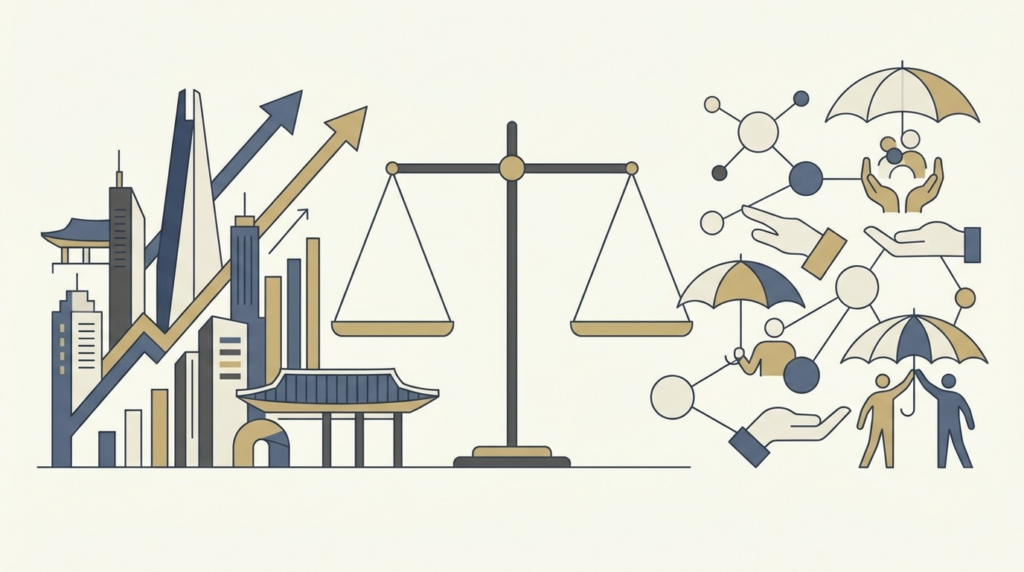
But it would also be inaccurate to read this purely as growth and redistribution competing as an either-or choice. The single largest response, at 38.5%, was “both growth and redistribution matter” — up 2.5 percentage points from last year. Most respondents appear to want the two goals pursued in parallel rather than abandoning one entirely. Answers on growth and redistribution don’t map neatly onto ideological self-identification, either. Regardless of whether someone places themselves as centrist, progressive, or conservative, their economic policy priorities can diverge from what that label might suggest.
The Numbers Aren’t a Verdict. They’re a Starting Point for the Next Question.
The survey also captured shifts in everyday outlook. The perceived possibility of improving one’s own social and economic standing through effort rose to 2.7 out of 4, up 0.1 point from the year before. The perceived possibility for the next generation held steady at 2.8. Satisfaction with the current political situation stood at 5.5 out of 10, and with the economic situation at 5.3. Outlooks for both political and economic conditions five years from now landed at 5.8. High conflict perception, in other words, doesn’t automatically translate into worse outlooks across every category measured.
Taken together, the Korea Institute of Public Administration’s data shows a society that views ideological conflict as its sharpest divide, while at the same time containing the largest share of people who identify as centrist and the largest share who want growth and redistribution pursued together. The key is not to let any single number stand in for the direction of the whole society. Whether the ideological conflict score climbs again next year, whether the centrist share recovers, and whether the preference for balancing growth and redistribution holds — those are the more useful indicators for reading where Korean society is actually headed.
Source: Korea Institute of Public Administration, “2025 Social Integration Survey” (government-approved statistics report); Munhwa Ilbo, July 7, 2026; The Korea Economic Daily, July 7, 2026.