
Table of Contents
If You’ve Lost Weight But Your Face Looks Different
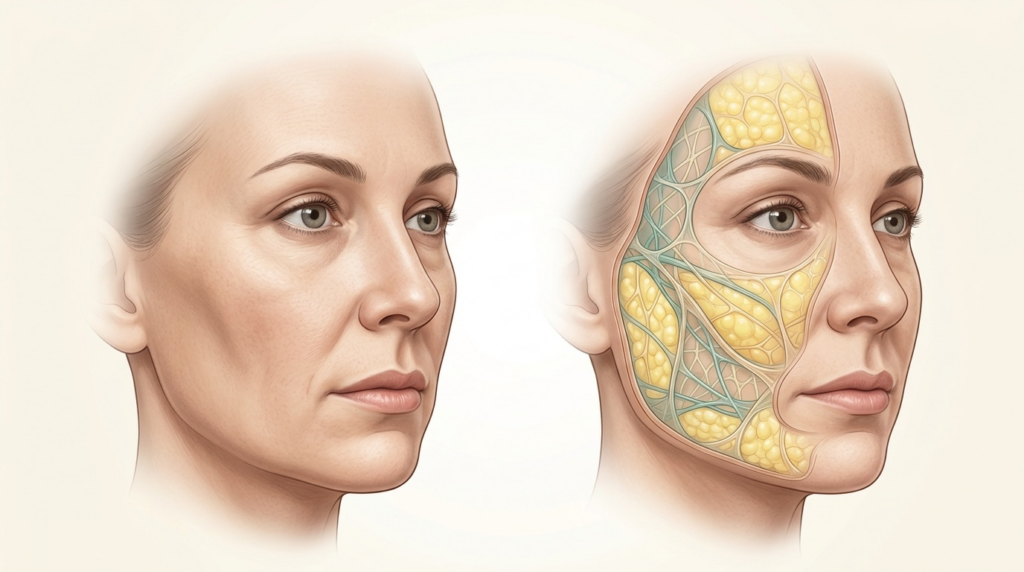
Have you heard people say their cheeks look hollow and their skin looks like it’s sagging after losing weight on an obesity medication? Online, this is often called “Ozempic face.” Korean biotech company L&C Bio is working on an injectable product made from donated human fat, aimed at improving this kind of facial volume loss. Rather than a cosmetic, it’s designed to be a human-tissue-based injectable product used in medical settings.
First, let’s clear up a misconception. “Ozempic face” isn’t an official medical condition or a side effect unique to Ozempic. It’s a term for the appearance change that can happen when subcutaneous fat in the face decreases along with rapid weight loss, whether from GLP-1 drugs or from significant weight loss for other reasons. It also doesn’t happen to everyone who takes these medications.
How Does Donated Fat Become a Volume Material?
L&C Bio’s technology has a working name: MegaAdipoECM. The process removes cells from donated human fat while leaving the extracellular matrix behind. The extracellular matrix works something like a fine net or scaffold that gives cells a structure to settle into and grow on. The company’s idea is to inject this into areas that have lost volume, creating an environment where a patient’s own fat cells can resettle there.
In theory, this is a different approach from synthetic fillers that fill space immediately. The company is also looking into restoring body volume elsewhere, and even a possible biological alternative to silicone breast implants, not just hollow areas of the face. Still, you should separate the company’s development goals from actual clinical results. The reporting that’s out there describes the company’s technology plans — it doesn’t mean the improvement in “Ozempic face” or how long it lasts has been clinically confirmed.
Re2O and the New Product Aren’t the Same Injection
L&C Bio already sells a human-tissue-based skin booster called Re2O (Elravie Re2O). Re2O is an extracellular matrix product processed from donated skin’s dermal tissue, focused on improving skin texture and conditions like wrinkles. The product now in development is different — it uses a matrix derived from donated fat rather than skin, and it’s aimed at restoring lost volume rather than improving surface skin quality.
The company also said it plans to launch Re2O V, a volume-focused addition to its existing Re2O lineup, in September. The similar naming makes it easy to confuse the two, but the September-bound Re2O V and the donated-fat-based MegaAdipoECM are not the same product. The latter is reported to have finished material development, but it’s still in the commercialization-prep stage, and its price, official product name, and how medical institutions would purchase it haven’t been disclosed.
Even With the Law Changed, It Won’t Go on Sale Right Away
The technology was developed around five years ago, but Korean law classified donated fat as medical waste, making commercial reuse difficult. That changed in June, when the National Assembly passed a revision to the Waste Management Act removing human-derived fat from the list of substances banned or restricted from recycling — but the change only takes effect after a one-year grace period following promulgation. Because of this, L&C Bio expects the product to launch, at the earliest, around late 2027. It isn’t a finished product you can buy or get treated with right now.
The company said it holds patents on this technology in Korea, the U.S., and China, and views those three as its priority markets. But having a patent means securing rights to the technology — it doesn’t mean regulators in each country have approved its safety or effectiveness. Actually selling it will require meeting each country’s regulations on human tissue and injectable products, along with enforcement decrees, detailed guidelines, and manufacturing and distribution requirements. The launch timeline could shift depending on that process.
A Medical Consultation Comes Before the Buzzword
If your face looks gaunt, that’s not a reason to stop taking your obesity medication on your own. Talk to the doctor who prescribed it first about your rate of weight loss, your nutritional status, and your medication plan. If you’re considering a cosmetic procedure after that, it’s worth asking your doctor specifically about the product’s approval or classification status, how the tissue used in it is processed, infection control, expected swelling and inflammation risk, and how to respond if something goes wrong.
This development shows that the mainstreaming of obesity medications is creating new demand that goes beyond cosmetics and into biotech and medical aesthetics. But a novel raw material doesn’t automatically mean a proven effect. You should keep the donated-fat product still in development separate from Re2O, which is already on the market, and Re2O V, due in September. What to watch next is whether commercialization actually happens after 2027, along with the clinical evidence and regulatory framework behind it.
Source: Bloomberg interview cited, South China Morning Post, August 6, 2026; BeInCrypto Korea, August 2026; Seol Ji-yeon, Hankyung, June 29, 2026.