Table of Contents
What the lights at Gwanghwamun were celebrating
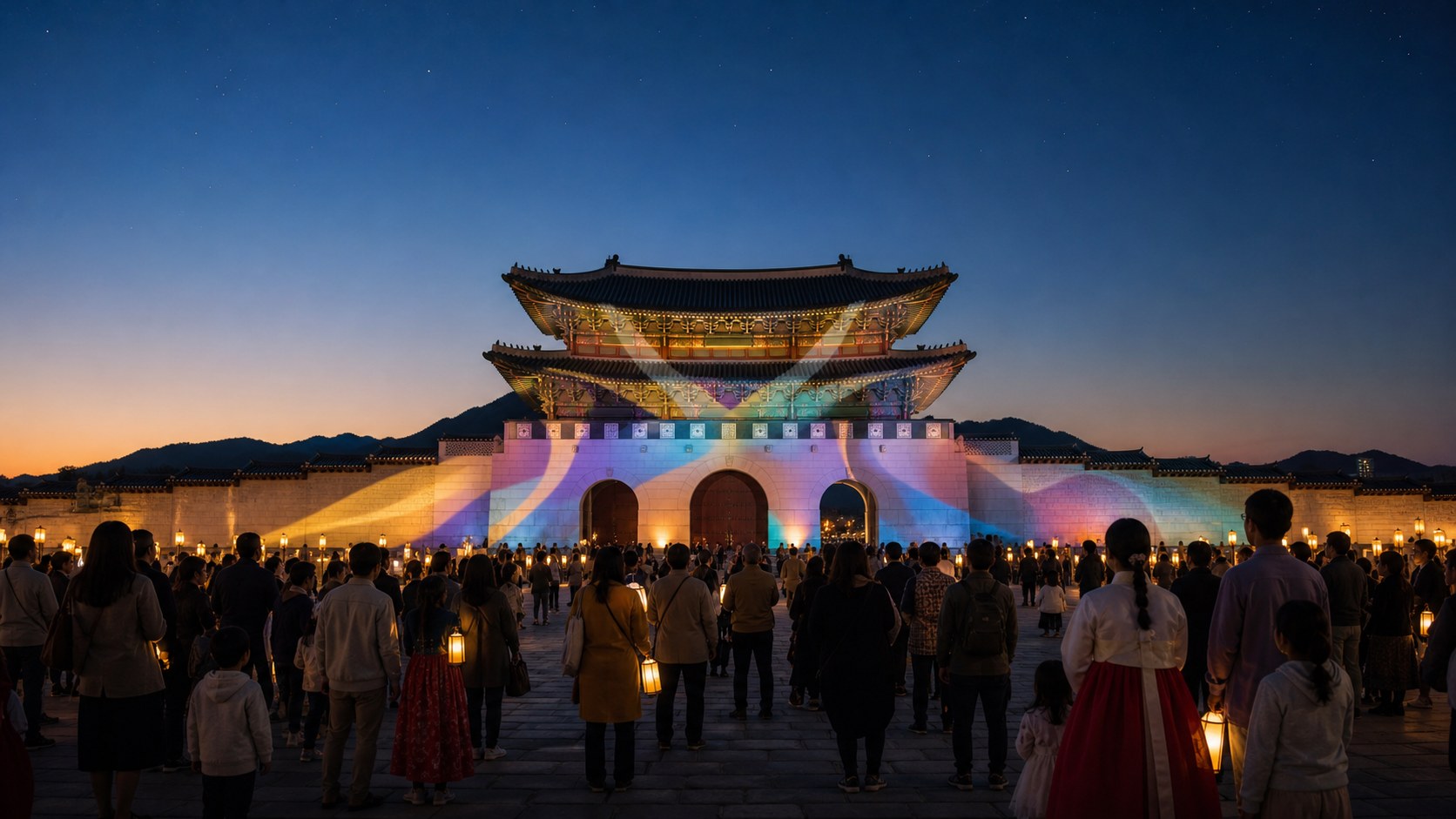
On the evening of October 8, Gwanghwamun Square in central Seoul hosted the eve of Hangul Day celebration. After sets by the K-pop group AtHeart and the indie band Broccoli, You Too?, the program moved on to a conversation with King Sejong Institute students, public readings and a media facade projected onto the walls of Gwanghwamun Gate. Foreigners learning Korean and Korean citizens shared the same stage, brought together by the same alphabet. This year’s festival honored an old writing system, and it also looked back at the history of honoring it.
For readers new to the subject, the numbers attached to the event need some explaining. 2026 marks 580 years since Hunminjeongeum was promulgated, but only 100 years since Hangul Day was established. The year the alphabet was made public and the year people began commemorating it together are different. Ask how old Hangul is and how old Hangul Day is, and you get two different answers.
This year also marks the 100th anniversary of Hunmaeng Jeongeum, the Korean braille system. Fold all of these anniversaries into a single number and it becomes hard to see who protected Hangul, and who widened access to it, and under what circumstances. Making sense of the festival in the square means going back to when each one began: the alphabet, the holiday and the braille.
1446 marks the promulgation, not the invention
The phrase “Hangul is 580 years old” needs a qualifier. According to the National Hangeul Museum, King Sejong created Hunminjeongeum in 1443. In 1446 came the book Hunminjeongeum, which explained why the new script was made and how it works. This year’s 580th anniversary counts from that promulgation, not from the invention. The year the alphabet was created and the year it was announced to the public are two separate dates.
Hangul and the Korean language are also two different things. Korean is the language people speak, and Hangul is the writing system used to write it. Celebrating the promulgation of Hunminjeongeum does not mean the Korean language itself began then. It is closer to celebrating the moment a way of putting speech into writing was created and made known.
That distinction clarifies where this year’s commemorations start. The story of 1446 is about introducing a script to society. The story of 1926, which comes next, is about how people chose to remember and carry on a script that already existed. Hangul Day was not born alongside the alphabet. Later generations created it because they needed it.
In 1926, the holiday’s first name was Gagya Day
According to the Encyclopedia of Korean Culture, the Korean Language Research Society, together with the publisher Sinminsa, held an event in 1926 marking the 480th anniversary of the promulgation of Hunminjeongeum and named the day Gagya Day (Gagyanal). The society is the forerunner of today’s Hangeul Society. The event was part of an effort to stir interest in the Korean language and its writing and to protect national identity. Today’s holiday grew out of this civilian movement during the Japanese colonial period.
With that background, it is clear that Gagya Day was more than a birthday party for an old invention. Celebrating your own language and script carried an intention to keep learning and using them. An alphabet existing on paper and people treating it as their own and passing it on were two separate tasks.
The name “Gagya” also brought the script closer to everyday life. It took the syllables learners meet when they first practice the alphabet and turned them into the holiday’s name, calling the script by a familiar sound instead of a scholarly term. That choice shows the holiday was aimed at more than a king’s achievement. It was also meant for the people learning to read and write.
The name Hangul Day, and Hangul read by fingertip
Gagya Day began to be called Hangul Day from the 1928 ceremony onward. So the 100th anniversary in 2026 does not mean the current name has been in use for exactly 100 years. The count runs from the first commemoration in 1926. The name changed, but the holiday’s starting point stays in the year the first event was held.
Also in 1926, Song-am Park Du-seong announced Hunmaeng Jeongeum, a Korean braille system for blind people. The National Hangeul Museum gives the announcement date as November 4. Instead of seeing the shapes of letters, readers of Hunmaeng Jeongeum feel raised dots with their fingertips. Hangul Day gave people an occasion to remember their script, and Korean braille opened another way to reach it.
Neither of these starting points treated Hangul as a finished achievement from the past. One brought people together to reflect on what their writing meant, and the other made it possible for blind people to read and write it too. Looking at both centennials side by side shows that the history of Hangul includes efforts to widen the circle of its users, along with efforts to preserve it.

A century later, the question is who uses it and how
The Ministry of Culture, Sports and Tourism’s 2026 Hangul Week ran from October 6 to 17 under the theme “Hangul by My Side.” The eve of Hangul Day event was planned to open with 100 lights switched on for the centennial, and the media facade “Twenty-Four, Universe” turned the 24 letters of the Korean alphabet into moving images on the walls of Gwanghwamun. The program used numbers to mark the anniversary and tied them to present-day cultural expression.
The Hangul Culture Industry Fair, held during the same period, looked at ways to use the letters in products and content. An academic conference at the National Museum of Korea on October 12 put the future of Hangul and the Korean language on the agenda, at a time when K-culture is spreading and AI is changing how language is used. This year’s events set looking back next to asking how the script will be used from here.
Ways of remembering the alphabet have expanded into performance, video, industry and technology, but the question from 1926 has not gone away. Who gets to learn to write, express their own thoughts and take part in culture still matters. Picture someone learning Korean as a foreign language next to someone who reads braille, and “by my side” starts to cover a lot more people.
Two exhibitions that outlast the festival
If you missed Hangul Week, there are still chances to explore the story behind it. “Ilguiryuk Muhaniryuk,” a title built on reading the year 1926 digit by digit in Korean, runs from October 2, 2026, to February 9, 2027. The National Hangeul Museum is one of its co-organizers, but the exhibition itself is held at the National Museum of Korean Contemporary History in Seoul, so check the venue before you go. It traces the path from Gagya Day to today’s Hangul Day.
At the National Museum of World Writing Systems in Incheon, “From Dots to the World: 100 Years of Hunmaeng Jeongeum” is under way. The museum’s pre-opening notice lists the run as October 7, 2026, to February 14, 2027. Between them, the two exhibitions cover the history of Hangul Day and the history of Korean braille, and both stay open far longer than the festival in the square did. Visitors should check each institution’s latest opening information.
2026 stands out for more than the anniversary numbers stacked on an old alphabet. Three histories meet in one year: the promulgation, the creation of a holiday under colonial rule and the opening of a way to read by fingertip. The two exhibitions go past the question of how old Hangul is, toward the work people have done so that more of them can share it.
Sources: Ministry of Culture, Sports and Tourism press release, October 2, 2026; Korea.kr policy briefing, October 12, 2026; Encyclopedia of Korean Culture, “Gagyanal”; National Hangeul Museum collection notes, September 2019; KBS report on the special exhibition, October 1, 2026; National Museum of World Writing Systems exhibition notice, accessed October 18, 2026.