Table of Contents
An alley where Hangeul and Cyrillic share the signs
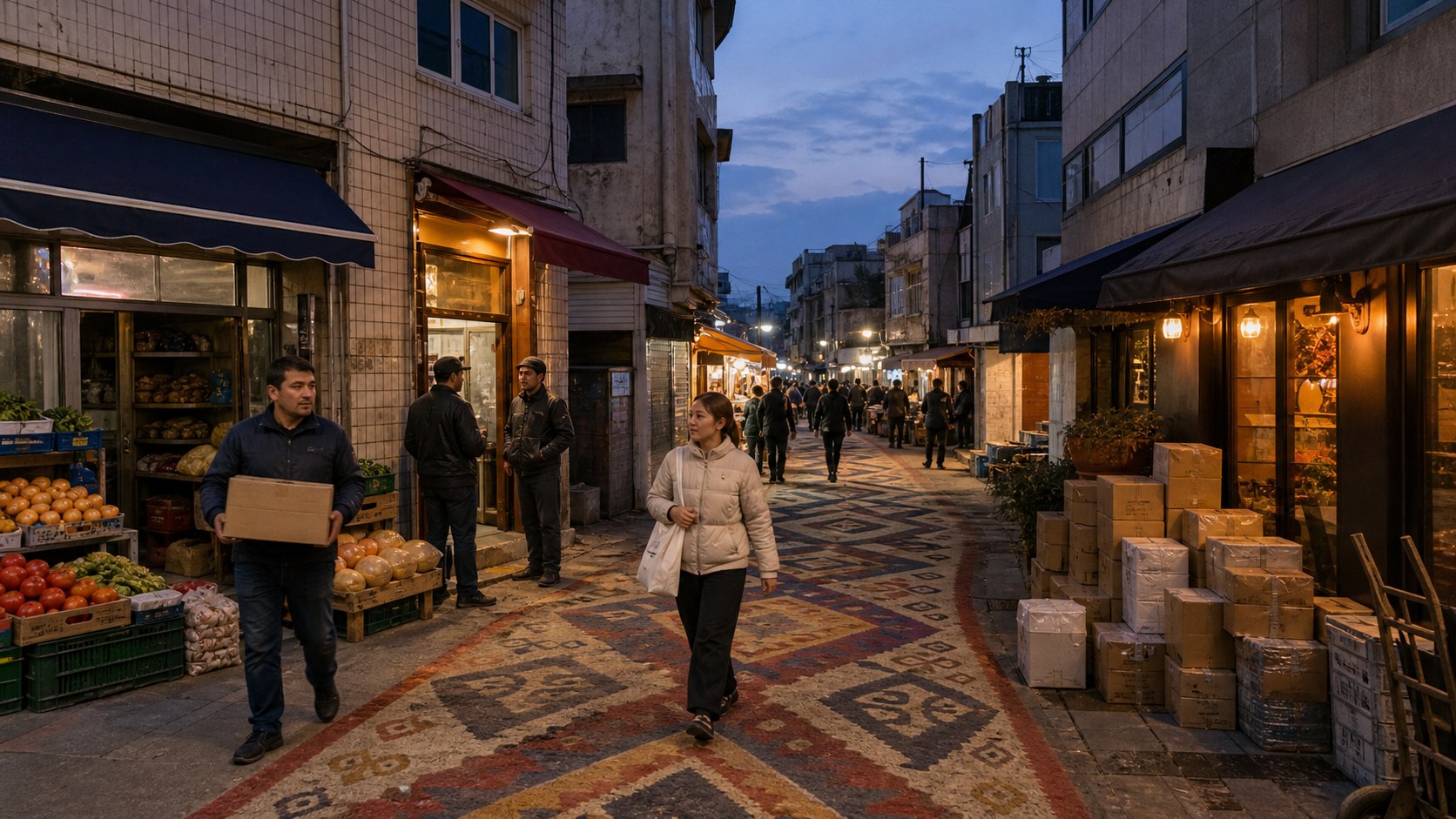
About a three-minute walk from Dongdaemun Design Plaza (DDP), there is a set of alleys where Korean and Cyrillic signboards hang side by side. This is Gwanghui-dong’s Central Asian Street, along Eulji-ro 42-gil and 44-gil near Dongdaemun History & Culture Park Station. Uzbek, Russian and Mongolian restaurants and grocery stores sit next to old Korean eateries. Visitors come for the food from many countries, but the street did not start with restaurants or tourism. It started with traders moving in and out of the Dongdaemun garment markets.
About 250 shops fill an area of roughly 23,000 square meters. With restaurants and grocery stores mixed together at that scale, this is less a single-country food street than a whole neighborhood people live in. Cheonggyecheon and Jangchungdan-gil are close by, but being near other sights does not explain what kind of place this is. It is easier to understand the street once you follow how a space where people of different nationalities trade, eat and meet came to settle in central Seoul.
Clues sit outside the restaurant signs, too. Shipping offices marked “cargo” or “EMS” are how goods bought in Korea get sent to other countries. A Silk Road signpost lists Samarkand, Tashkent, Astana and Bishkek, the hometowns of people who settled here. Food, freight and languages overlap in one alley, and that shows the street was a base for migrants’ daily lives and business before it was a place for outside guests.
1990: the clothing trade brings people in
As the Dongguk University paper Dongdae Shinmun traces it, the story goes back to September 1990, when South Korea and the Soviet Union established diplomatic relations. Russian clothing buyers looking for cheap, good-quality apparel then gathered around Dongdaemun. The movement of people buying clothes and keeping their trade going spread into the surrounding alleys. That is why the Dongdaemun garment district sits at the start of what is now called Central Asian Street. Seoul’s fashion distribution and cross-border trade met in this neighborhood. The first piece of background, then, is not a tourism plan but the commercial ties that formed around Dongdaemun Market.
After the 1997 financial crisis, which Koreans usually call the “IMF crisis,” the people changed. Many of the Russian traders left, and migrants from Central Asia took their place. The street went from a gathering spot for Russian clothing traders to a space used by people from many regions. The signs in many languages you see today were not put up all at once. They are what that change left behind.
The next turning point was the New Geumho Tower, completed in 2001. Many Mongolians moved into the building, now known as Mongol Town. Migrants from Uzbekistan, Kazakhstan and Kyrgyzstan then grew the alley’s businesses, mainly restaurants, grocery stores and shipping offices. Ties that began in the clothing trade carried over into food and everyday services. Mongol Town is the name of one building, and it is also where you can see Gwanghui-dong’s shops turning into a base for several migrant communities. The arrival of traders after diplomatic ties, the change in who stayed after the financial crisis, and the rise of Mongol Town lead, one after another, to the street as it is now.
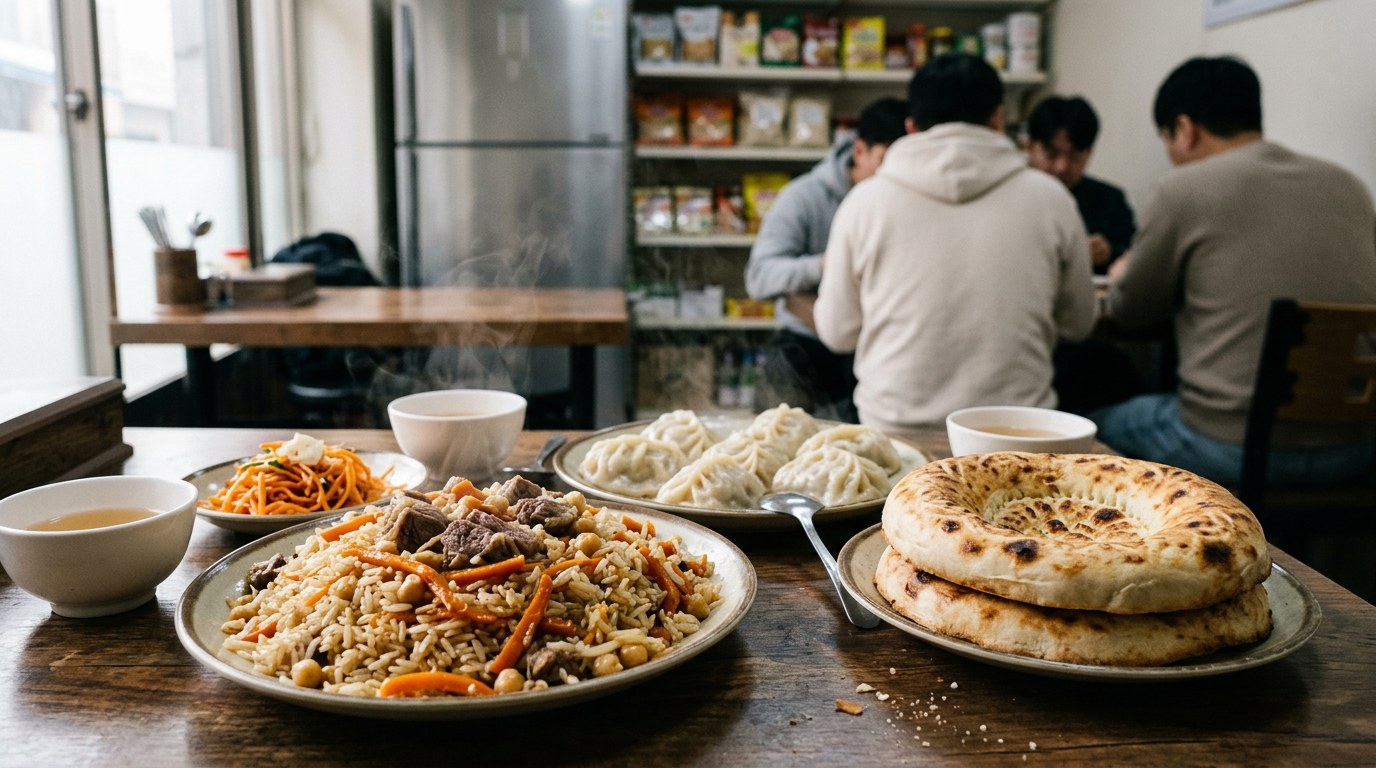
A shared language and a shared table
Russian and the Cyrillic alphabet are what allowed people of different nationalities to connect. Dongdae Shinmun explains that after the Soviet era, Russian worked as a common language among migrants from different places. So the Cyrillic signs on the street point less to one nationality than to a language that several communities have shared. Here, Russian and Cyrillic let people from different homelands do business and pass along everyday information. One script on the signs holds the histories of many hometowns.
Migration has left its mark on the table as well. The “carrot kimchi” that some restaurants serve as a side dish ties back to the Koryo-saram of Central Asia, the ethnic Koreans who put down roots in the former Soviet Union. After the forced deportations of the 1930s, when napa cabbage was hard to find, a version made with carrots became part of the local food culture. A food memory that began in Korea passed through Central Asian life and came back to tables in Seoul.
That is why it helps visitors to look at the grocery stores as well as the restaurants. A restaurant shows you a finished meal. The grocery stores and shipping offices show the daily life and movement around that meal. In Gwanghui-dong, places to eat and everyday services share the same alleys. Behind the food a tourist meets in passing are people looking for the taste of home, sending things back, and carrying on with their lives in Seoul.
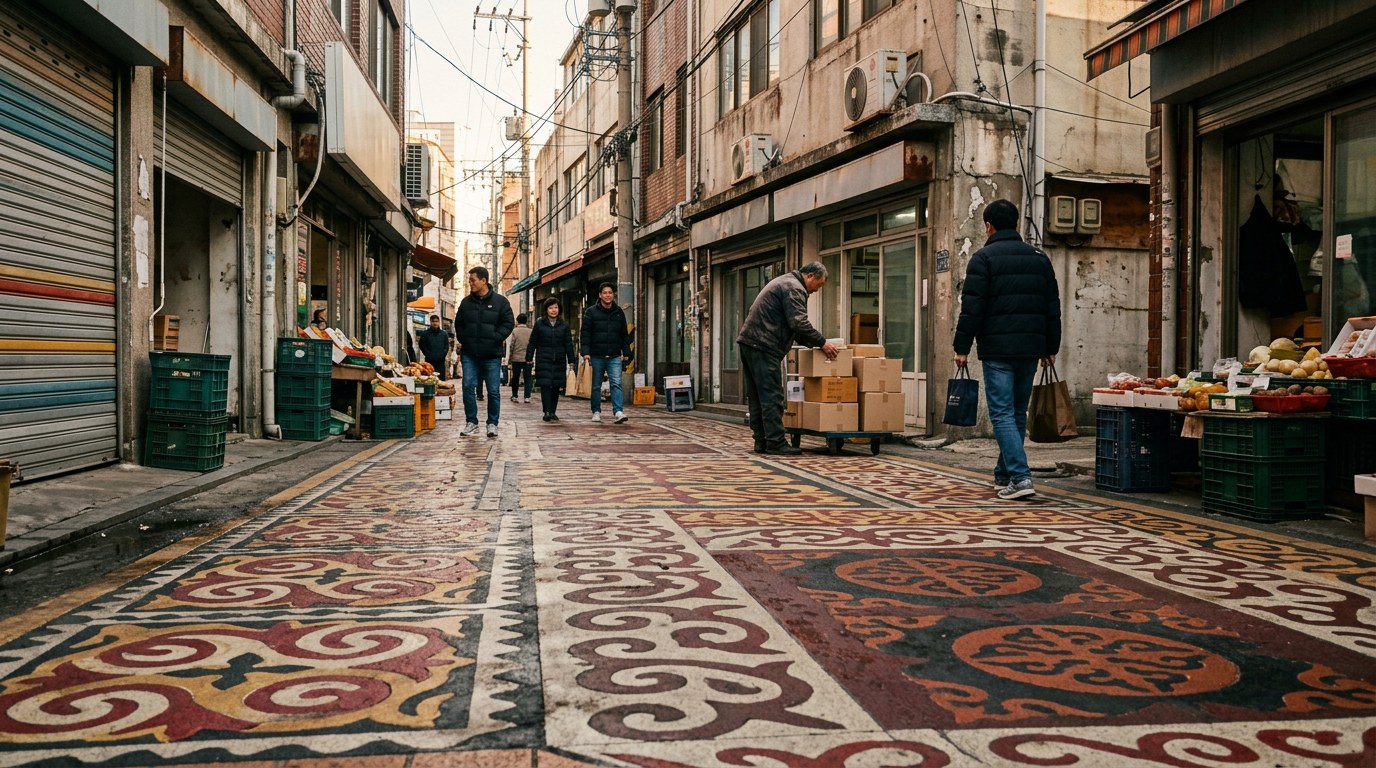
2022: Central Asia worked into the pavement
Later, public design that expresses the area’s identity was added to a street shaped by migration and trade. The “Carpet Street” on Eulji-ro 44-gil was created in a 2022 streetscape improvement project. Its base motif is the shyrdak, a traditional Kyrgyz felt carpet, and the designers also drew on patterns from several parts of Central Asia, such as the Kazakh koshkar muiz and the Turkmen gul. The pavement itself became a guide that represents several home regions at once. Using patterns from many places, instead of one country’s symbol, matches the mix of the alley.
The street logo on the wall combines the Korean consonant “ㅈ” (j) with the Cyrillic letter “Ф” (f). Put together with the Silk Road signpost and the pavement patterns, the logo shows what the street’s visual design tries to connect: its place as a Seoul neighborhood, and the cultural background of residents from Central Asia. Walking along Eulji-ro 44-gil, visitors can read the history of migration stored in the alley through these markers.
Policy support followed in January 2026, when Gwanghui-dong’s Central Asian Street was named a site for Seoul’s Local Brand Commercial District program. The city’s list puts it in the fifth group, alongside Magok Art Road, Konkuk University Youth Boulevard and Noryangjin Manna-ro. The program develops a name and content for each district based on what makes it distinct. For this street, it marks the start of a stage that introduces an existing migrant business district to visitors in language and routes that are easy to follow.
A new name for 2026: Gwanghui Road
Jung-gu District, the Seoul Metropolitan Government and the Seoul Credit Guarantee Foundation’s Myeongdong support center are putting in a total of 1 billion won over 2026 and 2027. The first year is about groundwork: nighttime lighting, information signs and help forming a merchants’ association. It also includes a food festival, docent tours with guides, and multilingual tour maps. In 2027 the plan moves on to a district council and specialty products. The program covers the street environment, things for visitors to do, and how merchants run the area. If the first year lays the base for visiting and running the district, the second is about making its character stick through the council and products.
The new brand, “Gwanghui Road,” is meant to evoke a culinary Silk Road in the middle of Seoul. The first Gwanghui Road Festa, held on October 24, introduced the name. The advance announcement promised food from Korea, Uzbekistan, Mongolia, Russia and Georgia, and free lunch boxes worth 10,000 won for the first 600 visitors. It also included guided tours and a chance to try on traditional Central Asian clothing. Jung-gu noted that about 10,000 foreign residents live in the district, around 10 percent of its population. The festival’s food map, “Gwanghui Story,” was planned around food cultures that several countries share, such as dumplings, fermented drinks and tea, along with stories about spices.
Jung-gu held a run of alley festivals around the same time. “Jungmartre” on St. Joseph Street in Jungnim-dong and an event at Baekhak Market took place on October 23 and 24. A night market on Sindang 5-gil is scheduled for October 30, with an embroidered-patch workshop that reflects the alley’s history as a sewing district. Gwanghui Road belongs to the same effort to link a neighborhood’s past with its current shops. After the festival, the center of a visit is still the restaurants, grocery stores and street markers on Eulji-ro 42-gil and 44-gil. The open question is what the new brand will mean for the migrant merchants already there, even as it brings in more visitors.
Sources: Dongdae Shinmun, December 1, 2025; Yonhap News Agency, April 24, 2026; Jung-gu District press release, October 21, 2026; Food Today, October 21, 2026; Seoul Metropolitan Government, Local Brand Commercial District list.