
Table of Contents
A Path Close to the River, Yet Still a Bridge for Cars
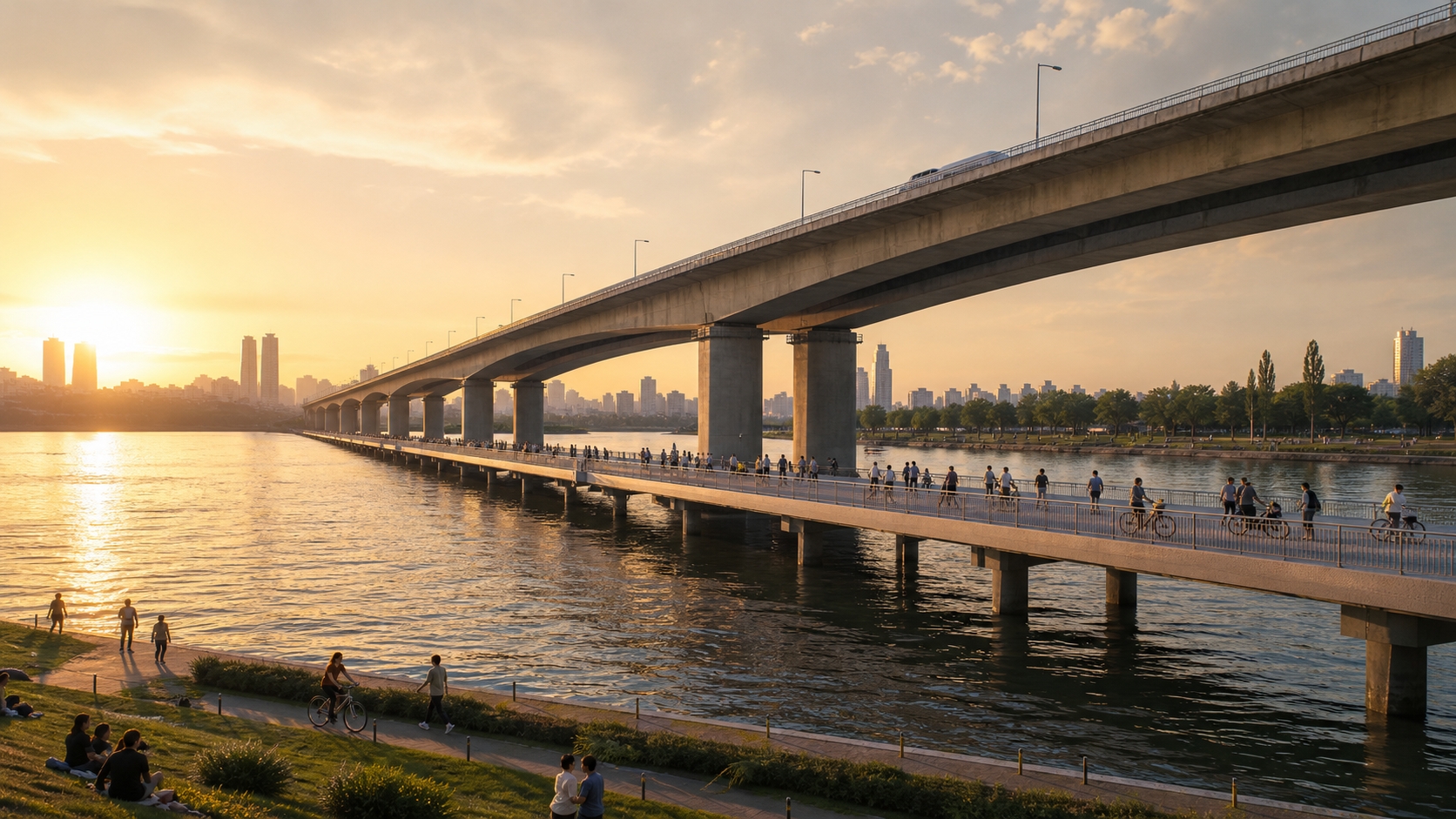
At Jamsu Bridge in Banpo, Seoul, the Banpo Bridge stretches overhead while the surface of the Han River flows closely alongside. This path, where you can take in the surrounding scenery while crossing the river, is an important connecting point for understanding the Banpo Hangang Park area. Its location directly beneath the Banpo Bridge Moonlight Rainbow Fountain is another defining feature. It’s a place where the experience of looking up at the bridge from the riverbank meets the experience of standing close to the water on the bridge itself. However, the Jamsu Bridge of today is not a space exclusively for pedestrians.
For visitors, the first step is distinguishing its name and location. Jamsu Bridge is the lower deck, positioned at a completely different height from Banpo Bridge. Even though they share the same crossing over the Han River, the upper road and lower path can be used quite differently. Just because you see cars speeding across Banpo Bridge doesn’t mean you can navigate Jamsu Bridge the same way. Understanding this distinction will help when making sense of the upcoming changes to bus routes and pedestrian pathways.
The current look of Jamsu Bridge isn’t the result of a space originally designed for leisurely walks. Its function has shifted in stages, as walking and cycling were gradually introduced to a bridge built for cars. The plan announced by the Seoul Metropolitan Government on October 8 marks the next phase in that shift. Looking only at what will be built in the future gives you a rundown of facilities, but tracing how the bridge’s purpose has changed over time gives a clearer picture of what’s happening across the Banpo area.
1976: A Vehicular Bridge Connecting North and South
Jamsu Bridge opened in 1976 as a bridge for vehicular traffic. Its starting point was not a place to rest over the river or admire the view, but a practical road connecting the north and south banks of the Han River. Understanding its function during this era is key to grasping what the later expansion of pedestrian spaces actually changed. Even if the physical structure stays the same, the meaning of a bridge shifts when the people moving across it and the purpose of using the space change. The history of Jamsu Bridge is the story of that shift in use.
For a vehicular bridge, passing through is the fundamental goal. Pedestrians, on the other hand, can slow down and take in the surrounding scenery as they move. Thanks to its position closer to the water than any other bridge on the Han River, Jamsu Bridge naturally held the potential for this kind of leisurely use. In outlining its latest plan, the city of Seoul emphasized that visitors will be able to enjoy the river, the surrounding landscape, and the Banpo Bridge fountain up close. The proximity to the water helps explain the bridge’s new purpose.
Yet being close to the water doesn’t automatically turn a car bridge into a cultural space. Walkable sections, places to linger, and pathways safely separated from other users all have to be established together. The next major shift for Jamsu Bridge wasn’t new sightseeing facilities. It was the introduction of paths for pedestrians and cyclists, the point when other ways of moving began to take root in a space that had been built entirely for cars.
2008: Two of the Four Lanes Find a New Purpose
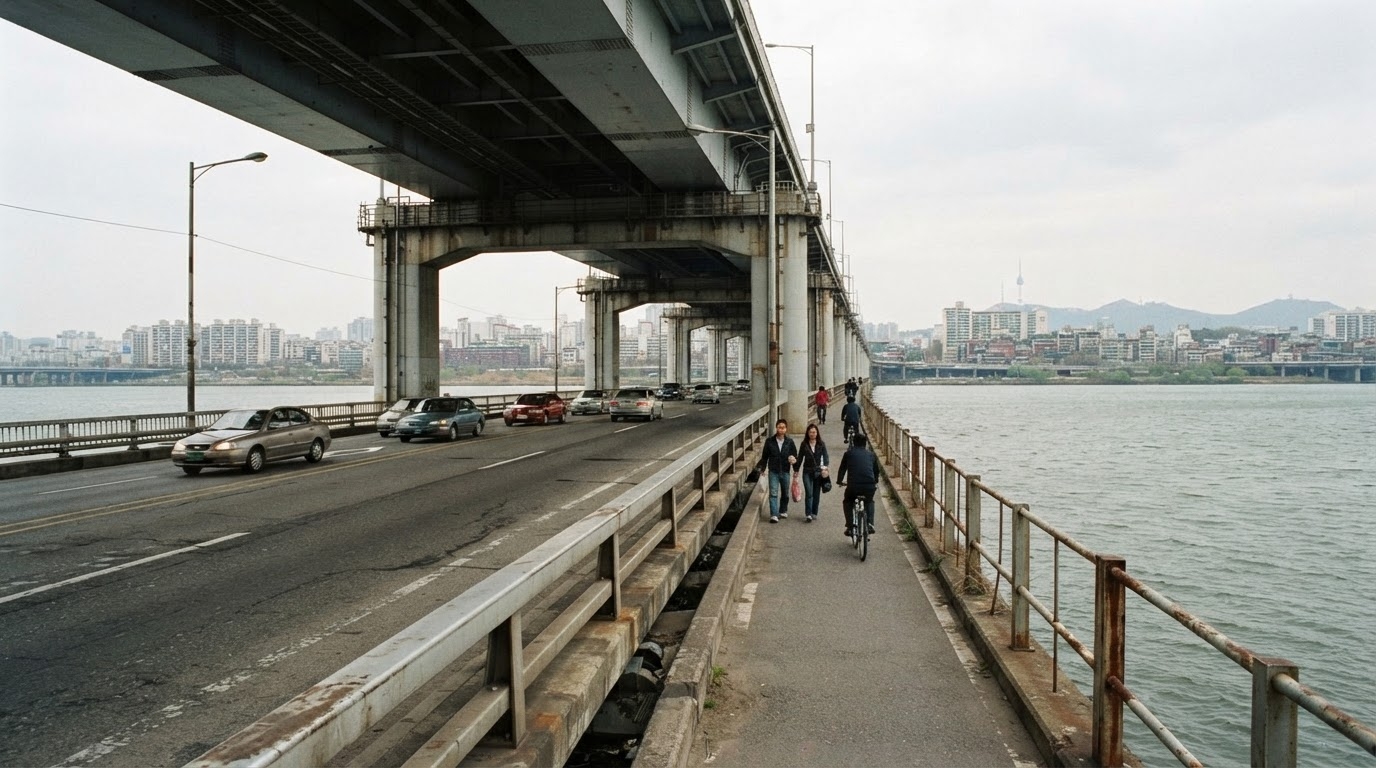
In 2008, Jamsu Bridge converted two of its four original lanes into dedicated spaces for pedestrians and bicycles. Vehicular traffic wasn’t completely removed from the bridge, but a portion of the road was reallocated to other users. From then on, Jamsu Bridge worked as a route for cars while also serving as a path for walking and cycling. For visitors to the Banpo Hangang Park area, this created an accessible way to experience the river up close.
It helps to distinguish between a partial and a complete transformation. Converting some lanes into pedestrian spaces creates areas for walking, but cars still cross the bridge. That means vehicular traffic still has to be factored into any decisions about how the whole road is used. So the changes that followed weren’t simply about widening a walkway a bit more. They were a choice about whether to anchor the bridge’s main function in moving vehicles, or in walking and staying.
Through this process, the way people see Jamsu Bridge naturally shifts. A corridor built for crossing the river quickly and a destination built for taking in the water are very different experiences, even within the same physical space. For a visitor, knowing which path to follow and where they can comfortably pause is more useful than just being told the view is nice. The partial pedestrianization in 2008 was the step that made this experience possible, even though the bridge still had to be shared with cars.
The 2026 Decision: Vehicular Traffic Ends and Construction Begins
On October 8, 2026, the Seoul Metropolitan Government announced the transformation of Jamsu Bridge into a fully pedestrian-centric space. Vehicular traffic will be permanently halted starting at midnight on October 26. This is entirely different from temporarily blocking cars for special events. Having started as a car bridge in 1976 and shifted some lanes to pedestrians and cyclists in 2008, the bridge is now moving into a phase where vehicle passage is eliminated altogether. Seen alongside those earlier changes, it becomes clear this is a complete functional overhaul of the bridge, not another incremental adjustment.
However, the day the cars disappear is not the day the new space is finished. Construction, including the expansion of pedestrian decks and repaving, begins this month, and the city plans to wrap it up by August 2027. That means visiting on the 26th won’t give you a finished pedestrian space right away. Safe zones will be kept open so pedestrians and cyclists can still pass through during construction, but the usable paths will need to be checked on-site, based on the ongoing work and signage.
There will also be a period of total restriction. According to a Money Today report covering the city’s announcement, pedestrian and bicycle access will be fully blocked for about a month and a half during the paving work scheduled between May and August 2027. That doesn’t mean the bridge will be closed continuously for all four months, and the specific closure dates still need to be confirmed separately. Bus routes 740 and 405, which used to cross Jamsu Bridge, will be rerouted over the upper Banpo Bridge. Visitors should be careful not to plan their trips based on the old bus routes.
Banpo in 2027: From a Crossing Path to a Place to Stay
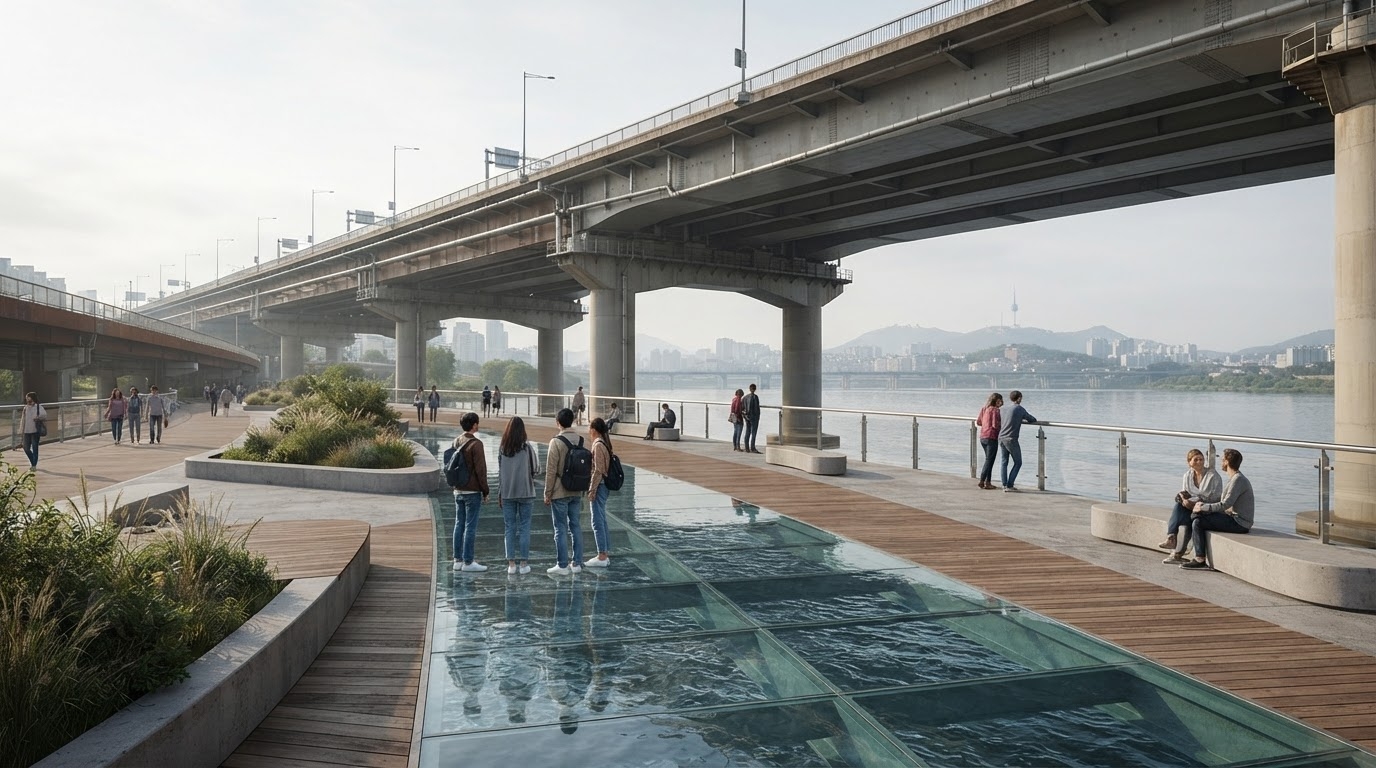
Upon completion, Jamsu Bridge will have 22 viewing areas looking out over the Han River. Transparent decks will be installed in two sections where ships pass below, letting visitors look straight down into the water. These are still plans at the announcement stage, not facilities you can use right now. The design adds spaces for resting and taking in the view to a location that’s already close to the river. What matters here isn’t the number of new attractions. It’s how the environment for pausing and lingering on the bridge changes.
From the perspective of a local guide to the Banpo area, this transformation means the Hangang Park and the bridge no longer have to be treated as separate destinations. The experience of strolling along the riverbank extends onto the bridge, turning it into both a path to the other side and a spot to take in the surroundings. When actually visiting, it’s worth following on-site pathways and safety guidelines.
There are two key dates to keep in mind when planning a visit: October 26, 2026, when vehicular traffic ends, and August 2027, the target for construction completion. In between, there will be walkable construction zones as well as periods of total closure. Jamsu Bridge isn’t turning into a new landmark overnight. It’s an example of an old car bridge being steadily remade into something different. What remains to be seen is how safely and naturally walking and resting fit into the space left behind by the cars.
Sources: Seoul Metropolitan Government Press Release, October 8, 2026, https://www.seoul.go.kr/news/news_report.do?bbsNo=158&nttNo=467847 ; Money Today, October 8, 2026, https://www.mt.co.kr/amp/policy/2026/10/08/2026100813464171741 ; Kyunghyang Shinmun, October 8, 2026, https://www.khan.co.kr/article/202610081414001/amp


