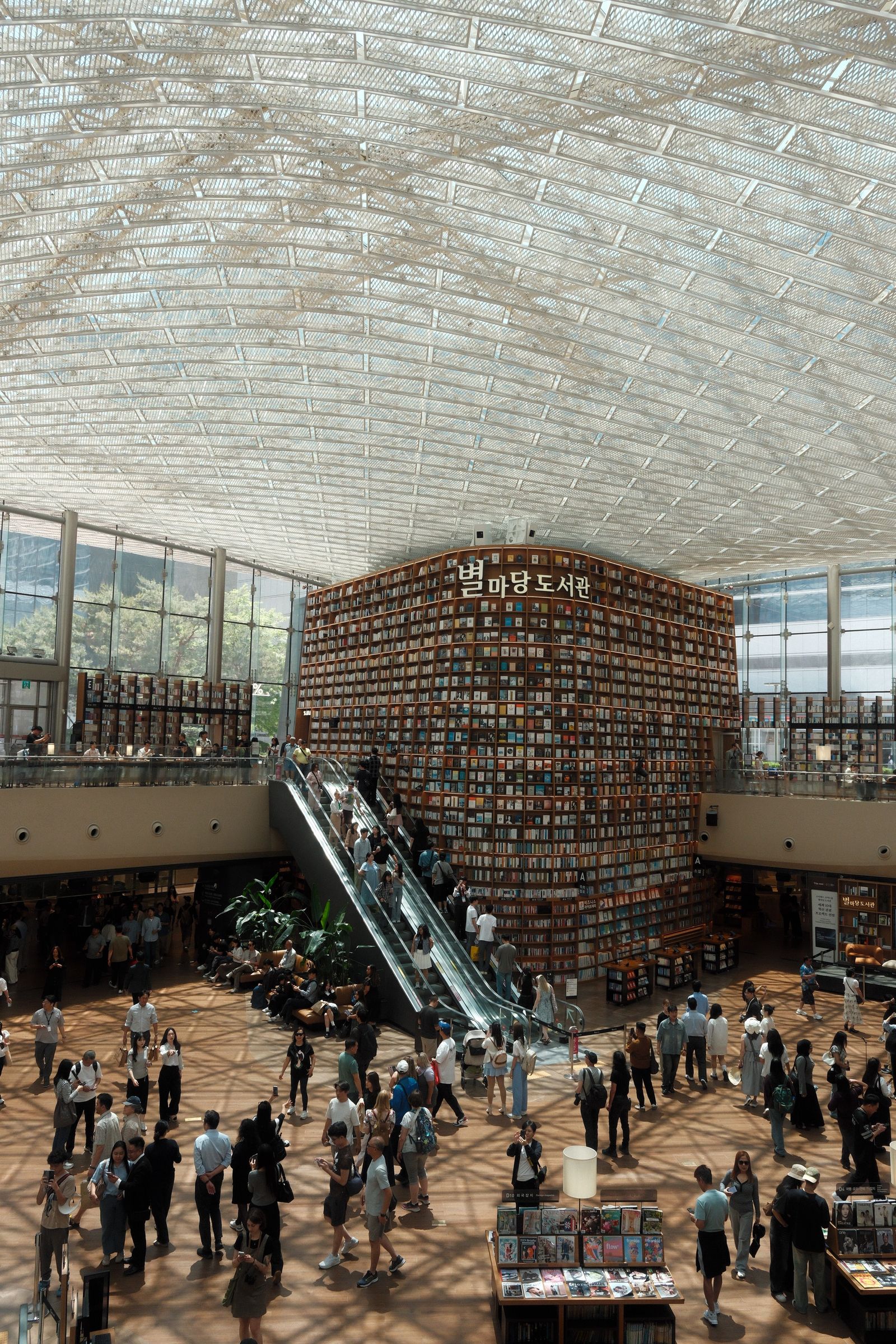
Walk into a Kyobo Book Centre in Seoul this month and the crowd looks different from a few years ago: more people in their 20s, fewer of them just browsing the magazine rack on their way somewhere else, more of them carrying a paperback to the register instead of opening an app. That shift in foot traffic is exactly what shows up in the numbers Kyobo’s own data team put out on June 8, and it points to something more specific than “people are reading more” — fiction, specifically, has taken over the chart, and a chunk of what’s selling isn’t new at all.
According to Kyobo’s “2026 First-Half Bestseller Trends” report, eight of the top 10 titles across all categories this year were novels, up from five of the top 10 over the same period last year, Kyunghyang Shinmun senior reporter Baek Seung-chan reported. Fiction also dominated deeper into the list: 30 of the overall top 100 best-selling books were novels, more than any other category. The number one spot went to Andy Weir’s “Project Hail Mary,” boosted by its film adaptation, followed by Japanese author Suzuki Yui’s “Goethe Said Everything” at number two and singer-turned-novelist Han Rollo’s “Grapefruit Apricot Club” at number three. Rounding out the top seven were “Contradiction,” “I Said Goodbye,” Hermann Hesse’s “Siddhartha” and “My Perfect Funeral.”
Of that list, Siddhartha is the outlier worth pausing on, because it isn’t a new book at all — it’s a decades-old entry in Minumsa’s World Literature Collection, a backlist series that doesn’t typically compete with this year’s new releases. Per Baek’s reporting, its return to bestseller status traces to a specific marketing push: Minumsa’s own YouTube channel, Minumsa TV, has built a dedicated fan following, and a recent video introducing Siddhartha to that audience reignited sales, compounded by what Kyobo describes as a broader “hip Buddhism” trend among younger readers. The effect wasn’t limited to one title — 12 of the top 30 best-selling foreign novels this year came from World Literature Collection-style classics, evidence that publishers reframing old texts as discoverable, YouTube-able content is pulling real sales rather than just generating views.
The other half of the story is where these books are actually being bought. Kyobo’s data shows offline purchases of fiction by readers in their 20s climbing every year — 28.5 percent in 2024, 30.1 percent in 2025, 30.6 percent this year — while every other age bracket has kept shifting toward online buying over the same stretch. Readers in their 20s are now the only group moving in the opposite direction. Kyobo’s own explanation, as quoted by Baek, is that a generation raised on online shopping has started treating reading itself as “a new, hip cultural content category,” making the act of physically going to a bookstore part of the appeal rather than a friction to avoid. That dynamic shows up directly in the offline-only sales chart, where Han Rollo’s “Grapefruit Apricot Club” jumps to number one — Kyobo attributes the gap to the book’s young fandom, who are more likely than older readers to buy it in person rather than order it.
None of this is a one-quarter blip Kyobo expects to fade, at least according to its own forecasting: the retailer told Baek it expects fiction to stay strong through the second half of 2026, pointing to new titles already lined up from Choi Jin-young, Hwang Jung-eun, Pyun Hye-young, Eun Hee-kyung and Bae Su-ah on the Korean side, alongside new work from Haruki Murakami, Yu Hua and Bernard Werber among the foreign authors Korean readers reliably buy in volume.
Put together, the picture is less “Koreans are reading more” than “a specific generation has decided a specific kind of shopping trip is worth taking” — and that decision is dragging an old German novella about a wandering ascetic back onto the same chart as a Hollywood-adapted sci-fi thriller and a pop singer’s debut book. Publishers chasing that 20-something offline shopper now have a clearer playbook than they did a year ago: a YouTube channel with real fan loyalty and a backlist title with the right cultural hook can outsell most new releases, as long as the reader has a reason to walk into the store.
Sources: Baek Seung-chan, “‘독서도 힙하게’···20대가 서점으로, 소설이 베스트셀러 휩쓸었다” (“Reading, Hip Too: Readers in Their 20s Head to Bookstores, Novels Sweep the Bestseller List”), Kyunghyang Shinmun, June 8, 2026, citing Kyobo Book Centre’s “2026 First-Half Bestseller Trends” report.