
Table of Contents
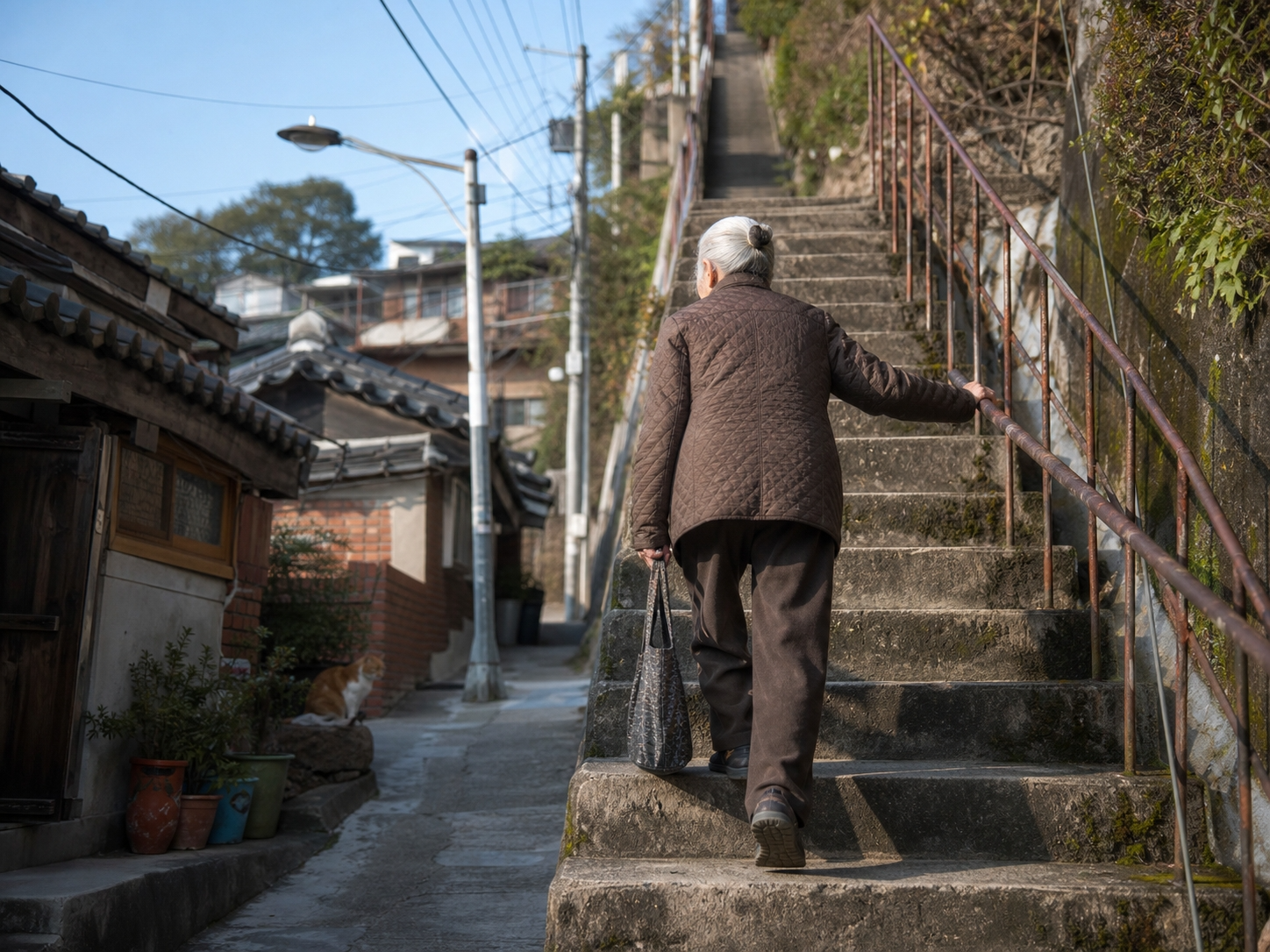
The first thing I noticed climbing the Mujigae Stairs in Junggok-dong wasn’t the view. It was my own breathing. Thirty-seven degrees of incline will do that to you, even on a mild morning. Halfway up, I passed a grandmother resting on a folding stool she’d clearly brought for exactly this purpose, and two kids in school uniforms weaving past her like it was nothing. For them, this staircase is just the way to school. For her, it’s a daily negotiation with gravity.
That gap between “just the commute” and “a daily negotiation” is what Seoul is finally trying to close. In June 2025, the city announced five neighborhoods where it will install elevators and monorail-style lifts to help residents get up and down some of the capital’s steepest terrain. Construction starts in 2026, with completion targeted for December 2027.
The Problem: Why 115-Meter Staircases Matter
Here’s a number that stuck with me: about 40 percent of Seoul’s terrain is hilly enough to demand real physical effort just to move through it. That’s not a quirky geographic footnote. It’s a mobility barrier baked into the map of the city.
The five selected neighborhoods are Junggok-dong in Gwangjin-gu, Hwagok-dong in Gangseo-gu, Bongcheon-dong in Gwanak-gu, Sungin-dong in Jongno-gu, and Sindang-dong in Jung-gu. Each has its own brutal staircase story. The Mujigae Stairs in Junggok-dong hit that 37-degree slope. Near Changsin Station in Sungin-dong, residents climb 115 meters of stairs at a 30-degree grade. In Sindang-dong, the hillside staircase runs 113 meters at over 33 degrees.
In Bongcheon-dong, I heard the practical version of the problem rather than the scenic one: residents told me that reaching the shops near Bongcheon Station meant either tackling the steep stairs or walking more than 200 meters out of the way to avoid them. There’s no elegant workaround. You either climb or you detour.
The stakes go beyond convenience. As of 2023, mobility-vulnerable residents make up 28.3 percent of Seoul’s population — 2.66 million people, counting older adults, people with disabilities, and parents pushing strollers. In Junggok-dong, that same staircase doubles as an elementary school route, and parents have raised safety concerns about it for years.
The Solution: Custom-Fit Elevators, Not One-Size-Fits-All
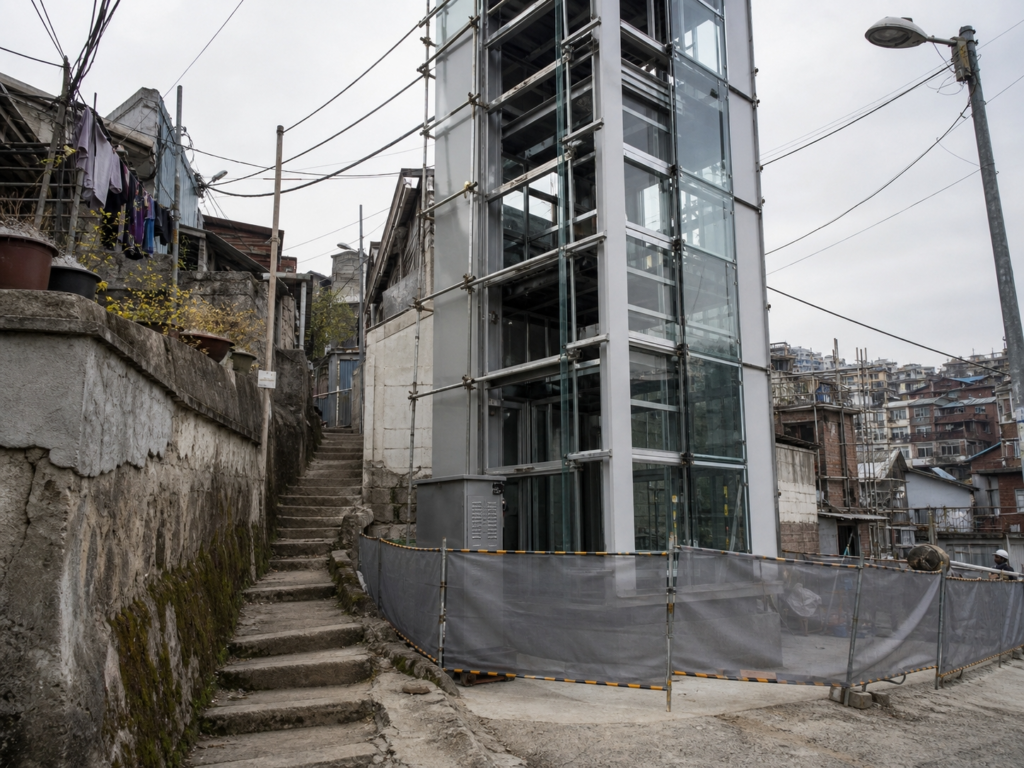
What struck me reading through the plan is that nobody’s bolting a generic elevator box onto a hillside and calling it done. Junggok-dong, Hwagok-dong, and Bongcheon-dong will get vertical elevators. Sungin-dong and Sindang-dong, where the terrain is more irregular, will get inclined elevators shaped to follow the slope itself.
The Sungin-dong elevator will connect Changsin Station to the hillside housing above it, while also making it easier to reach Naksan Park and the Seoul City Wall trail — routes that are popular with hikers but rough going for anyone with knee problems or a stroller. In Sindang-dong, the city is planning something more ambitious: a barrier-free path linking the forest trail at the base of Namsan to the residential area above it, which planners are describing as a new “viewpoint destination” once a deck path is added alongside the elevator.
For the seven older staircases where an elevator simply isn’t structurally possible, the city is instead upgrading what’s already there — handrails, rain covers, non-slip surfaces, and rest areas along the climb. It’s a smaller fix, but it matters for the same reason the elevators do: not every hill can be engineered away, so you make the climb itself safer.
The whole project runs on a budget of roughly 20 billion won, about 15 million dollars. Kim Chang-gyu, head of Seoul’s Balanced Development Headquarters, framed the goal plainly: freedom of movement, he said, should be a right guaranteed equally to everyone, and a city only earns real dignity when everyone can move through it freely.
Seoul’s Gentrification Paradox
Here’s where I’ll be honest instead of cheerful. Making a rundown neighborhood easier to reach has a track record in Seoul, and it isn’t purely a feel-good one.
Look at Sewoon Sangga. When the city launched its “inclusive urban regeneration” project there back in 2015, it built in tenant-protection agreements specifically because planners knew accessibility upgrades tend to invite developers, and developers tend to bring rising rents with them. Even with those safeguards, property values in the surrounding area climbed significantly.
The five-elevator project doesn’t have anything like that built in yet. No tenant protections, no rent stabilization mechanism, no community benefit-sharing plan — at least none that’s been made public so far. To be fair, local tenant groups and resident organizations haven’t raised alarms publicly either, which could mean it’s simply too early, or it could mean nobody’s watching closely yet. Improving a stair-worn commute for an elderly resident is an unambiguous good. Whether that same improvement quietly raises the rent on the apartment she’s lived in for thirty years is a separate question, and right now, nobody’s officially answering it.
The Weight of an Aging City
It’s worth sitting with why this matters beyond five specific staircases. Seoul’s postwar housing boom pushed affordable housing up into hillside neighborhoods, and many of the people who moved in decades ago are still there, older now, still climbing the same stairs that once felt unremarkable. With people 65 and older making up 14.9 percent of the population, and steep terrain covering 40 percent of the city, neighborhood-level accessibility stops being a nice-to-have and starts being closer to basic infrastructure.
What I find genuinely different about this approach is what it isn’t. It isn’t a redevelopment plan that clears out a hillside neighborhood and rebuilds it from scratch — the kind of project that tends to displace the very residents it claims to help. Instead, it’s trying to improve daily mobility inside the neighborhoods as they already exist. That’s a narrower, more modest ambition than a full renewal project, and it’s also probably why the risk of triggering the kind of speculative rush seen elsewhere feels, for now, somewhat lower — though “lower” isn’t “absent.”
Completion, Unfinished
December 2027 will mark five ribbon-cuttings, not five finished stories. An elevator solves the climb. It doesn’t solve what happens to rents once a neighborhood becomes easier to live in, and it doesn’t automatically extend the same relief to the dozens of other steep alleys across Seoul that didn’t make this first list of five.
If you’re in Seoul before these projects wrap, do what I did: walk the Mujigae Stairs in Junggok-dong, or the hillside path in Sindang-dong, before the elevators go in. Time yourself. Notice who’s resting on the way up and who isn’t struggling at all. That gap is exactly what this project is trying to close, and it’s a lot easier to understand a policy once you’ve felt the incline yourself.
Source: Seoul Metropolitan Government Media Hub, June 13, 2025; Seoul Metropolitan Government Official Portal, July 2026.