
Table of Contents
The Landscape of Creation, Told in a Single Number
Before a story emerges into the world, there is usually a very quiet time that precedes it. The writer sits before the screen, revising the first sentence, changing a character’s name, pondering the scene that will hold the reader at the end of the next chapter. But when that quiet time multiplies by roughly ten thousand, it becomes a landscape that can no longer be called an individual’s practice piece. The results of the ‘2026 The Greatest Web Novel Contest on Earth,’ announced on July 22 by Naver Webtoon and Munpia, reveal precisely that landscape. This year, the contest received submissions from May 13 to June 21, gathering over ten thousand works—a figure the organizers say is approximately 35% higher than last year.
Numbers, of course, do not guarantee the quality of a story. But they do reveal what people in a certain era want to write, and through which door they wish to reach their readers. The contest attracted about 7,400 participating authors, among whom 6,600 were newcomers without any paid serialization experience. It is also notable that over 80% of the applicants are in their teens to thirties. Unlike the debut system of the era when manuscript paper was sent by post, the web novel contest has become an entry point that simultaneously considers the serialization platform, reader response, and the potential for webtoon adaptation and media adaptation. The fact that four out of five applicants are complete newcomers without even paid serialization experience shows that this contest functions not as a stage for already proven writers, but as a gateway for those who want to release their stories into the world for the first time.
What the Grand Prize Title Says About the Current State of Genre
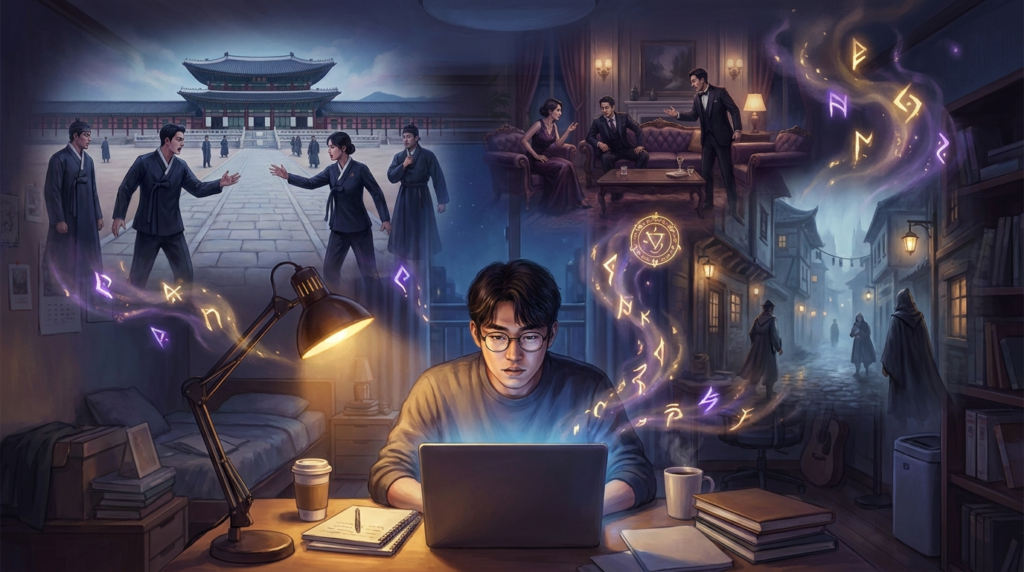
The grand prize went to Pitkong’s ‘Bingui into the Ending of a Makjang Drama.’ Right from the title, it carries the genre grammar familiar to today’s web novel readers. ‘Bingui’ (possessed) refers to a setting where a character enters another world or another narrative, and is a device widely used in Korean web novels, from romance fantasy to modern fantasy and game fantasy. The work is a modern fantasy and alternate history piece that deals with the power struggles and survival of a protagonist who, after being possessed into a character from a makjang drama, finds an unexpected claim to succession when a bomb attack at the ending scene kills key imperial family members. The organizers said it was recognized for its political and business narrative and the completeness of its characters. This combination of alternate history, modern fantasy, and romance is hard to pin down as a single genre, but it is precisely this hybridity that reflects where today’s web novel readers respond.
Here, the Korean word ‘makjang’ (막장) requires a bit of explanation for foreign readers. Originally meaning a dead end, it has now become a term for a drama style marked by extreme twists, exaggerated conflicts, and relationships that defy expectations. But web novels do not stop at merely consuming this familiar stimulus. They take the grammar of a drama that readers already know well and turn it into a world, then reorder power, succession, and post-disaster order within it. To use the familiar as a stepping stone and then show what comes after—that may be a skill that serialized narratives have long possessed.
The Newly Established Wuxia Special Prize and the Return of a Genre
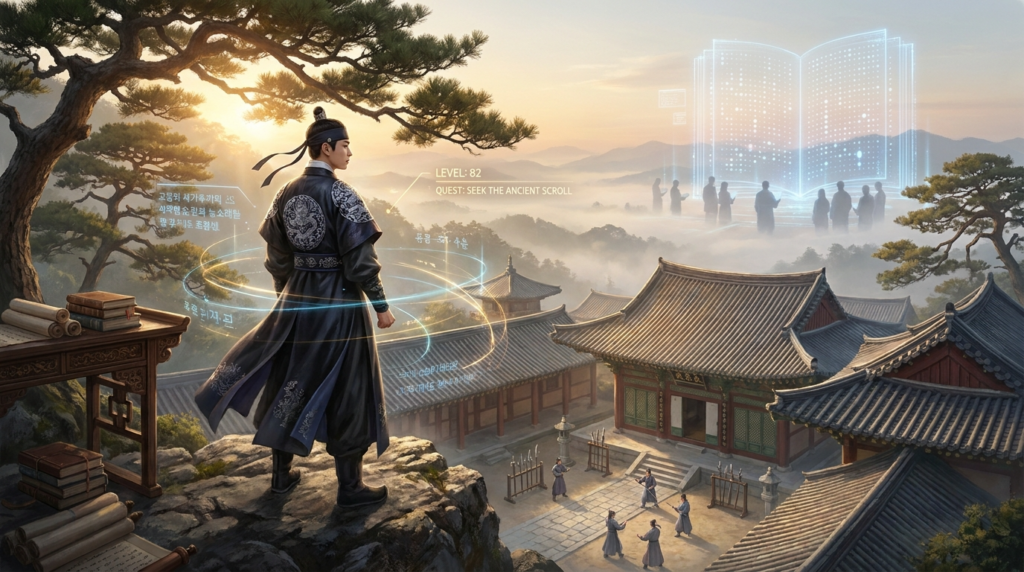
One particularly intriguing part of this year’s results is the establishment of a Wuxia Special Prize. Wuxia (martial arts fiction) shares roots with Chinese wuxia, but in Korea, it has developed its own rhythm over many years through rental shop novels, comics, and online serializations. Vocabulary like ‘munpa’ (sect), ‘gangho’ (martial world), ‘naegong’ (inner energy), and ‘bigip’ (secret manual) may seem like a barrier to unfamiliar readers, but at its core, there is usually a growth narrative of a person finding their place through learning, competition, revenge, and solidarity. This year, the contest received about 1,400 wuxia works, more than double last year’s number, according to the organizers.
The works that received the Wuxia Special Prize are: ‘How a Wanderer Lives in the Martial World’ by Teruchi, ‘Repairing the Immortal Realm with Gacha’ by Seogong, and ‘A Village Boy Grew Up as a Martial Artist’ by Apyeong-a. Even from the titles, one can see a mix of traditional martial world narratives, game-like choices, and growth stories that begin at the frontier. Genres are not fixed exhibits in a museum, but a language that readers reassemble with the sensibility of their time. The fact that wuxia, once considered old-fashioned, has earned a separate category in the contest suggests not that an old genre has disappeared, but that it is being retranslated in the hands of new readers.
The Long Time of Serialization, Beyond the Prize Money
This contest offered a total prize pool of 360 million won, including 100 million won for the grand prize, 30 million won each for three top excellence awards, 10 million won each for ten excellence awards and three wuxia special prizes, and 2 million won each for twenty honourable mentions. The winning works will first be released on Munpia, then expand their serialization to Naver Series, and the grand prize and top excellence works will also be given opportunities for webtoon adaptation on Naver Webtoon. All winning works will receive promotional support and be prioritized for review as one-source-multi-use (OSMU) including media adaptation.
However, the ecology of web novels cannot be explained solely by the prize money and contract possibilities of a contest. Unlike publishing a single completed book, web novel writing involves handling reader responses, the platform’s recommendation structure, per-chapter payment, and the rhythm of breaks during serialization. For a writer who must produce the next chapter daily or on a fixed schedule, the narrative becomes both a literary conception and a timetable of labor. The figure of ten thousand submitted works also contains the expectations and anxieties of those preparing to endure that long time.
The Platform Threshold and the Next Chapter of Stories
Naver Webtoon announced in March that it would invest over 70 billion won this year in discovering works and supporting creators, and Munpia also runs programs like ‘The Greatest Casting on Earth’ that support promotions from the early stages of serialization. Such support can become a crucial first step for newcomers. However, the more deeply platforms become involved in discovery, distribution, promotion, and review of secondary works, the more carefully the contract terms, revenue sharing, and sustainable serialization environment must be discussed. The fact that many works were submitted speaks to the market’s vitality, but it does not automatically mean that many writers can remain stable.
Nevertheless, this contest once again makes clear that the Korean web novel is still a genre waiting for new voices. Of the ten thousand manuscripts, 37 works were selected as winners, but the unpublished manuscripts may also find their way under other names and to other serialization venues. In the world of web novels, the end of one work often becomes the first chapter of the next. Right now, ‘Bingui into the Ending of a Makjang Drama’ has received the grand prize, but what readers will watch for longer is whether that work, through the time of serialization and webtoon adaptation, will meet its readers, and which of the 6,600 newcomers will write the next sentence all the way to the end.
Source: Naver Webtoon and Munpia press releases, July 22, 2026.