
Table of Contents
What the Numbers Reveal About a Shifting Conversation
By now, it’s hardly news that artificial intelligence has woven itself into daily life. What’s more interesting is how the substance of that conversation is changing. According to the “2026 Sociocultural Trends” report released by Korea’s Ministry of Culture, Sports and Tourism on December 31, 2025, an analysis of 538 million pieces of online data collected from news, social media, online communities, and video platforms between January and November 2025 found that online mentions of artificial intelligence rose 44% year-on-year. That the volume of mentions grew is unsurprising in itself — what’s telling is which words grew alongside it.
The ministry said it extracted roughly 74,000 core keywords from the collected data. Among terms co-occurring with “artificial intelligence,” the ones that climbed fastest were security (up 220.4%), policy (up 147.5%), and regulation (up 109.1%) — growth rates far outpacing the 44% rise in AI mentions overall.
From “How Do I Use This” to “How Do We Manage This”
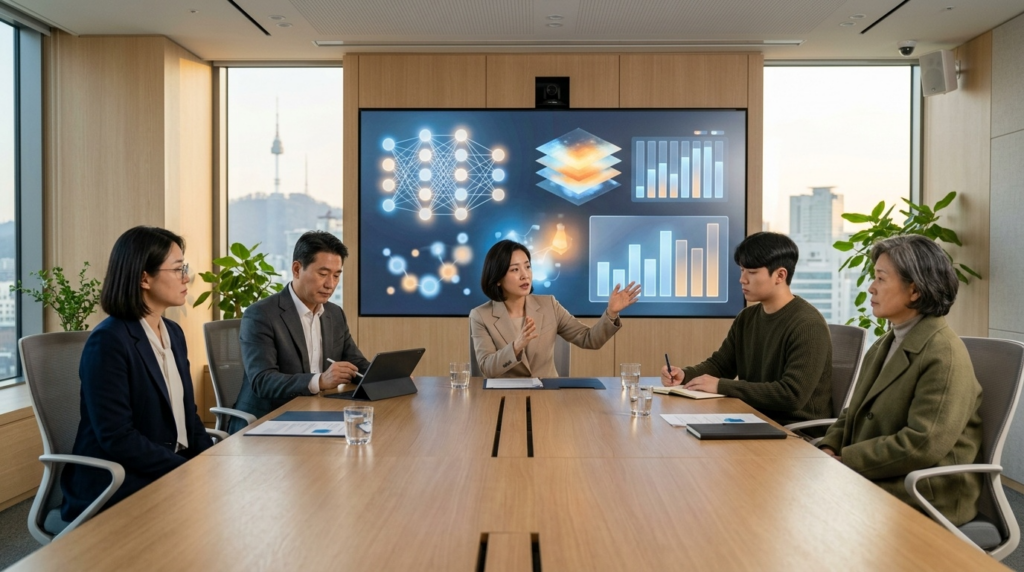
What these figures point to is simple: the center of gravity in how the public talks about AI is shifting from “how do I use this” to “how do we keep this under control.” The ministry described the phenomenon this way: “It shows that while people are embracing AI’s convenience and potential, they are simultaneously grappling with its effects on jobs, safety, and fairness.”
This is a different story from the earlier trend of rising corporate AI adoption rates that has been covered before. Adoption-rate statistics measured how quickly companies were embracing AI. This new data, by contrast, shows how public reaction is forming around that pace of expansion — the faster the spread, the louder the calls for control, and that dynamic shows up directly in the discourse data.
A Structure Where Institutions Are Playing Catch-Up
That security, policy, and regulation all surged together is itself significant. Each word carries a different layer of concern: security reflects anxiety about the technology’s inherent risks, policy reflects interest in how the government will respond, and regulation reflects demand for actual legal and institutional mechanisms. All three rising in tandem suggests public concern isn’t forming along a single track but taking shape across multiple layers at once.
Behind this shift appears to be a growing recognition that AI has already begun directly affecting concrete areas of daily life — jobs, safety, fairness. When a technology remains an abstract, future-facing topic, interest in how to use it tends to lead. But once it starts penetrating deeply into the actual labor market and everyday life, questions about how to manage its impact inevitably follow.
The Ministry’s Bigger Frame: a ‘Human-Centered Shift’
The ministry classified this trend as one of six major sociocultural currents under the name “A Human-Centered Shift After AI.” For 2026 as a whole, it proposed the overarching keyword “K-Society: From Recovery to Adaptation” — a diagnosis that Korea has moved past simply trying to return to a pre-crisis normal, and has entered a phase of reshaping how people live around the changed environment itself.
The report was released on December 31, 2025, drawing on cumulative online data from January through November of that year to forecast the sociocultural currents of 2026. Worth flagging: the data collection period, the release date, and the year being forecast are three different points in time.
What to Watch Next
This data has its limits — it only captures mention volume through November 2025. Whether the rising interest in regulation and security actually translates into legislation or institutional change is something only future data releases can confirm. Still, judging purely from the growth rates, Korea’s public conversation about AI already appears to have moved past the stage of simple use and into a stage centered on control and management. How closely that shift in tone keeps pace with actual policy discussions is the next thing worth watching.
Source: Ministry of Culture, Sports and Tourism, “Korea’s 2026 Sociocultural Trends: ‘From Recovery to Adaptation'” press release, December 31, 2025.