
Table of Contents
Corporate Benefits Are Expanding to Include Mental Health
Corporate benefits in Korea have long been described around a set of fairly visible line items: housing assistance, meals, medical costs, tuition support for employees’ children, vacation time. More recently, psychological counseling, stress management, and mental health education have started appearing on that list with increasing frequency. Behind the shift is a growing recognition that depression, anxiety, and difficulty in interpersonal relationships don’t stay confined to an employee’s private life — they carry over into work focus, relationships within an organization, and workplace safety. It’s now common to see major companies’ sustainability reports introduce mental health programs alongside sections on employee health and safety, human rights, and welfare.
None of this means counseling automatically resolves turnover or organizational conflict. Opening a single counseling office doesn’t make workplace problems, poor decision-making, or tension in office relationships disappear. What is clear, though, is that companies are moving away from treating an employee’s psychological struggles as something the individual has to handle entirely alone, and toward building support systems that are actually accessible. What matters more than a program’s polished branding is whether employees can genuinely use it, whether confidentiality is protected, and whether the organization is willing to fix the underlying issue once it’s identified.
Samsung Electronics Runs Counseling Infrastructure at Home and Abroad
Samsung Electronics has said it operates a combined 30 in-house psychological counseling centers and mental health clinics domestically to manage employees’ psychological wellbeing. Overseas, the company has introduced 29 in-house counseling centers, concentrated around its manufacturing sites and research facilities. It also runs mental health promotion programs and career-stage-specific mental health education. For a company with large operations spread across multiple regions, this reads as an attempt to improve the physical accessibility of counseling rather than centralizing it in one location.
The advantage of an in-house counseling system is that it gives employees a channel for support before they have to seek out a hospital or an outside institution on their own. For people who find in-person counseling intimidating, phone, video, or online-based access points can matter even more. But an internal system only works if trust is already in place. If employees suspect that what they say in a counseling session could affect their performance review or job placement, they will avoid using it. Companies need to be explicit about the independence of the counseling process, how records are handled, and how personal information is protected. A sense that the service is safe to use matters more than simply pushing up utilization numbers.
Kakao’s ‘Talk Terrace’ Combines a Physical Space With a Program
Kakao operates a meditation and professional counseling space for employees called “Talk Terrace.” According to the company’s official materials, Talk Terrace offers professional counseling addressing stress that comes from interpersonal relationships, work, and career concerns, alongside mindfulness meditation programs. The company also supports self-assessment tools so employees can check in on their own psychological state, and provides mental health guides that include comprehensive, individual-factor, and in-depth reports.
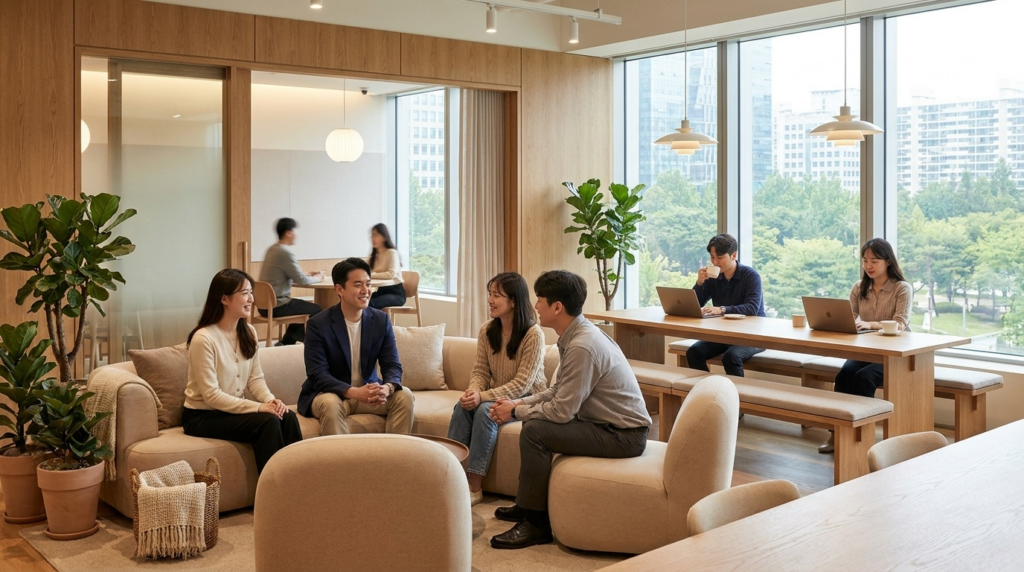
What distinguishes this kind of model is that it treats counseling as part of everyday maintenance rather than a service reserved only for a crisis. The assumption that only people in serious distress need to seek help tends to delay people from asking for it in the first place. Lower-barrier programs — meditation, stress check-ins, short counseling sessions — can lower that threshold. That said, having the physical space doesn’t guarantee every employee will feel comfortable using it. During busy periods, it can be hard to carve out time for a session, and if a team’s culture treats rest or psychological support as a sign of individual weakness, the program can end up existing in name only.
The ‘Social’ Pillar of ESG Now Extends to Psychological Safety
Within ESG — environmental, social, and governance — employee mental health mostly falls under the social pillar’s set of concerns. It sits alongside industrial accident prevention, diversity and inclusion, human rights protection, and improving working conditions, all part of the broader question of what environment a company provides for the people who work there. A May 2026 Seoul Economic Daily analysis of materials from five companies — Samsung Electronics, SK Hynix, Hyundai Motor, Naver, and Kakao — found that each operates some form of mental health management program that includes psychological counseling.
Still, a program being listed in an ESG report and a program being genuinely effective are two different questions. What matters is how often counseling is offered, how easy the process is to use, whether there’s a link to outside professional institutions, how the company responds in a crisis situation, whether managers receive training, and whether organizational culture itself is improving. If psychological distress stems from structural issues — excessive workload, harassment, discrimination, unstable employment — individual counseling alone has real limits. Counseling can be a starting point for looking at a problem, but it can’t substitute for changing the environment that produced the problem in the first place.
The Psychological Wellness Gap Can Widen Along Company Size
The expansion of counseling systems at large corporations doesn’t automatically translate into a shift across the entire labor market. The Seoul Economic Daily report notes that a large share of Korean companies are small operations, and that access to welfare services like psychological counseling can vary sharply by company size. The gap between a company that can afford to build a dedicated counseling space and hire specialized staff, and one that can’t, doesn’t close easily. The result can be a structure where the scope of mental health support an employee receives depends less on the nature of their job and more on which company happens to employ them.
The next challenge for corporate psychological wellness isn’t simply promoting these programs more widely. It requires guaranteeing confidentiality, having managers and colleagues respect requests for help, connecting employees to outside medical and counseling systems when necessary, and following through on fixing problems once they’re identified. Samsung Electronics’ counseling infrastructure and Kakao’s Talk Terrace are signs that companies have started treating mental health as a genuine welfare agenda. The indicator worth watching from here isn’t how many counseling rooms get built — it’s whether the system is actually trusted in employees’ day-to-day working lives.
Source: Samsung Electronics sustainability management materials; Kakao, “Kakao’s Working Culture and Welfare”; Seoul Economic Daily, May 7, 2026.