
Table of Contents
Nongshin Is the First Team to Reach the Final
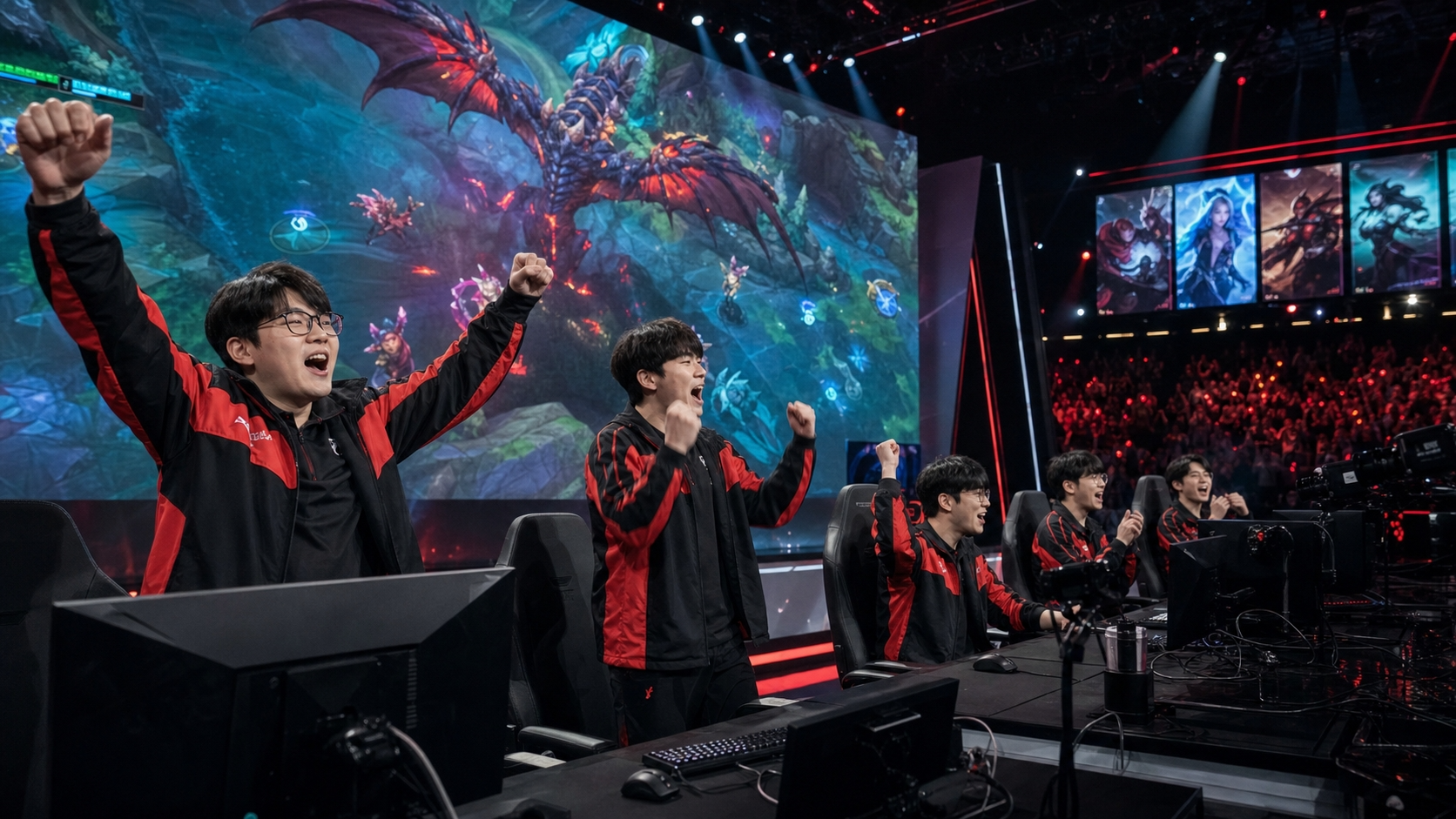
It’s easy to assume the regular-season power rankings carry over directly into a short tournament. The 2026 League of Legends KeSPA Cup has repeatedly unsettled that assumption. Nongshin RedForce beat T1 2-1 in the first round of Final Stage 1 on August 3. The win sent Nongshin straight into the Final Stage 2 final, making it the first of the ten LCK teams in the competition to lock in a spot in the ultimate final.
The context around the match matters too. This year’s tournament allowed combined rosters mixing first and second teams, and T1 fielded a lineup built mostly around its second team that day. Even so, the start didn’t favor Nongshin. T1 took control of the early skirmishes in Game 1 and held off Nongshin’s push, winning the kill count 26-18. Under a best-of-three format, a team that drops the first game has to win both of the remaining games.
Diable’s Lucian and Kingen’s Olaf
In Game 2, bot laner Diable Nam Dae-geun’s Lucian took center stage. Nongshin repeatedly came out ahead in the key fights and won the kill count 21-15, pushing the series to a decisive third game. What mattered wasn’t just that T1 seized the early momentum — it was how quickly Nongshin adjusted its approach right after the loss. It was a scene that showed exactly the kind of pressure a cup format puts on teams: they have to produce a fix in a short break between games.
T1 again grabbed the early initiative in Game 3, but Nongshin turned the tide in the mid-game objective fights. Top laner Kingen Hwang Seong-hun’s Olaf played a decisive role in the fight over the Fire Dragon that ended up deciding the game. Nongshin again put up a kill count of 21-15, completing the comeback. What decided the outcome wasn’t that the final kill counts matched in Games 2 and 3 — it was the decision to narrow the deciding moments down to the fights around objectives.
Hanwha Life Also Swept Gen.G 2-0
An earlier match the same day produced an equally lopsided result. Hanwha Life Esports beat Gen.G 2-0. In Game 1, after banking an advantage from early bot-lane and scuttle-crab skirmishes, Buffing Park Gyu-yong’s Camille got involved across multiple parts of the map to rack up kills, and Hanwha Life won 23-4. In Game 2, Pyeonsik Pyeon Min-gi’s Lucian became the center of the fighting, and the final kill count came to 30-11.
Hanwha Life’s win, though, didn’t mean the same trip straight to the final that Nongshin got. Final Stage 1 runs on a modified Swiss format, where each round splits into winners who advance and losers who drop. Nongshin had been seeded into a direct-to-final match as the No. 1 seed from its group and won it, punching its ticket immediately. Hanwha Life still had another round to play. And in fact, Hanwha Life lost to T1 1-2 the next day, pushing its own advancement back.
Why Summer Cup Tournaments Carry More Variance
The KeSPA Cup isn’t a regular season that averages results out over a long stretch. Several stages run back-to-back in a short window, and a single draft decision or objective fight can redirect an entire team’s path. Players and coaching staff also have relatively limited time to break down an opponent’s recent games. A team that looks stable across the regular season isn’t automatically favored here — the team that adapts fastest to a specific patch and that day’s matchup can go further.
The roster rules add another variable. Most teams entered this year’s tournament with combined first- and second-team rosters, widening the room to test rookies. Much like Haetae Sim Su-hyeon’s Jayce and Guti Moon Jeong-hwan’s Galio in Game 1 against T1, a player who’s relatively unfamiliar to fans can end up taking a game. The structure ends up reflecting the sum of a day’s specific lineup and a short series’ in-game adaptability more than a team’s regular-season name value.
What to Watch For in Daejeon on August 18
Nongshin now needs just one more win for the title. The final is set for August 18 at the Daejeon Esports Stadium in Yuseong-gu, Daejeon. The earlier matches of Final Stage 2 run online on August 11, followed by offline matches in Daejeon on August 17 and 18. Nongshin also picked up a scheduling advantage: it can wait for its final opponent while the other teams fight for survival.
Still, being first to the final and being favored to win it aren’t the same measure. The long break gives Nongshin time to scout its opponent, but it also risks a drop in in-game sharpness. Whether Nongshin can reproduce the mid-game objective decisions it showed against T1 in the final — and how its opponent tries to shut that down — is the thing to watch. Since both teams are likely to field their strongest lineups in the final, the weight of matchups and rosters will look different too.
Source: Korea e-Sports Association tournament notice, July 2026; Roh Hee-ju, Etoday, August 4, 2026.