
Table of Contents
Before spice level, there’s something Buldak Bokkeummyeon and Shin Ramyun have to prove to land in a Muslim shopper’s cart: halal certification, meaning everything from ingredients to production, storage, and distribution lines up with Islamic law.
This Time, We’re Looking at How It Got In, Not How Much It Sold
Korea’s agri-food and livestock product exports came to $3.5834 billion between January and April 2026, up 4.7% year over year. Within that, exports to the six Gulf Cooperation Council (GCC) countries hit $159.7 million, up 37.6%. That roughly 38% figure is specifically for the GCC bloc — Saudi Arabia, the UAE, and others — not the Middle East as a whole.
Ramyeon exports worldwide over the same period reached $616.6 million, up 28.9%. That doesn’t mean you can just ship the same export packaging straight to a Middle Eastern supermarket shelf, though. For Muslim shoppers to buy with confidence and for local distributors to formally carry the product, it has to meet halal standards.
This piece follows up on “K-Ramyeon’s Overseas Sales Are Closing In on 5 Trillion Won,” published August 3, 2026. Where that story covered export revenue and product buzz, this one zeroes in on halal certification, the market-entry mechanism that makes that revenue possible in the first place.
Halal Certification Isn’t Just About Leaving Out Pork
“Halal” is Arabic for “permitted.” For food, that means no pork, no blood, no meat that wasn’t slaughtered the Islamic way, and no alcohol that isn’t permitted. For a processed food with as many ingredients as ramyeon, the scope of what gets checked is much wider.
Certifiers have to trace the source and manufacturing process of the flavor oils, meat extracts, emulsifiers, enzymes, and seasoning powders that go into the noodles and soup base. Suppliers may be asked for raw material verification documents, process flow diagrams, and test reports. If any animal-derived ingredient is used, its source and how the animal was slaughtered get checked too.
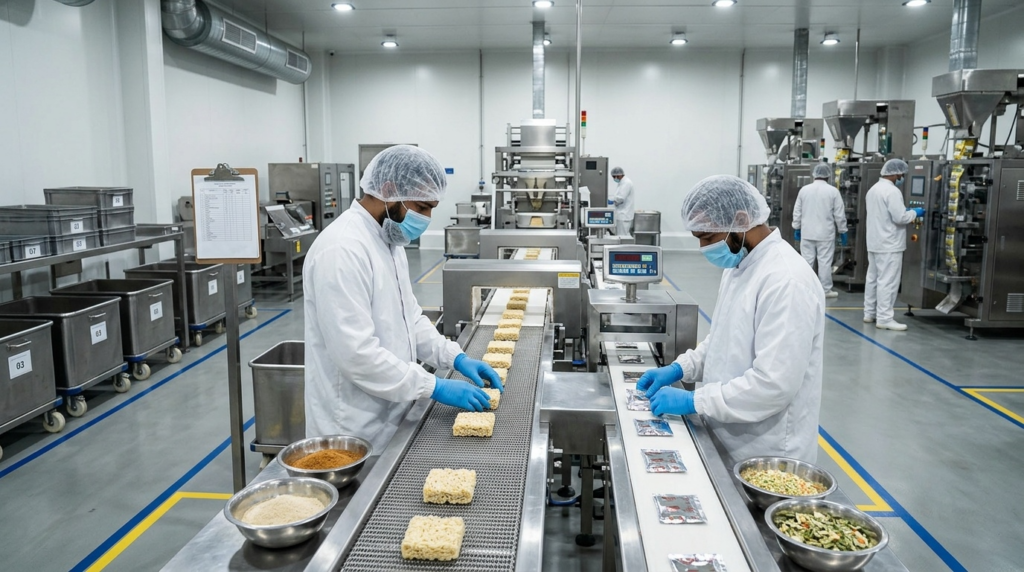
Passing the paperwork review isn’t the end of it. Raw material intake, storage, weighing, manufacturing, and finished-product shipping all have to stay separate from non-halal products. Equipment, tools, even transport containers need to be kept apart, and worker hygiene management gets inspected too. Depending on the certifying body and export country, regular renewal and on-site monitoring are also required.
Nongshim Built a Dedicated Halal Line at Its Busan Plant
Nongshim converted part of its Busan plant into a dedicated halal production line back in 2011. Starting with Shin Ramyun, it has secured halal certification for 46 ramyeon products, including Ansung Tangmyun, Neoguri, and Chapagetti, and sells them across some 40 countries, including Malaysia, Indonesia, and Saudi Arabia.
The approach keeps the original taste while swapping out any animal-derived ingredients that don’t meet halal standards and using raw materials processed the permitted way. Running a dedicated line is also about cutting down the risk of cross-contamination with non-halal food made on the same equipment.
Samyang Foods got its certification from the Korea Muslim Federation (KMF) in 2014, then became the first Korean ramyeon maker to earn certification from Indonesia’s Ulama Council (MUI, as it was known at the time) in 2017. The review of its ingredient labels, manufacturing process, and distribution chain took about a year. Building on a halal lineup that includes its Buldak Bokkeummyeon line, the company expanded business in Malaysia and Indonesia, and signed an exclusive supply deal with a UAE distributor in 2021.
The exact product count can shift depending on when it’s tallied and how certification scope is defined. Samyang’s numbers, for instance, have been reported as either 22 export products or 23 KMF-certified products depending on the source, so it’s worth checking country-specific certificates for what’s currently valid.
One Certification Doesn’t Get You Into Every Muslim-Majority Country
The global Muslim population is estimated at around 2 billion. According to Pew Research Center, Muslims made up 25.6% of the world’s population in 2020, up 347 million from 2010. But that “2-billion-person market” isn’t one single market.
Countries recognize different bodies and procedures — Korea’s KMF, Malaysia’s JAKIM, Indonesia’s BPJPH and MUI systems, and so on. Companies also have to check whether certification earned at home is automatically recognized in the export destination. Beyond per-product certification, they may also need production facility registration, local-language labeling, importer licenses, and customs paperwork.
So in practice, companies start by picking a target country, then identifying which certifying body the local government recognizes. From there, they review the raw material supply chain, adjust recipes, separate production and storage areas, and go through document and on-site review. Even after certification, if a raw material or supplier changes, they have to report the change and prepare for re-review.

The Halal Mark Is a Small Piece of Export Infrastructure Printed on a Ramyeon Bag
That 37.6% growth in GCC agri-food exports points to real growth potential. At the same time, ramyeon exports to the GCC region actually fell 35.9% year over year in March and April of 2026, hit by war and logistics instability. Getting certified doesn’t make demand and logistics risk disappear.
Even so, halal certification widens the distribution channels available to a product. Big-box stores, convenience stores, and online retailers can confirm religious compliance, and shoppers can buy an unfamiliar Korean product without having to research every single ingredient themselves. For companies, it also becomes a foundation for expanding certification from ramyeon into sauces, snacks, and frozen foods.
If Buldak’s spice level is what gets someone to buy it the first time, halal certification is the trust mechanism that lets it stick around as part of a Muslim household’s everyday food. K-ramyeon’s next stretch of growth depends not just on export revenue, but on how carefully companies manage ingredient sheets, production lines, and local certifying bodies.
Source: Herald Economy, May 21, 2026; Etoday, August 5, 2026; Pew Research Center, June 9, 2025.