
Table of Contents
A Classroom Carrying Sejong’s Name Is Spreading Across the World
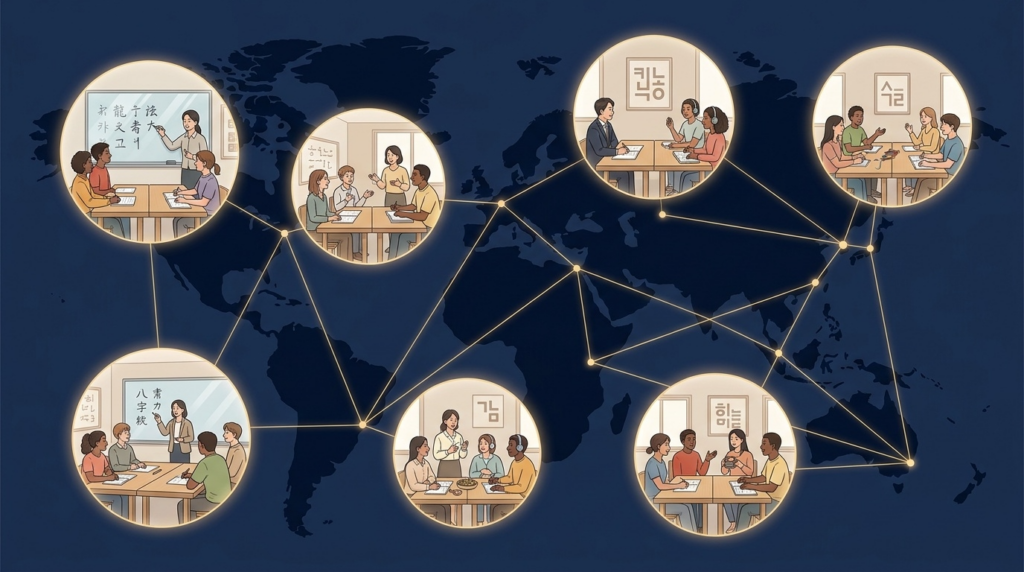
In 2026, five hundred and eighty years after King Sejong promulgated Hangeul, his name has outgrown its place in a royal temple title and is being written again on classroom doors around the world. Sejong Hakdang — the Sejong Institute — is the network of government-backed Korean language and culture schools that Korea operates abroad, a public education system built to introduce learners meeting the language for the first time not only to its script and grammar but to the everyday life and culture the language carries with it.
President Lee Jae-myung has laid out a plan to substantially expand the number of Sejong Institutes worldwide by 2030, working with governments abroad to also grow Korean-language classes in elementary and secondary schools and Korean courses at universities overseas. The premise is that interest in Korean popular culture, once it grows into study, tends to lead somewhere further — into overseas study, employment, and long-term academic research — and that trajectory is what the government wants to build durable educational infrastructure for, rather than treating it as a one-off Hallyu event.
A Correction on the Opening Ceremony’s Date and Who Actually Attended
A detail worth correcting before it spreads any further: the opening ceremony of the World Korean Educators Conference was not an event scheduled for August 13 — it was already held on July 13, in the Grand Ballroom of COEX in Seoul. Nor did President Lee attend the venue in person. Culture Minister Choi Hwi-young read a written congratulatory address on the president’s behalf, and it was in that address that the vision for expanding the Sejong Institutes and supporting Korean-language education abroad was laid out.
The conference, jointly hosted by the Ministry of Culture, Sports and Tourism, the Ministry of Education, the Ministry of Foreign Affairs, and the Overseas Koreans Agency, drew roughly 550 Korean-language educators from around the world. It was the first time in nine years that the separate teacher-training programs run by each ministry had been folded into a single event, and once the joint session concluded, more specialized training continued by institution. The Sejong Institute teacher training track alone brought together 209 instructors from 125 institutes across 56 countries.
From 273 Institutes Toward a Target of 360
As of June 2026, there are 273 Sejong Institutes worldwide, staffed by 1,163 working instructors. The Sejong Institute Foundation had already set a mid-to-long-term target of expanding that number to 360 institutes by 2030. The president’s address, rather than restating a specific final figure, emphasized the policy direction of “substantial expansion” — which means the actual scale of growth will have to be confirmed year by year, through designation results and budget allocations.
Growing the number of institutes is not simply a matter of adding more dots to a map. A new operating institution is designated only after document review, an on-the-ground inspection, and a final screening, and once designated, it receives a budget along with dispatched or trained instructors and teaching materials. Even when a local university or cultural institution supplies the classroom itself, an institute only becomes sustainable once instructors, textbooks, evaluation methods, and administrative systems capable of maintaining educational quality are all in place alongside it.
The foundation also draws on what it calls “linked Sejong Institutes,” where an established institution helps a new one get running, and “collaborative Sejong Institutes,” which bring in local governments and overseas diplomatic missions as partners. Rather than exporting a single model unilaterally from Korea, the approach is closer to connecting the experience and local networks an institution has already built to whichever institute is newly getting started.
The Reasons for Learning Korean Are Changing
If the first question in an overseas Korean class once tended to be which Korean singer a student liked, the same classroom today seats learners aiming at admission to a Korean university, employment, tasks at their own workplace, or simply conversation with family. As interest that began as enjoyment migrates into the language of everyday life, it generates a kind of educational demand that beginner conversation alone can no longer satisfy.
That is also why the government’s plan mentions elementary, secondary, and university programs abroad in the same breath as the Sejong Institutes. Where a Sejong Institute functions as a point of access for the general adult public and local residents, a Korean-language class inside a regular school becomes the channel through which a younger learner studies the language over many years. University courses handle major-specific instruction, research, and preparation for study abroad, while Hangeul schools become the space where the next generation of overseas Koreans stays connected to its roots and language.
These several kinds of institutions look similar from a distance, but their audiences and purposes differ. The expansion of the Sejong Institutes should not, then, be read as a policy to fold every overseas Korean-language institution into one. The core of this vision is to connect these separate educational networks to one another while still preserving what each one is for.
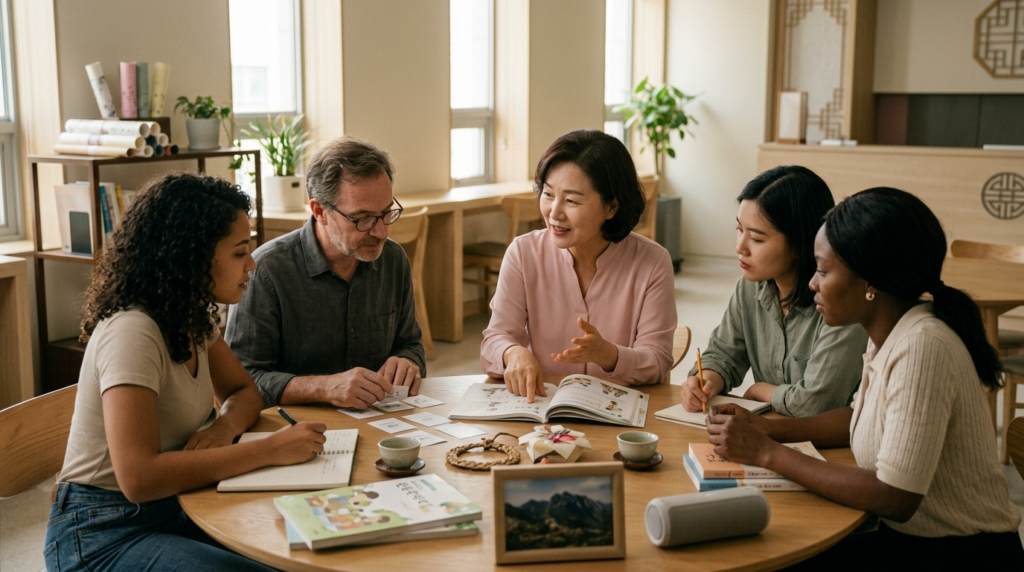
After the Expansion, the Question Becomes the Classroom’s Depth
The count of institutes is the simplest number by which to display policy achievement, but a number alone cannot say whether a learner who finishes one term goes on to the next, whether instructors keep teaching with any stability, or whether textbooks and evaluations suited to local circumstances actually get delivered. In an age when machine translation has become an everyday tool, in particular, the instructor’s role may matter more, not less — less for supplying the correct answer than for explaining the nuance of a phrase and the cultural context behind it.
What is worth watching through 2030, then, is not only how many new institutes open. It is which regions see their waiting demand actually absorbed, how the number of learners a single instructor is responsible for changes, and whether beginners actually continue on into intermediate and advanced study. A classroom carrying Sejong’s name growing larger will only be complete once it means that more people can go on telling their own stories in Korean, for a long time to come.
Source: Sung Do-hyun, Yonhap News, July 13, 2026; Sejong Institute Foundation, “2026 World Korean Educators Conference Concludes,” July 2026; Sejong Institute Foundation, “Call for Applications: New Sejong Institute Operating Institutions for 2026,” December 2025.