In late May, a video began circulating on Korean social media showing someone removing the green logo from a Starbucks tumbler with two items bought for 2,000 won at a Daiso: nail polish remover and a Magic Eraser sponge. “It feels wasteful to throw out, and weird to keep using as-is, so this way you get a clean cup with no logo and can keep using it,” the poster explained, framing the process as both eco-friendly and, more pointedly, as a way to keep drinking from the cup without the brand attached to it. The clip was re-shared on other forums under the title “스타벅스 불매 레전드” — the Starbucks boycott, legend-tier.
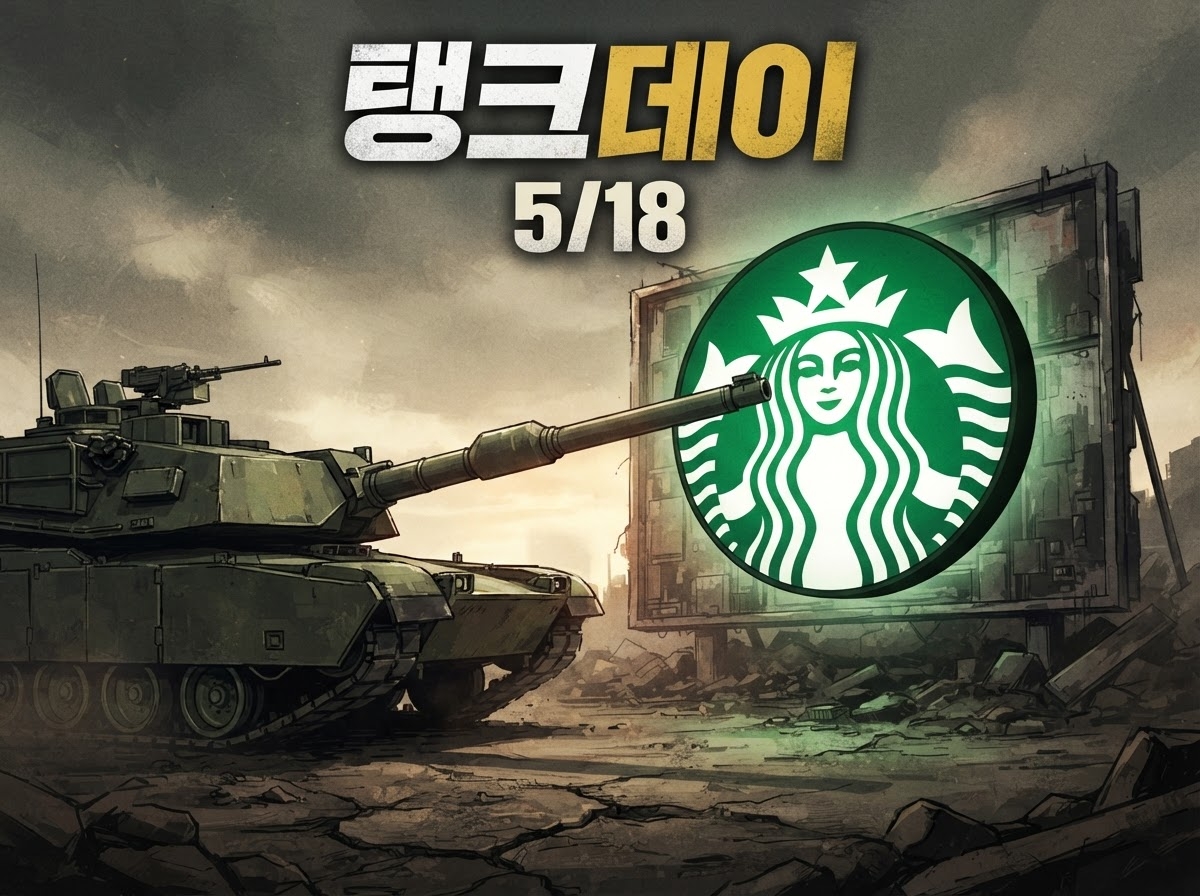
What it was reacting to was a tumbler discount promotion Starbucks Korea ran on May 18 — the anniversary of the 1980 Gwangju Democratization Movement — under slogans including “Tank Day” and “Tak on the desk!” The first phrase echoes the military tanks deployed against Gwangju’s citizens that year; the second references the 1987 phrase police used to cover up the torture death of student activist Park Jong-cheol, claiming an investigator merely struck a desk and Park collapsed from shock. Both references to two of modern Korea’s defining tragedies, used as marketing copy for a coffee discount, set off a backlash that online communities labeled history and human-rights mockery rather than a marketing misstep.
The company’s response escalated over the following month. Starbucks Korea posted apology notices in stores starting June 16, and at 3 p.m. on June 22, all of its roughly 2,160 stores nationwide closed simultaneously and early — the first time the chain has done so since opening its first Korean location at Ewha in 1999, 27 years of continuous operation broken in a single afternoon. Staff then sat through roughly three hours of training: a lecture on “the historical awareness companies should have” from Sungkyunkwan University history professor Oh Je-yeon, a session on “social sensitivity and ethical standards” from sociology professor Koo Jung-woo, and a brand-values workshop. Parent company Shinsegae Group dismissed the Starbucks Korea CEO, and chairman Chung Yong-jin was scheduled to watch the same training video ahead of a June 24 executive meeting.
Beyond the apology theater, Starbucks Korea announced structural changes to how it approves marketing: a mandatory “social sensitivity checklist,” vetted by outside consultants, covering history, anniversaries, politics, disaster, military matters, gender and hate speech; a new sign-off step requiring approval from non-marketing departments like quality and legal; a logging system to track the approval chain; and funding toward historical preservation projects.
The numbers say the apology hasn’t landed yet. Weekly card payments fell from roughly 32.16 billion won the week before the controversy to 23.69 billion won the week after — a 26.3 percent, 8.47-billion-won drop, according to mobile data firm IGAWorks’ Mobile Index, cited in Reportera’s June 24 report. App installs cratered further on a lag: 43,540 new installs in the first week of June fell to 28,484 the second week (down 34.6 percent) and 22,783 the third week (down another 20 percent) — by June 21, new installs were running at less than half of pre-controversy levels, and the Starbucks app’s rank among food-and-beverage membership apps slid from third to tenth to thirteenth across those same three weeks. Payment volume has stayed roughly flat in the 22.7–24.2 billion won range since, with no clear recovery.
Industry analysts reading the data split it into two groups: existing members, anchored by prepaid balances and membership benefits, who haven’t fully walked away, and a new-customer pipeline that has effectively frozen. Marketing specialists quoted in the same coverage were more pointed about the ceiling on recovery, warning that “negative associations tied to history and human-rights issues like Gwangju or Park Jong-cheol’s death don’t recover quickly through discounts or limited-edition merchandise” — a different category of damage than a bad product launch or a pricing complaint.
Sources: Park Yong-min, “스타벅스코리아, ‘탱크데이’ 논란에 전국 2,160개 매장 일제히 문 닫는다,” Reportera, June 22, 2026. Park Yong-min, “‘탱크 데이’ 한 달…스타벅스 앱 신규 설치, 2주 만에 절반으로 쪼그라들었다,” Reportera, June 24, 2026. Han Seung-gon, “‘스타벅스 로고 지워버리자’…’탱크데이’ 논란 후폭풍,” Financial News, May 26, 2026.