Table of Contents
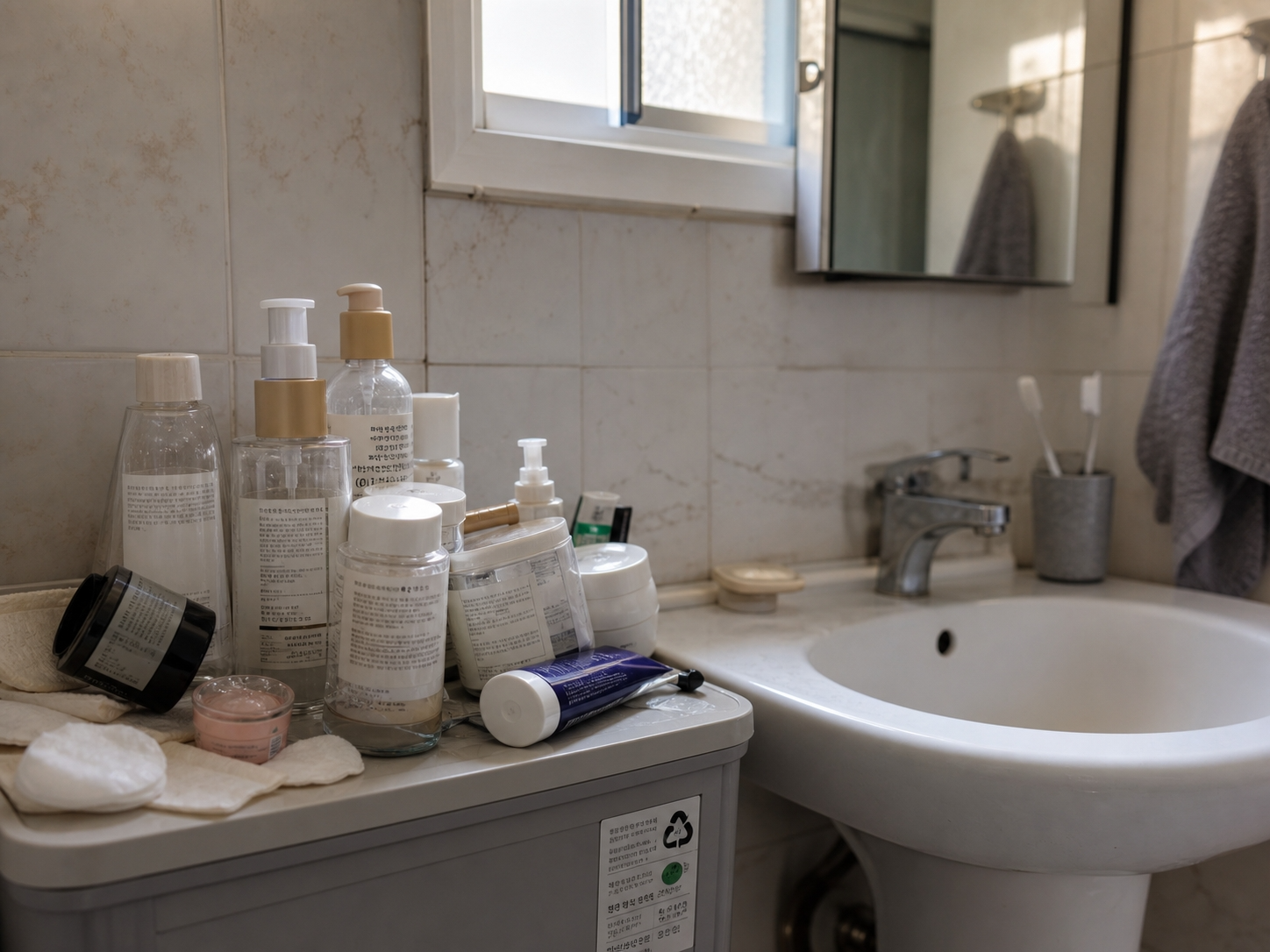
If you’ve ever separated your empty toner bottle from the trash and felt a flash of eco-virtue, you should know that instinct is probably wasted. According to South Korea’s 2020 government assessment, 90% or more of all cosmetic packaging sold in the country is classified as “difficult to recycle” or simply non-recyclable. That standard has been in force since March 2021, so this isn’t an old problem — it’s the current baseline.
The 90% Problem
Here’s a myth worth correcting: people assume glass or “clean” plastic means recyclable. The Korea Environmental Institute found the real issue is design, not material. In 12% of surveyed products, the container itself is five times larger than the amount of product inside it. That oversized jar you loved for its heft on your vanity? It was built to look substantial, not to be sorted at a recycling facility.
Labeling makes this worse. Korea’s Promotion of Saving and Recycling of Resources Act, passed in December 2018, requires manufacturers to mark packaging with one of four recyclability grades. Yet 67% of Korean cosmetics manufacturers still don’t carry compliant labels. A 2024 audit by the Korean Environmental Movement Organization checked products on Olive Young shelves — Korea’s dominant beauty retail chain — and found 89% of samples had no clear label, or carried labels that contradicted each other. So even if you wanted to sort correctly, you often can’t tell what you’re holding.
Designed to Impress, Engineered to Trash
Premium Korean skincare has a signature look: a glass jar, a metal-trimmed pump, maybe a spring mechanism tucked inside the dispenser. It feels luxurious in your hand, and that’s the point — packaging is doing marketing work, not just holding product.
The problem is that “feels luxurious” and “can be recycled” pull in opposite directions. Mixed-material packaging, meaning a single container that fuses glass, plastic, and metal, makes up 38% of Korean premium skincare and luxury cosmetics packaging. Recycling facilities need materials sorted by type before they can process them; a jar fusing three materials together usually can’t be separated economically, so the whole thing gets landfilled or incinerated no matter what any single part was made from.
Zoom out and the scale gets clearer. In 2018, the global beauty industry shipped roughly 152 billion packaging units, and plastic made up 43% of that, about 66 billion units. Korea sits among the world’s top five cosmetics packaging waste generators per capita, a striking position for a country whose beauty exports are a point of national pride. There’s also a quieter ingredient issue tangled up in this: environmental groups have found microplastics, meaning tiny plastic particles too small to filter out easily, in 24% of mid-range Korean skincare products tested, largely in exfoliants. Korea banned plastic microbeads back in 2015, but alternative microplastic ingredients remain legal and still show up in 31% of Korean exfoliating products today. Banning one ingredient category didn’t fix the underlying design habit.
What Happens to Your Empty Skincare Jar
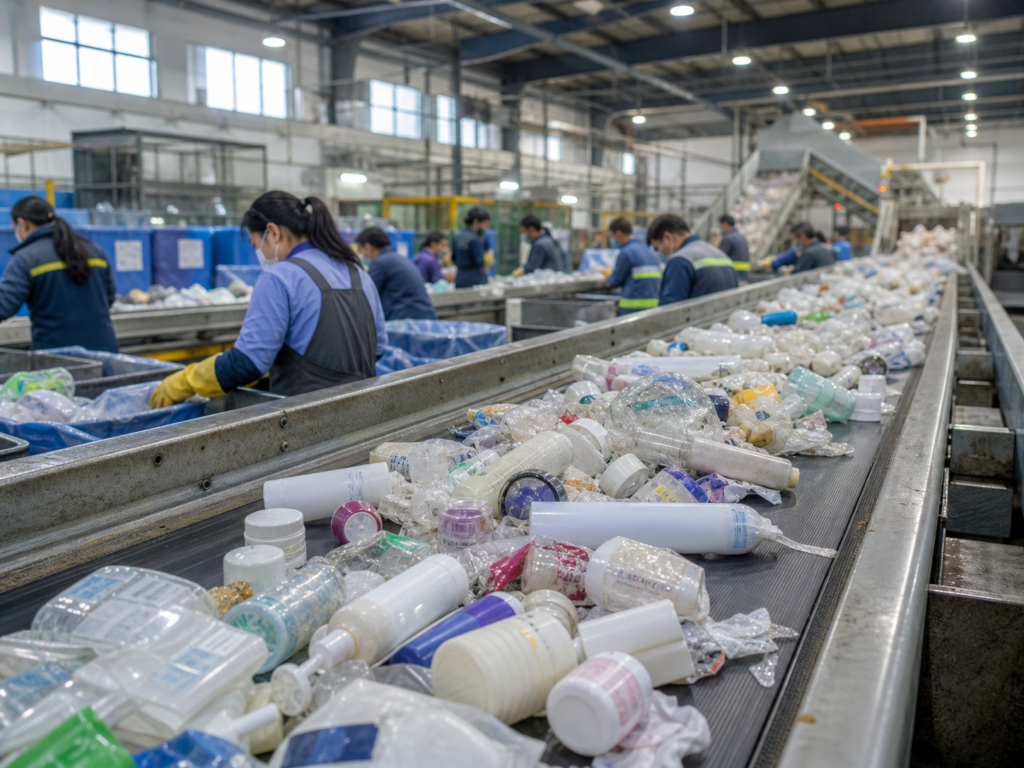
Let’s follow your empty moisturizer jar after it leaves your bathroom. Most Korean consumers simply drop half-empty or expired containers into household trash, and the numbers back that up starkly: 97% of this packaging ends up in landfills or incinerators rather than entering any recycling stream. That’s true even for people who consider themselves environmentally conscious.
Do the math on how fast this adds up. The average Korean woman buys about 4.2 new cosmetics products per month. If roughly 70% of those arrive in packaging that can’t realistically be recycled, which tracks with the 90% “difficult to recycle” classification, Korea generates an estimated 3.5 million tons of unrecyclable cosmetics waste every year. That’s already piling up, not a hypothetical.
Some brands are trying alternatives. Innisfree runs 12 in-store refill stations across Seoul and Busan as of this year, letting you bring back a container and refill it instead of buying new packaging each time. It’s a genuinely useful option if you live near one. But scale matters: those stations currently serve fewer than 2% of the brand’s Korean customer base. Call it a pilot program, not a solution — useful for the few who can access it, not proof the industry has this handled.
The Price-Sustainability Dilemma
Here’s where it gets complicated — a purely “corporate failure” framing falls short. A 2023 study found packaging waste concerns influence purchasing decisions for 67% of Korean shoppers aged 18 to 35. That’s a real, sizable group who say sustainability matters to them.
But stated concern and actual behavior split apart at the checkout counter. When researchers offered Korean consumers a choice between a standard product and a sustainably packaged version priced roughly 30% higher, shoppers chose the standard option 72% of the time. Manufacturers aren’t entirely wrong to point to this gap. A Korea Cosmetics Association survey from 2025 found 44% of manufacturers cite the cost of sustainable materials as their primary barrier to phasing out plastic, and one anonymous manufacturer estimated switching to fully recyclable materials would raise production costs 18 to 25%, costs they say they can’t pass fully to shoppers without losing market share. Industry analysts separately estimate a full switch could raise retail prices 15 to 22%, since low-cost packaging is part of how local brands compete on price against foreign labels.
Big players have made commitments anyway. Amorepacific and LG Household & Health Care have both pledged that 30 to 40% of their packaging will be recyclable, compostable, or refillable by 2030. As of now, that’s still under 5% of their actual product lines — a pledge date years out isn’t a shelf full of redesigned bottles today.
The 2028 Reckoning
Regulation is coming, even if slowly. Korea’s Cosmetics Safety Evaluation System, rolling out in phases starting in 2028, will require far more ingredient transparency than current rules demand. Compliance is expected to cost manufacturers between 500 million and 2 billion won per product, a serious sum likely to accelerate consolidation among smaller brands that can’t absorb it.
There’s also a new certification worth knowing about: the government’s “Green Beauty Label,” which certifies cosmetics with more than 80% recyclable or compostable packaging. So far, only three Korean brands have qualified. That’s a useful shorthand if you want to shop for lower-impact packaging today, though with just three brands certified, don’t expect to find it on your usual drugstore shelf yet.
It’s worth noting the counterargument too: the 90% non-recyclable figure describes a labeling classification, not necessarily what happens at the end of a product’s life in every single case, and some manufacturers argue their ingredient-transparency standards already exceed global norms, treating packaging as secondary to product safety. That’s a fair point as far as it goes, but it doesn’t change what’s sitting in your bathroom trash can right now.
So what can you actually do with this? If you’re loyal to a brand with a refill station near you, use it. It’s a small dent, but not a symbolic one. If you’re comparing two similar products, check for a Green Beauty Label or a clear recyclability grade before you buy, and don’t assume glass or “premium-looking” packaging is automatically the better environmental choice.
Source: Grace Lim, koreaupclose.com, July 21, 2026.