
Table of Contents
The Curiosity That Started in Front of the Convenience Store Fridge
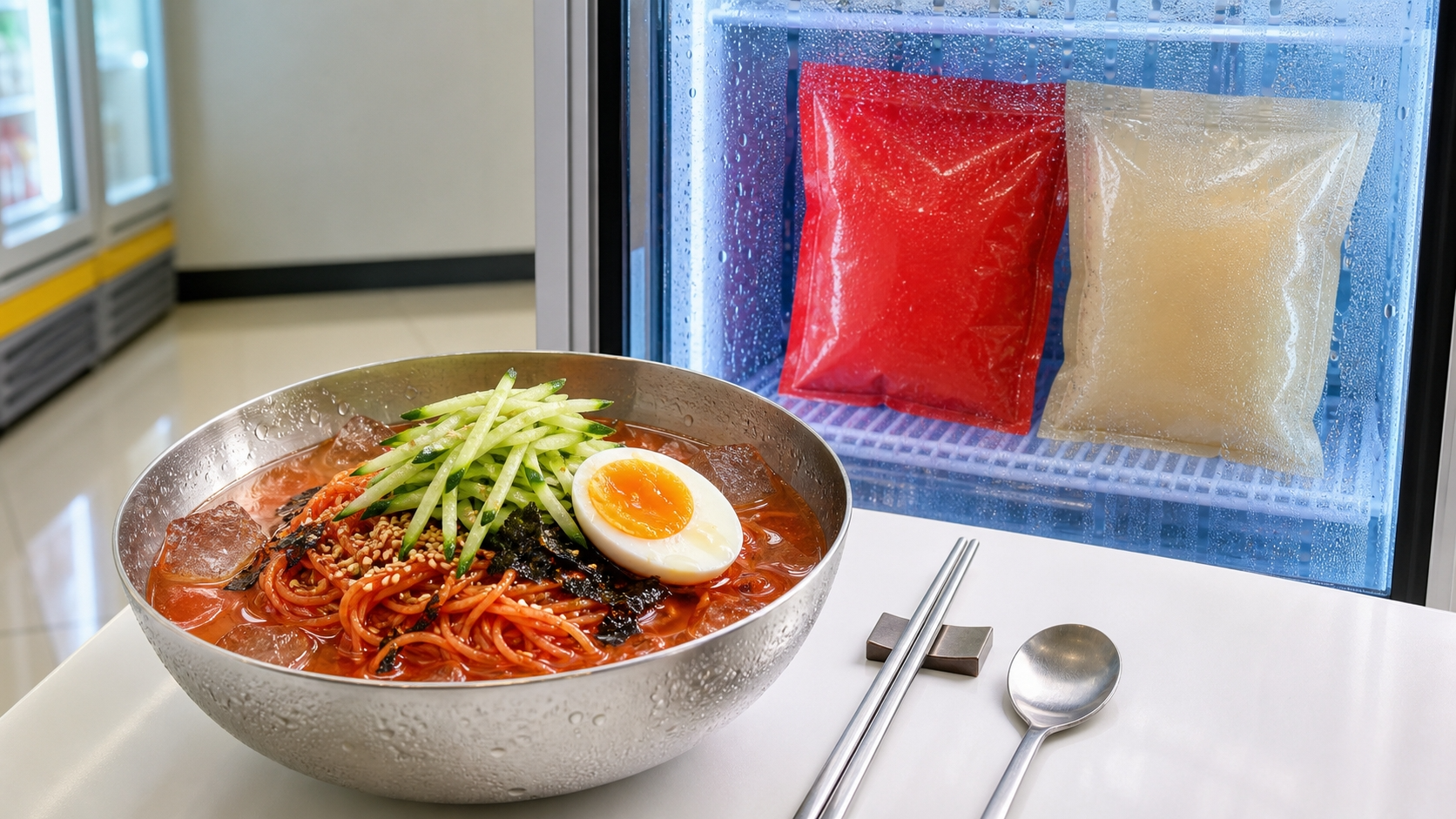
Standing in front of the convenience store fridge on my way home, I’ve noticed a combination that’s been catching my eye lately. The red packet of Buldak Bokkeummyun and the cold noodle broth pack right next to it. On their own, they seem unrelated, but on social media, people have been mixing the two into what’s called ‘Buldak Cold Noodles’ — a summer treat that’s been gaining buzz. When I first heard about it, I was skeptical. Pouring cold naengmyeon broth over spicy, stir-fried instant noodles? It just didn’t sound like it would work.
But after checking out reviews from people who tried it, the response was surprisingly positive. The ingredients are simple: one pack of Buldak Bokkeummyun (1,250 won) and one pack of store-bought mul-naengmyeon broth (2,500 won). You can buy both at any convenience store. Total cost per serving: 3,750 won — less than half what you’d pay for a bowl of naengmyeon outside.
The Recipe and Tips I Tried
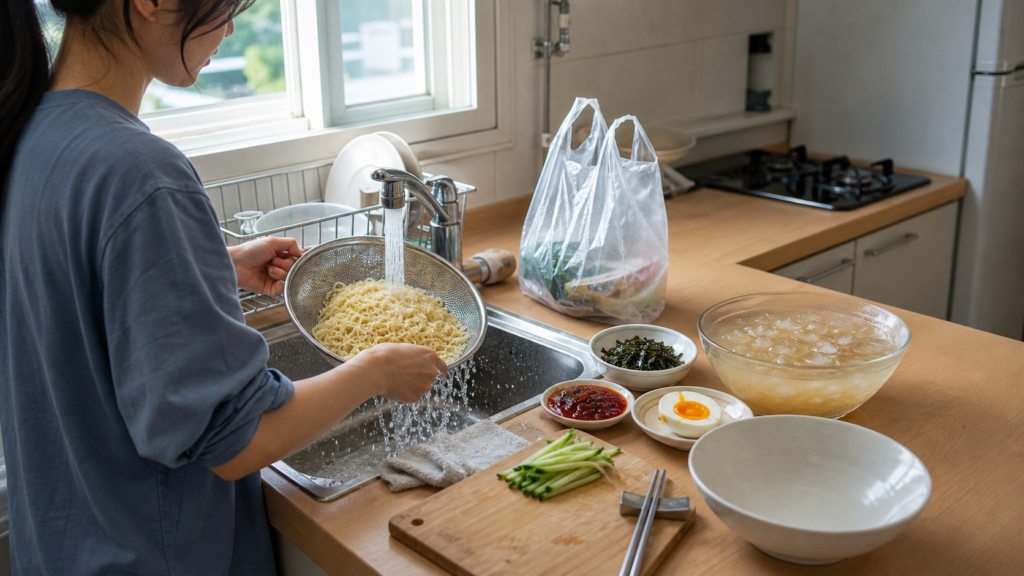
The method itself isn’t hard. First, boil the noodles for 5 to 6 minutes. At 5 minutes, they’re chewy-firm; at 6, a bit softer. After boiling, rinse the noodles thoroughly in cold water to remove the starch — this step matters more than I thought. If you don’t drain them well, the broth gets watery fast. Once drained, put the noodles in a bowl, pour in the icy cold naengmyeon broth, stir in the liquid Buldak sauce packet, and top it with the dried seaweed flakes. Done.
Looking at the bowl, the red-tinted broth with floating ice crystals already had my appetite going. The cold broth seemed to calm the spiciness one notch, and the heat melted away into a refreshing cool — it was surprisingly nice. Most of all, the noodle texture impressed me. The boiled noodles met the cold broth and turned even more springy and chewy, a completely different feel from the usual slightly sticky Buldak noodles.
The Seasonal Noodle Market Grows to 200 Billion Won
This dorm-living recipe isn’t just a passing social media fad — the seasonal noodle market itself is expanding. Companies like Nongshim, Ottogi, and Paldo have been releasing new products every year to target the summer noodle market. According to the Korea Agro-Fisheries & Food Trade Corporation (aT), the domestic bibimmyeon market grew from 750 billion won in 2015 to 1.5 trillion won in 2023, and including all seasonal noodle products, the total market is estimated to have exceeded 2 trillion won last year.
What’s interesting is that one driver of this growth isn’t the companies but the consumers. Buldak Bokkeummyun isn’t originally a seasonal product. Yet consumers have taken it upon themselves to turn it into a summer dish — proving that with social media buzz, even an existing product can become a dark horse in the summer season.
Between Pyeongyang Naengmyeon and Hamheung Naengmyeon, and ‘Noodleflation’
If Buldak cold noodles are a new twist, another trend is emerging in the traditional naengmyeon market. Among twentysomethings and thirtysomethings, Pyeongyang naengmyeon (pyeongnaeng) with its mild broth has become a gourmet culture, while Hamheung naengmyeon (hamnaeng) with its sweet-spicy sauce keeps its classic popularity. Debates over which one is better have become a common summer conversation topic.
But it’s not all good news for naengmyeon restaurants this summer. With high prices pushing up dining-out costs, most naengmyeon shops have had to raise prices, and a new term — ‘noodleflation’ (noodle + inflation) — has emerged. As bowls of naengmyeon easily top 10,000 won, alternatives like convenience store Buldak cold noodles at 3,750 won feel all the more appealing.
Why I’d Make It Again
Of course, this combination isn’t for everyone. If you usually enjoy Buldak noodles for the thick, sticky sauce coating the noodles, you might find this version a bit off — the noodles and sauce feel separate. And if you don’t like a chewy texture, I wouldn’t recommend it. Still, for noodle lovers, this social media recipe is definitely worth a try.
The idea of making a 3,750-won cold noodle bowl from two convenience store packets is a low-stakes experiment for this summer. Adding a boiled egg or some shredded cucumber could make it even better. If you pass by a convenience store on a hot day after work, maybe give this combo a thought in front of the fridge.
Sources: Edaily, May 25, 2026; Korea Agro-Fisheries & Food Trade Corporation (aT) seasonal noodle market statistics.
Korean Original Version
한국어 원문 보기 / 원작 저자의 톤 비교(클릭하여 확장)
저자: Hana Suh
한국어 원문 영어 번역에서 드러나지 않은 한국 문화의 뉘앙스와 저자의 고유한 표현 스타일을 보여드립니다.
편의점 냉장고 앞에서 시작된 궁금증
퇴근길 편의점 냉장고 앞에 서면 요즘 유독 눈에 띄는 조합이 있어요. 빨간 봉지의 불닭볶음면과 그 옆 칸의 물냉면 육수 팩. 따로 보면 아무 상관없는 두 제품인데, SNS에서는 이 둘을 섞어 먹는 이른바 ‘불닭냉면’이 여름 별미로 떠오르고 있더라고요. 처음 이야기를 들었을 땐 반신반의했어요. 맵고 뜨겁게 볶아 먹는 라면에 차가운 냉면 육수를 붓는다니, 상상만으로는 어울릴 것 같지 않았거든요.
그런데 직접 만들어본 사람들 후기를 찾아보니 반응이 생각보다 좋았어요. 재료는 단순해요. 불닭볶음면 한 봉지(1250원)와 시중 물냉면 육수 한 팩(2500원)이면 끝이에요. 둘 다 편의점에서 바로 살 수 있고요. 1인분에 3750원, 밖에서 사 먹는 냉면 한 그릇 값의 절반도 안 되는 가격이더라고요.
직접 만들어본 조리법과 요령
만드는 법 자체는 어렵지 않았어요. 끓는 물에 면을 5~6분 삶는 게 첫 단계예요. 5분이면 꼬들꼬들한 식감이, 6분이면 좀 더 부드러운 식감이 나와요. 삶은 면은 찬물에 충분히 헹궈 전분기를 빼야 하는데, 이 과정이 생각보다 중요하더라고요. 면 물기를 제대로 짜내지 않으면 육수가 금세 묽어져 버리거든요. 물기를 뺀 면을 그릇에 담고 살얼음 낀 냉면 육수를 먼저 붓고, 동봉된 불닭 액상소스를 풀고 김가루 후레이크를 뿌리면 완성이에요.
그릇을 마주하니 빨갛게 풀린 국물 위로 살얼음이 떠 있는 모습부터 식욕이 확 당기더라고요. 차가운 육수가 매운맛을 한 단계 눌러주는 느낌이라, 매운맛이 시원하게 풀려나가는 게 신기했어요. 무엇보다 면 식감이 인상적이었어요. 삶은 면이 차가운 육수와 만나면서 한층 쫀쫀하고 꼬들꼬들해지는데, 일반 불닭볶음면 눅진한 면발과는 확실히 결이 다르더라고요.
2000억원 규모로 커진 계절면 시장
이 자취생표 레시피가 단순한 SNS 유행으로 끝나지 않는 이유는 계절면 시장 자체가 커지고 있어서예요. 농심, 오뚜기, 팔도 같은 라면업체는 매년 신제품을 내놓으며 여름 계절면 시장을 공략해왔거든요. 한국농수산식품유통공사(aT)에 따르면 국내 비빔면 시장은 2015년 750억원에서 2023년 1500억원대로 성장했고, 계절면 제품까지 모두 합치면 지난해 시장 규모가 2000억원을 넘어섰을 거라는 추정도 나와요.
흥미로운 건 이 성장의 한 축을 기업이 아니라 소비자가 만들어내고 있다는 점이에요. 불닭볶음면은 원래 계절면 제품이 아니거든요. 그런데 소비자들이 알아서 이 라면을 여름 메뉴로 변주해 먹고 있다는 건, SNS 파급력만으로도 기존 제품이 여름철 다크호스가 될 수 있다는 얘기예요.
평양냉면과 함흥냉면 사이, 그리고 ‘면플레이션’
불닭냉면이 새로운 변주라면, 전통적인 여름 냉면 시장에서는 또 다른 흐름이 감지돼요. 최근 2030 세대 사이에서는 슴슴한 국물이 특징인 평양냉면(평냉) 선호 현상이 하나의 미식 문화로 자리 잡았고, 매콤달콤한 양념이 강한 함흥냉면(함냉) 스타일도 전통적인 인기를 유지하고 있어요. 어느 쪽을 더 좋아하느냐를 두고 벌어지는 논쟁, 이제 여름철 흔한 대화 소재가 됐죠.
다만 올여름 냉면집을 찾는 게 마냥 반갑지만은 않아요. 고물가 영향으로 외식 물가가 오르면서 대부분의 냉면집도 가격 인상을 피하지 못했고, 이런 흐름을 두고 ‘면플레이션(면+인플레이션)’이라는 신조어까지 등장했더라고요. 한 그릇에 만 원을 훌쩍 넘는 냉면집이 늘면서, 편의점에서 3750원으로 완성하는 불닭냉면 같은 대안이 더 매력적으로 느껴지는 것도 자연스러운 흐름이에요.
내가 다시 만들어 먹을 것 같은 이유
물론 이 조합에 호불호가 없는 건 아니에요. 평소 불닭볶음면 매력을 면에 진하게 밴 눅진한 소스 맛으로 즐겼다면 다소 어색하게 느껴질 수 있거든요. 면과 소스가 따로 노는 듯한 느낌이 드는 탓이죠. 꼬들한 식감 자체를 선호하지 않는다면 굳이 추천하기 어렵다는 의견도 있어요. 그래도 면 자체를 좋아하는 사람이라면 한 번쯤 시도해볼 만한 SNS 레시피라는 건 분명해 보여요.
편의점 두 봉지로 3750원짜리 냉면을 완성한다는 발상 자체가 이번 여름 부담 없이 시도해볼 만하더라고요. 삶은 계란이나 오이채를 곁들이면 좀 더 풍성해질 것 같아요. 더운 날 퇴근길에 편의점을 지나친다면, 냉장고 앞에서 한 번쯤 이 조합을 떠올려보세요.
출처: 이데일리, 2026년 5월 25일; 한국농수산식품유통공사(aT) 계절면 시장 통계.