
Table of Contents
Busan Draws UNESCO’s Summer Gaze
During the Joseon Dynasty, the craftsmen of palaces and temples mostly worked without names. The carpenter who assembled a soban (small dining table), the hwaseung (Buddhist painter) who painted the Buddha’s face, the wagong (tile maker) who laid the roof tiles — they simply fulfilled their appointed tasks, never intending to leave their names for posterity. Those nameless hand techniques have now, under the South Korean government, been given the title of “holder” (boyuja) and brought to the forefront, precisely because the compressed modernization of the past half-century nearly erased these skills entirely. And this summer, that current rises onto a stage that draws the world’s attention.
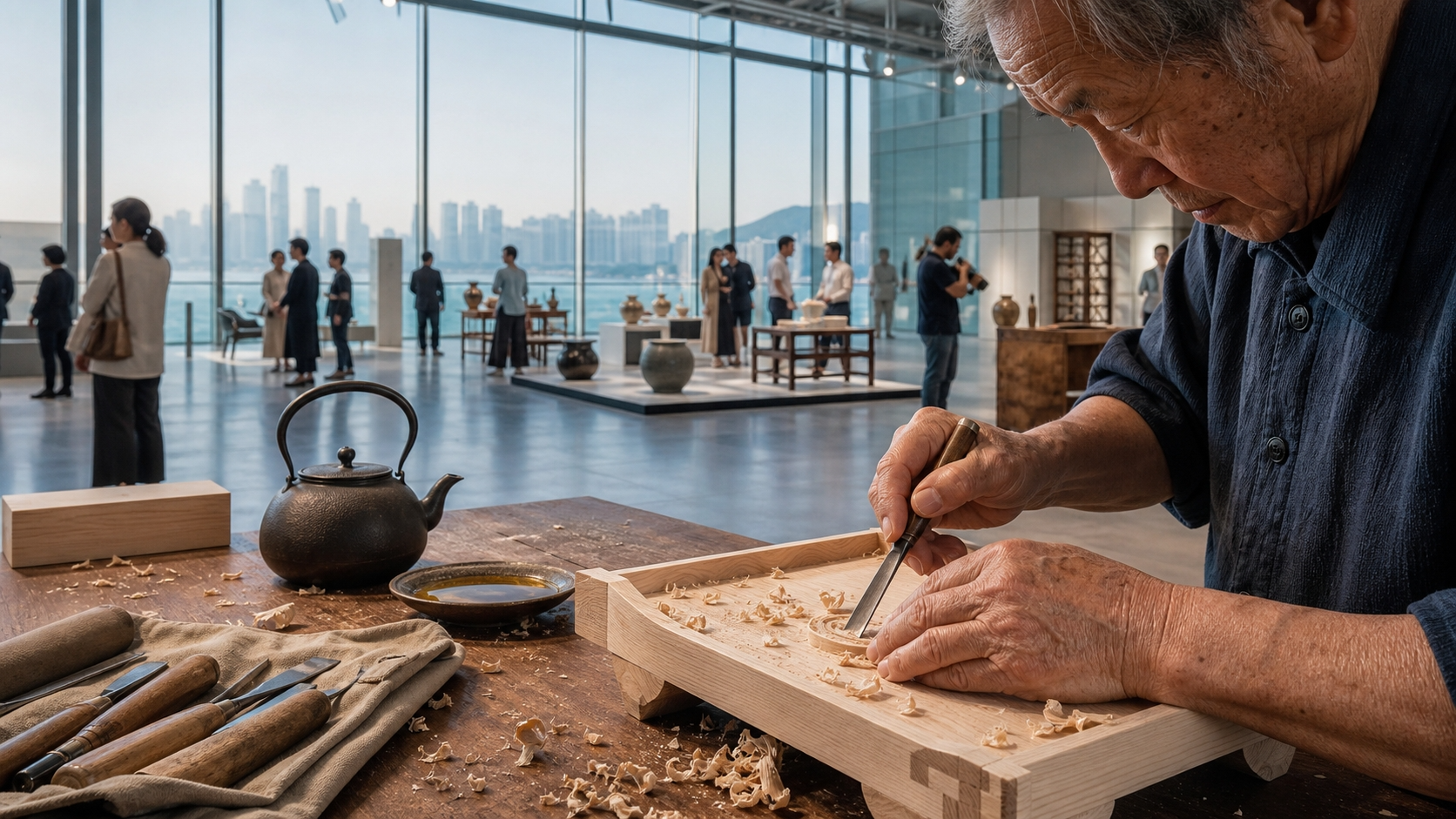
The 48th session of the UNESCO World Heritage Committee will be held in Busan from July 19 to 29, 2026. This gathering of cultural heritage experts and delegates from around the world is, by nature, an administrative forum for discussing the inscription and preservation of heritage sites. But the Korea Heritage Service has decided to use this opportunity as a window to introduce living traditions to the world. Thus was born “LIVING HERITAGE×ICH,” held at BEXCO exhibition hall from July 20 to 29. Fourteen designated master craftsmen and holders will participate, demonstrating 11 intangible heritage items directly, with free admission. This summer event is being hailed as the most ambitious UNESCO World Heritage Committee-related program in Korean history.
Two Craftsmen’s Fingertips at BEXCO
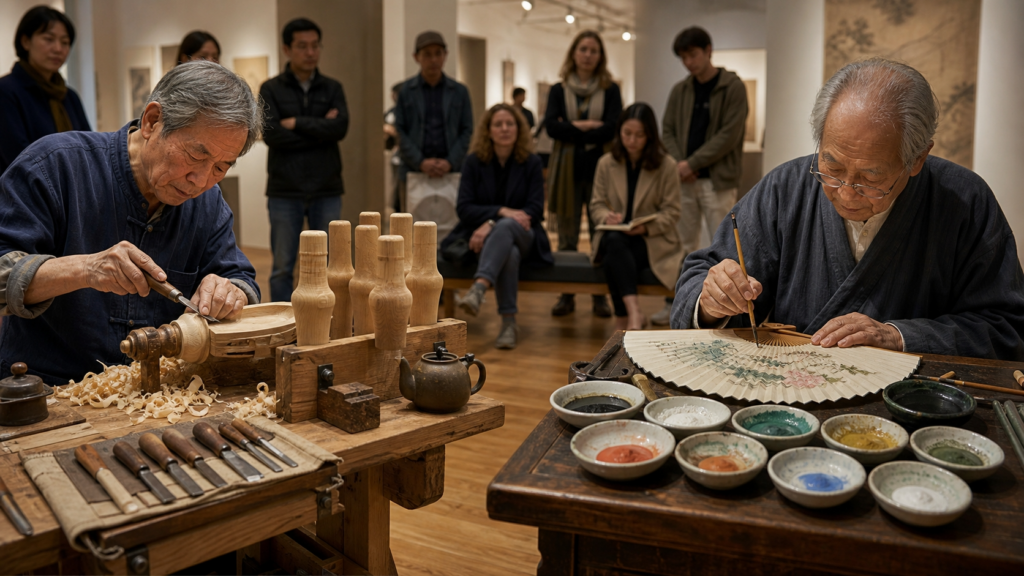
At the BEXCO exhibition hall, the first thing visitors encounter is a hand working wood. Master sobanjang (small-table maker) Kim Chun-sik will demonstrate the process of crafting a traditional soban from July 14 to 19. A soban is a dining table, but not just any dining table — it is a miniature of Joseon woodworking skill, requiring decades of tactile knowledge to carve each leg and join the top board. Master Kim says this exhibition is “the first time so many craftsmen have gathered in one place during a UNESCO committee session,” offering unprecedented visibility to Korea’s living craft traditions.
During the same period, at Gallery Nuri, a hand skill of an entirely different grain unfolds. Bulhwajang (Buddhist painter) Im Suk-hwan will present a demonstration from July 17 to 19, transferring the traditional painting techniques of bulhwa — depicting Buddhas and bodhisattvas — onto fans. It is the condensation of the meticulous brush lines and colors used in temple murals and taenghwa (hanging Buddhist paintings) onto a palm-sized fan. Soban and bulhwa, wood and pigment — the skills shown by these two masters differ in texture but share one commonality: both demand an accumulation of time that mass production cannot mimic.
What Is Intangible Heritage and Why Is It at Risk of Disappearing?
The term “intangible heritage” may sound abstract at first, but its meaning is simple. It refers to skills, knowledge, and customs transmitted through people’s bodies and memories, not something you can hold like a building or artifact. South Korea currently has over 140 types of intangible cultural properties, and craftsmen are officially designated as “holders” (boyuja) by the government under the Intangible Cultural Heritage Protection Act. This designation is not merely an honor; it is a promise that the state will support the transmission of skills and public demonstrations.
Museums preserve artifacts by fixing them inside glass display cases, but intangible heritage cannot exist unless people move. When a person who knows the skill passes away, the skill disappears with them. Over the past 50 years of compressed modernization, many of Korea’s traditional crafts and rituals have been silently driven to the brink of extinction in exactly this way. Yet this system carries an inherent tension. The moment the state designates a skill and puts it on display before an audience, it risks being detached from its original living context and becoming a mere “performance for show.”
A Summer Tour Connecting Five Regions Across the Country
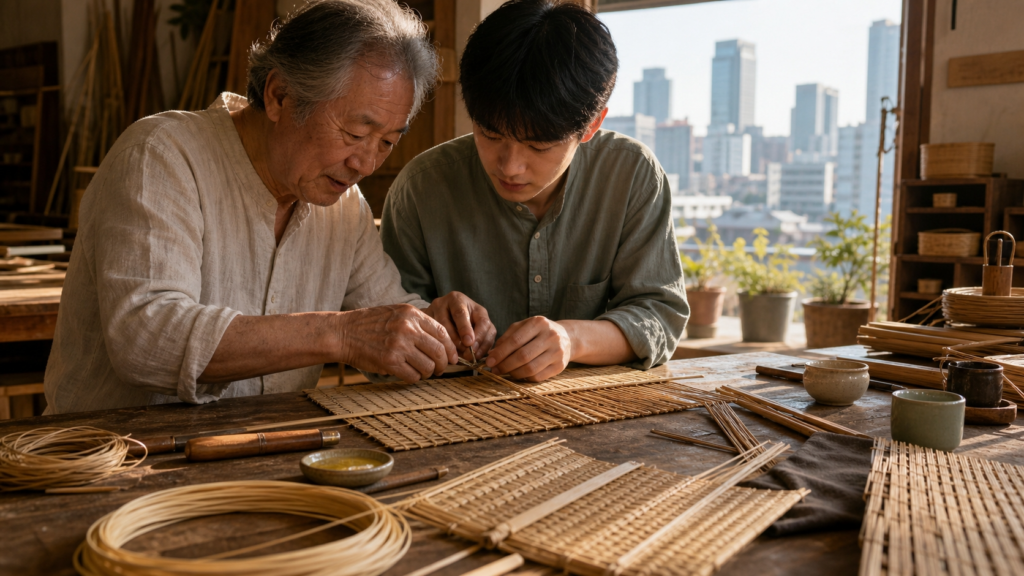
The UNESCO meeting and BEXCO exhibition in Busan are the centerpiece, but the Korea Heritage Service has expanded the summer season into a nationwide tour. Seven different intangible heritage items will be introduced across five regions: Incheon, Jeonju, Goyang, Tongyeong, and Seoul. In Goyang, beonwajang (roof-tile maker) Yi Geun-bok will demonstrate from July 24 to 26 the technique of laying curved roof tiles — the gentle upward curve at the eaves is one of the most distinctive features of traditional Korean architecture. In Tongyeong, choseokjang (straw-mat maker) Jo Dae-yong will show the traditional process of weaving screens (bal) from bamboo and reeds during the same period. These screens, serving both as cooling devices and privacy barriers, encapsulate the wisdom of Koreans who adapted to the climate in an era without air conditioning.
The oldest grain of tradition can be found at Incheon’s Sorae Port. The West Coast Bae Yeonsin Gut (boat ritual for a bountiful catch) will be held on July 4 and 5 — a shamanic rite praying to the sea for safety and abundant fish, historically tied directly to the survival of fishing communities. It is less a flashy performance and more the desperate prayers of a fishing village clothed in ritual form.
How Long Can Tradition Survive?
The question that runs through all these events is ultimately sustainability. If support is cut off or demographic shifts mean the next generation does not step forward to learn these skills, the techniques of the craftsmen now working their hands at BEXCO may end with this generation. Some scholars point out that repeated tourism-oriented demonstrations risk diluting the true transmission process — the apprenticeship training of repeated failure and bodily learning at the master’s side — and turning skills into mere “performances.”
Yet the significance of this Busan summer is not small. The skills that began with the hands of nameless Joseon craftsmen are now being carried forward under the names of state-designated holders, on an international stage watched by UNESCO — that fact itself is a change. The hand that carved the soban, the brush tip that painted the bulhwa, the rhythm of the gut (shamanic ritual) — ultimately, they can only pass from person to person. This passing pauses this summer in Busan and five other regions, opening a door for passersby. No one can guarantee how long that door will remain open, but at least this summer, anyone can look inside.
Sources: Korea Heritage Service, July 4, 2026; Korean Cultural Center New York, July 10, 2026; National Heritage Promotion Agency, 2026; BEXCO, July 2026.
Korean Original Version
한국어 원문 보기 / 원작 저자의 톤 비교(클릭하여 확장)
저자: Joon-ho Baek
한국어 원문 영어 번역에서 드러나지 않은 한국 문화의 뉘앙스와 저자의 고유한 표현 스타일을 보여드립니다.
부산에 쏠리는 유네스코의 여름 시선
조선시대 궁궐과 사찰의 장인들은 대개 이름 없이 일했다. 소반을 짜던 목수도, 부처의 얼굴을 그리던 화승도, 기와를 얹던 와공(瓦工)도 그저 맡은 소임을 다했을 뿐 후대에 이름 석 자를 남기려 하지 않았다. 그 무명의 손기술이 지금 대한민국 정부로부터 ‘보유자’라는 이름을 얻어 전면에 나서게 된 것은 지난 반세기 근대화가 이 기술들을 거의 지워버릴 뻔했기 때문이다. 그리고 올여름, 그 흐름이 세계의 이목이 쏠리는 무대 위로 올라선다.
제48차 유네스코 세계유산위원회가 2026년 7월 19일부터 29일까지 부산에서 열린다. 세계 각국의 문화유산 전문가와 대표단이 모이는 이 회의는 본래 유산의 등재와 보전을 논의하는 행정적 자리이지만, 국가유산청은 이 기회를 살아있는 전통을 세상에 소개하는 창구로 삼기로 했다. 그렇게 마련된 것이 7월 20일부터 29일까지 벡스코 전시장에서 열리는 ‘LIVING HERITAGE×ICH’다. 이 행사에는 14명의 지정 장인과 보유자가 참여해 11개 무형유산 종목을 직접 시연하며, 입장은 전액 무료다. 이번 여름 행사는 한국 역사상 가장 야심찬 유네스코 세계유산위원회 연계 행사로 평가된다.
벡스코에서 만난 두 장인의 손끝
벡스코 전시장에서 관람객이 가장 먼저 마주치는 것은 나무를 다루는 손이다. 소반장(小盤匠) 김춘식 명장이 7월 14일부터 19일까지 전통 소반을 제작하는 과정을 시연한다. 소반은 밥상이되 그냥 밥상이 아니다 — 다리 하나하나를 깎고 상판을 짜맞추는 데 수십 년 손에 익은 감각이 필요한, 조선 목가구 기술의 축소판 같은 물건이다. 김춘식 명장은 이번 전시가 “유네스코 위원회 기간 중 이렇게 많은 장인이 한자리에 모이는 것은 처음”이라며, 한국의 살아있는 공예 전통에 전례 없는 가시성을 제공한다고 말했다.
같은 기간 갤러리 누리에서는 전혀 다른 결의 손기술이 펼쳐진다. 불화장(佛畫匠) 임숙환이 7월 17일부터 19일까지 불화, 곧 부처와 보살을 그리는 전통 회화 기법을 부채 위에 옮기는 시연을 선보인다. 사찰 벽화나 탱화에 쓰이던 정교한 필선과 색감을 손바닥만 한 부채에 응축시키는 작업이다. 소반과 불화, 나무와 안료, 이 두 장인이 보여주는 기술은 결이 다르지만 공통점이 하나 있다 — 둘 다 대량생산이 흉내 낼 수 없는 시간의 축적을 요구한다는 것이다.
무형유산이란 무엇이며 왜 사라질 위기인가
‘무형유산’이라는 말은 얼핏 추상적으로 들리지만 뜻은 단순하다. 건물이나 유물처럼 손에 잡히는 게 아니라 사람의 몸과 기억 속에 전해지는 기술, 지식, 관습을 가리킨다. 한국에는 현재 140여 종의 무형문화재가 있으며, 장인들은 무형문화재보호법에 따라 정부로부터 ‘보유자’로 공식 지정된다. 이 지정은 단순한 명예가 아니라 기술 전수와 공개 시연을 국가가 지원하겠다는 약속이기도 하다.
박물관은 유물을 유리 진열장 안에 고정시켜 보존하지만, 무형유산은 애초에 사람이 움직이지 않으면 존재할 수 없는 것이다. 기술을 아는 사람이 세상을 뜨면 그 기술도 함께 사라진다. 지난 50년의 압축적 근대화 속에서 한국의 전통 공예와 의례 상당수가 바로 이런 방식으로 소리 없이 소멸 직전까지 몰렸다. 다만 이 제도에는 태생적인 긴장도 있다. 국가가 지정하고 관람객 앞에서 시연하게 만드는 순간, 그 기술은 원래 있던 생활의 맥락에서 떨어져 나와 하나의 ‘보여주기 위한 행위’가 될 위험을 안는다.
전국 다섯 지역을 잇는 여름 순회 일정
부산의 유네스코 회의와 벡스코 전시가 중심이지만, 국가유산청은 여름 한 철을 전국 순회로 확장했다. 인천, 전주, 고양, 통영, 서울 다섯 지역에서 7개의 서로 다른 무형유산 종목이 소개된다. 고양에서는 번와장(燔瓦匠) 이근복이 7월 24일부터 26일까지 곡선 기와를 얹는 시공 기법을 시연하는데, 처마 끝이 하늘로 살짝 들려 올라가는 이 곡선은 한국 전통 건축에서 가장 독특한 특징 중 하나로 꼽힌다. 통영에서는 초석장(草席匠) 조대용이 같은 기간 대나무와 갈대로 발을 엮는 전통 공정을 보여준다. 냉방과 사생활 보호라는 두 가지 기능을 동시에 해결한 이 발은, 에어컨 없이 여름을 나야 했던 시절 한국인들이 기후에 맞춰 고안한 지혜를 고스란히 담고 있다.
가장 오래된 결의 전통은 인천 소래포구에서 만날 수 있다. 서해안 배연신굿이 7월 4일과 5일 이틀간 열리는데, 이는 바다를 향해 안전과 풍어를 비는 무속 의례로, 역사적으로 어업 공동체의 생존과 직결된 행사였다. 화려한 공연이라기보다 실제 어촌 공동체의 절박한 기원이 의례의 형식을 입은 것에 가깝다.
전통은 얼마나 오래 살아남을 수 있을까
이 모든 행사를 관통하는 질문은 결국 지속가능성이다. 지원이 끊기거나 인구 구조가 바뀌어 다음 세대가 이 기술을 배우겠다고 나서지 않는다면, 지금 벡스코에서 손을 놀리는 장인들의 기술은 이번 세대에서 멈출 수도 있다. 일부 학자는 관광 중심의 시연이 반복되면서 진정한 전승 과정 — 스승 곁에서 실패를 거듭하며 몸에 새기는 도제식 훈련 — 이 옅어지고, 기술이 하나의 ‘공연’으로 변질될 위험을 지적한다.
그럼에도 이번 부산의 여름이 갖는 의미는 작지 않다. 조선시대 이름 없던 장인의 손에서 시작된 기술이, 지금은 국가가 지정한 보유자의 이름으로, 그리고 유네스코가 지켜보는 국제 무대 위에서 이어지고 있다는 사실 자체가 하나의 변화이기 때문이다. 소반을 깎던 손도, 불화를 그리던 붓끝도, 굿판의 장단도 결국 사람에게서 사람으로만 건너갈 수 있다. 그 건넘이 이번 여름 부산과 다섯 지역에서 잠시 멈춰 서서, 지나가는 이들에게 문을 열어 보인다. 그 문이 얼마나 오래 열려 있을지는 아무도 장담할 수 없지만, 적어도 올여름만큼은 누구나 그 안을 들여다볼 수 있다.
출처: 국가유산청, 2026년 7월 4일; 뉴욕한국문화원, 2026년 7월 10일; 국가유산진흥원, 2026년; 벡스코, 2026년 7월.