Table of Contents
The Diary Format Has Returned
A diary—ilgi (日記)—is by nature a text never meant for other eyes. The illok (日錄, daily records) left by Joseon literati, or their sahaeng ilgi (使行日記, travel journals to China), were initially private jottings; only later did they become historical sources and literature. What happens when a private record crosses over into public reading material? Kakao Webtoon’s July release Noejeonjeung Ilgi (Epilepsy Diary) revives that age-old question. Just as sahaeng ilgi came to be read as documents of diplomacy and customs of their time, an individual’s bedside record can, over time, become evidence of how an era dealt with illness. The only difference is that the webtoon format compresses that process from centuries into weeks.
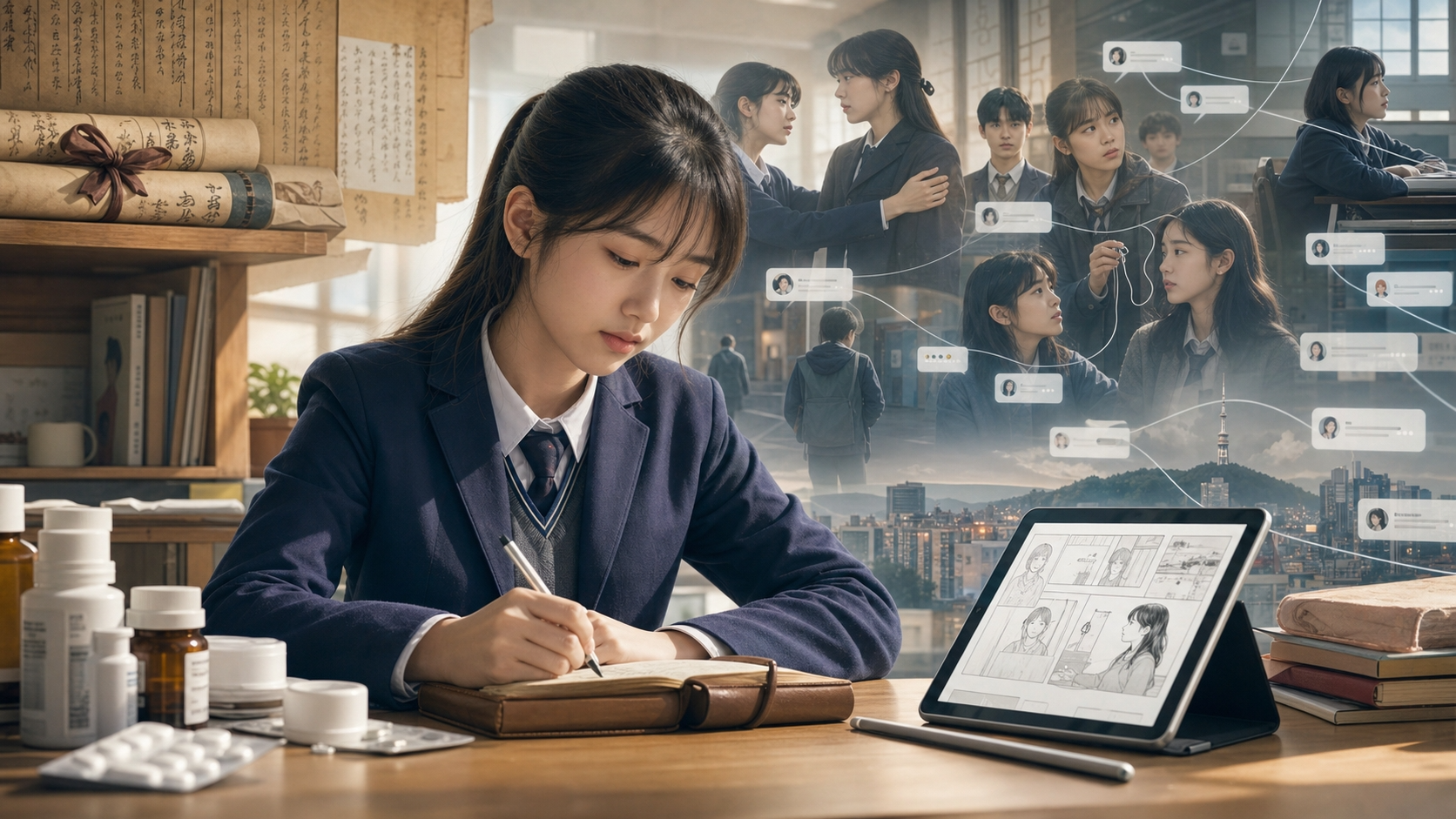
Released on July 2, 2026, this work is the record of a girl diagnosed with epilepsy in the midst of adolescence. The very inclusion of ‘ilgi’ in the title reveals the work’s attitude: a declaration that it will not dramatize events but simply record what was experienced day by day. In that sense, the title Noejeonjeung Ilgi also serves as a device that informs readers of the rules in advance. Those who enter expecting dramatic reversals or decisive events may instead find themselves disoriented by the pace at which trivial daily records accumulate.
It Depicts Not the Disease, but the Gaze
What the work addresses is not the disease epilepsy itself. As multiple reports have commonly noted, this webtoon focuses on society’s gaze toward the illness rather than the illness itself. The protagonist shoulders a double burden: the physical condition of medication side effects and seizures, and the social condition of surrounding prejudice and misunderstanding. In the process of maintaining school life and treatment, it becomes clear that the latter is as heavy as the former. Each reaction of the characters around the protagonist constitutes scenes that build this social condition. The moments that linger longer for the girl are not the physical event of a seizure but the expressions and words of those who witnessed it.
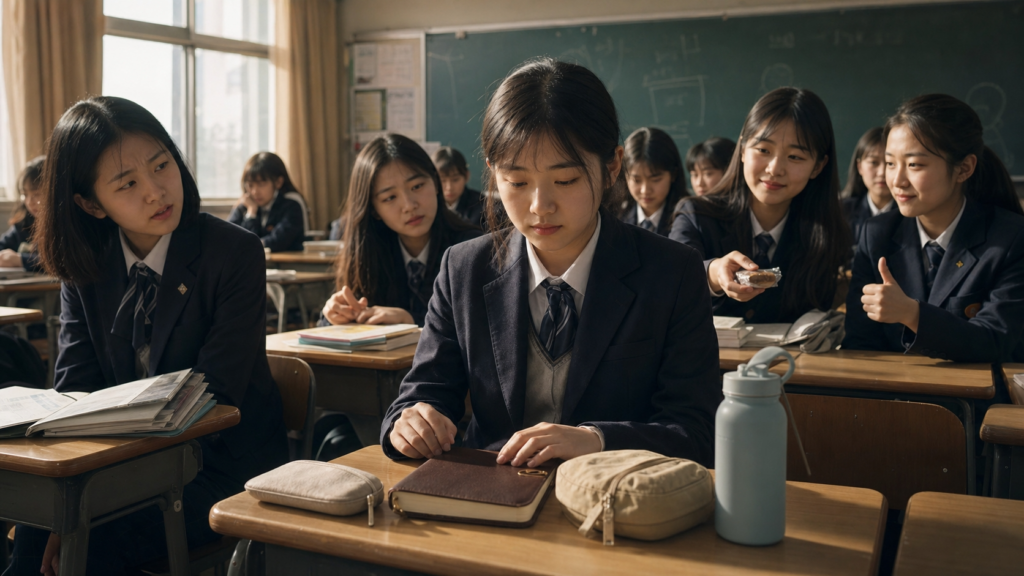
Epilepsy is a disease that has long suffered from misunderstanding. In Korea it was once called ganjil (癎疾), and the stigma attached to that name was so strong that in 2009 the Korean Epilepsy Society changed the disease name itself. ‘Noejeonjeung (腦電症)’ is a name that contains only the medical fact of an electrical abnormality in the brain. It is a rare case of changing words to erase prejudice, yet the existence of this work paradoxically proves that prejudice outlives words. Changing the disease name does not change the gaze surrounding it, as this work shows through concrete scenes of the girl’s school life.
Another Text Created by Readers’ Comments
What deserves attention in this work is not only the main story. The reader reactions posted on the serialization page form a text together with the work. In episode 1, a comment expressed hope that through this webtoon, many people would properly understand epilepsy and that prejudice against patients would disappear. In episode 4, a comment from a reader who said they too are an epilepsy patient and came in because of the title rose to the top. A space where those suffering from the same illness confirm each other’s existence was created in the comment section, even if not intended by the author.
This is something paper books have rarely been able to do. The webtoon medium has a structure where readers can respond immediately to each episode, and those responses are then read by subsequent readers. In illness narratives, this structure carries special meaning because those with chronic conditions most often experience isolation. Simply confirming that someone else shares your condition can alleviate that isolation to some extent. Whether intended or not, this work has created a small community by borrowing the serialization format.
You Were Not Alone
Looking at Kakao Entertainment’s July new release lineup, it becomes clear that Noejeonjeung Ilgi is not an isolated work. Uri Oneuldo Saraitne? (We’re Still Alive Today), released on June 30, depicts the time of a father diagnosed with ALS and his family. It portrays the process of collapsing and rising again before unexpected pain, through the way patients and families continue daily life amid care and anxiety. Both works are autobiographical in nature. Kakao Entertainment released four new webtoons in July, placing two autobiographical works dealing with daily life with illness side by side, and adding fantasy series to complete the lineup. The fact that the two works were released side by side in the same month also means that webtoon readers are now willing to spend time on stories that observe someone’s actual day rather than flashy settings.
The platform releasing two illness narratives at the same time is hard to see as coincidence. Considering that the Korean webtoon market has grown around strong commercial genres like romance fantasy and regression/reincarnation tales, this arrangement is a choice unlikely to appear without a judgment that the readership has broadened. Placing two such works side by side outside commercially proven genres signals that, at least at this time, the webtoon market believes illness narratives can attract readers.
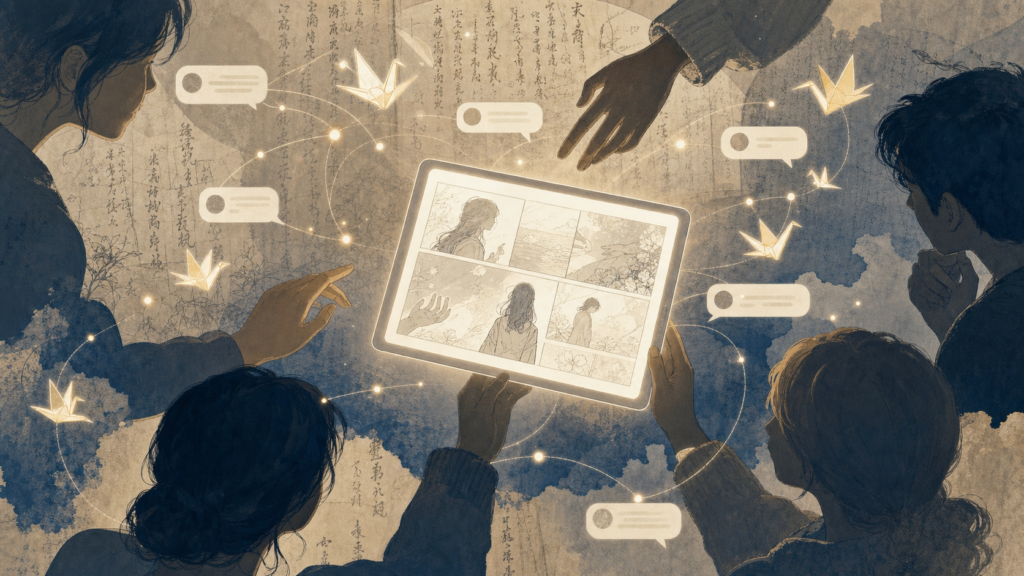
Until a Private Record Becomes Public Language
Narratives dealing with illness always walk a precarious tightrope. Tilt one way, and they turn the patient into a hero of overcoming, erasing real life; tilt the other, and they are consumed as objects of pity. Either way, the place of the person themselves disappears. The diary format is an old method of avoiding these two traps. A diary does not move toward a conclusion. Today is today, tomorrow is tomorrow; it does not prepare a narrative climax of overcoming. That is exactly how time with chronic illness actually is: not curing but living with it, and the diary says this through its very form. Noejeonjeung Ilgi likewise does not race toward a finish line of cure or overcoming; it simply passes on the record of enduring today to the next episode.
However, the moment a private record is made public, it no longer remains entirely private. Just as the illok left by Joseon literati became historical sources for later generations, one girl’s epilepsy diary now becomes a window for countless readers who know nothing of this illness. The comment in episode 1 asking to eliminate prejudice tells us what that window is actually open toward. Prejudice persists even when words are changed, and misunderstandings that statistics cannot erase exist. To convey such things, ultimately, the concrete day of one person is necessary. The fact that the most popular medium—the webtoon—is carrying that day may be the most important aspect of this work. The daily life of a girl portrayed neither as someone who overcame illness nor as someone to be pitied is perhaps the most honest portrait.
Sources: Kakao Entertainment press release ‘July New Webtoon Releases’ (July 15, 2026), Web Economy (July 2026), Creator Journal, Kakao Webtoon Noejeonjeung Ilgi serialization page and reader comments.