Table of Contents
Check the Back of the Product
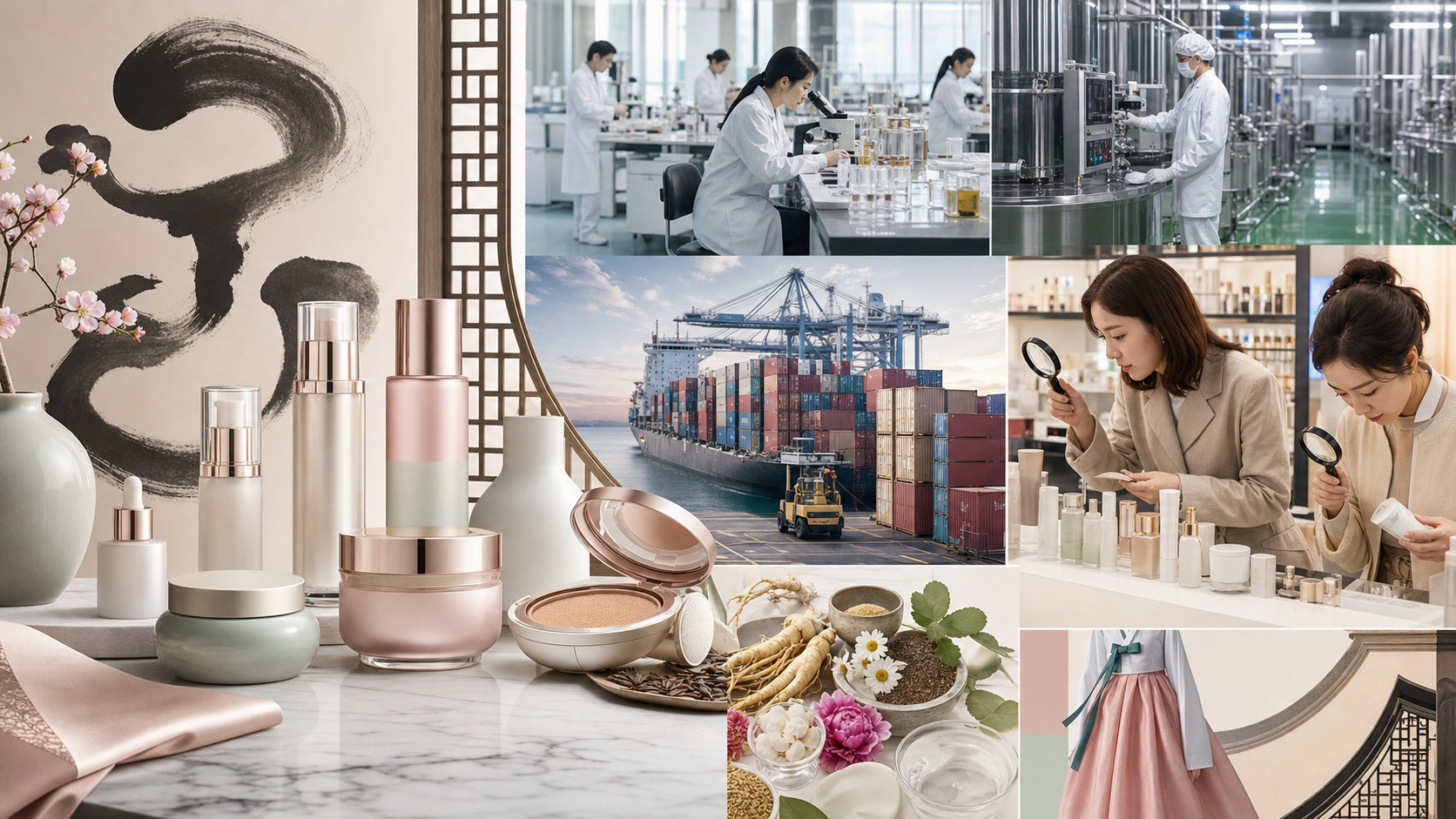
When you’re buying cosmetics abroad, you’ve probably seen products with ‘K-beauty’ or ‘Korean skincare’ plastered all over the package. They might have Seoul or Korean words in the name, and emphasize Korean skincare philosophy—but the actual country of manufacture isn’t always Korea. On the flip side, more brands founded overseas are now openly touting that they produce in Korea. So it’s important to separate three things: the brand’s nationality, the product’s country of manufacture, and where the ingredients come from.
The background here is K-beauty’s rapid growth. According to a Seoul Economic Daily report citing Korea International Trade Association data, Korea’s cosmetic exports in the first half of 2026 hit $6.979 billion—a 26.9% jump from the same period last year, and the highest ever for a first half. The Ministry of Food and Drug Safety also reported roughly $7 billion for the same period (rounding up). The two sources differ slightly in how they tally and present the numbers, but the trend is clear: K-beauty exports are booming.
As ‘K-beauty’ became a powerful marketing term worldwide, foreign brands started highlighting their Korean connections. But just seeing ‘K-beauty’ doesn’t tell you whether the brand is owned by a Korean company, whether the formula was developed in Korea, or whether it was made in a Korean factory. Each product has a different story, so it’s smarter to look past the hype and check the actual manufacturing details.
Foreign Brands Can Be Made in Korea Too
There are actually overseas brands producing in Korea. One example is ‘Rini’, a kids’ personal care line launched in 2025 by Canadian actress Shay Mitchell, Esther Song, and Matt Babel. The brand name comes from the Korean word for ‘children’, and its official site says ‘consciously crafted in Korea’ and ‘made in Korea’. They explain they combined Korean manufacturing know-how with advice from U.S. pediatric toxicologists.
‘Yepoda’, which started in Germany, also uses a Korean brand name. Their official intro says the brand was founded in 2020 and all cosmetics are made in Korea by K-beauty experts. ‘Hwarang’, conceived in Finland, also promotes a Korean design-and-manufacture identity. None of these are owned by Korean companies, but at least according to their official descriptions, the products are made in Korea.

It’s hard to just say ‘these are foreign brands, so they’re not K-beauty.’ Korea’s cosmetics manufacturing industry does a ton of OEM and ODM—contract manufacturing and original design manufacturing—for overseas brands. Where the brand’s headquarters is and where the product is made are two different things. When foreign brands openly say ‘made in Korea’, it shows that Korea’s production tech and supply chain have become a marketing asset in their own right.
‘Inspired by Korea’ Is Not the Same as ‘Made in Korea’
There are also borderline cases. U.S. brand ‘Seoul Ceuticals’ uses Seoul in its name and says its products are inspired by Korean skincare. But according to the company, everything is 100% made in U.S. facilities. So these are not cosmetics made in Korea.
The company doesn’t hide this—they explain they source some key ingredients like PDRN, ginseng extract, rice bran, centella asiatica, and snail filtrate from Korean suppliers. They also emphasize working with product development consultants who have experience with Korean beauty brands. So it’s more accurate to call this ‘a U.S.-made brand inspired by Korean cosmetics and using some Korean ingredients’ rather than ‘Korean-made cosmetics.’
The case involving David and Victoria Beckham’s daughter Harper Beckham needs a careful look. Reports say Harper’s team was preparing a beauty venture inspired by K-beauty and filed a trademark for ‘HIKU BY HARPER’, but the U.S. Patent and Trademark Office initially rejected it due to possible confusion with an existing trademark. Later, a filing for ‘HARLO BY HARPER’ was spotted. Some overseas media mistakenly wrote it as ‘Halo by Harper’.
But the brand hasn’t officially launched yet, and no specific country of manufacture has been announced. So it’s not fair to conclude it’s not Korean-made at this stage, or to use it as an example of a non-Korean K-beauty product already on sale. Also, comments about ‘HIKU’ sounding Japanese are more about consumer and media perception than hard facts. The verified info is limited to the trademark filing, the initial rejection, and the new application.
K-Beauty Isn’t a Legally Protected Origin Label Yet
Right now, ‘K-beauty’ isn’t a legally uniform origin certification. It’s different from a geographical indication like ‘Champagne’, which can only be used on products from a specific region meeting set standards. ‘Extra virgin olive oil’ is also not a geographical indication for Italy—it’s a quality grade based on acidity and production method—so you have to keep that distinction when comparing to K-beauty.
But that doesn’t mean anyone can use ‘K-beauty’ without any limits. If a product not made in Korea says ‘Made in Korea’, it could violate country-of-origin labeling rules. If the whole ad campaign makes people think the product is from a different country or company, consumer protection or labeling laws might apply. And using another company’s registered trademark or packaging without permission could be trademark infringement or counterfeiting.
However, phrases like ‘K-beauty inspired’ or ‘Korean skincare philosophy’—which indicate inspiration or style—are treated differently from a direct ‘Made in Korea’ claim. As it stands, you can’t judge a brand’s ownership country, manufacturing country, ingredient origin, or tech development location based on the single umbrella term ‘K-beauty’. That’s why, as Seoul Economic Daily reported, officials from the Korea Intellectual Property Office and industry insiders are saying there’s a need to discuss a definition and protection plan for K-beauty.
Government support for overseas IP rights currently focuses on cracking down on counterfeits and similar products that steal trademarks from Korean companies. But foreign brands using Korean-style imagery or skincare philosophy in marketing isn’t the same as typical counterfeiting. Even if they start discussing regulations, they’ll first need to decide what counts as K-beauty: Korean ownership? R&D in Korea? Manufacturing in Korea? Using Korean ingredients?
When Shopping, Break It Down Into Three Checks
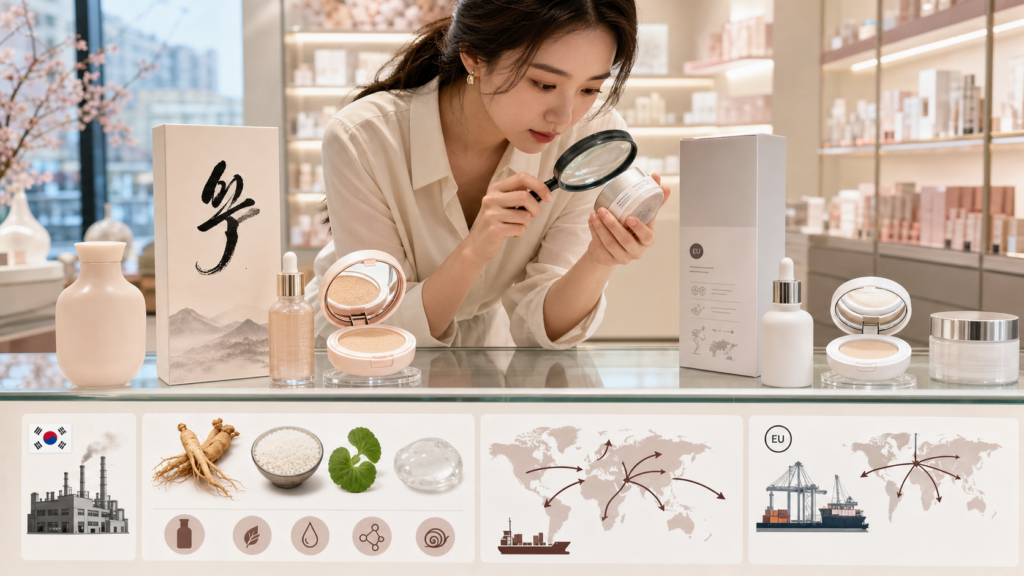
If you specifically want products made in Korea, first look for ‘Made in Korea’ or the equivalent country-of-origin label. In the U.S., imported products must show the origin in English. The EU and other markets may have different rules. If you’re buying online, check the origin info on the official product page and also the packaging of the item you actually receive.
Second, read phrases like ‘Korean-inspired’, ‘Korean ingredients’, and ‘developed with Korean experts’ separately. ‘Korean-inspired’ means they got the idea from Korea. ‘Korean ingredients’ only tells you where some raw materials come from, not where the finished product was made. ‘Developed with Korean experts’ is also separate from the manufacturing location. To confirm Korean manufacturing, the most direct clue is the finished product’s country-of-origin label.
Third, distinguish between ‘Manufactured by’, ‘Manufactured for’, and ‘Distributed by’. In the U.S., if the business listed on the label isn’t the actual manufacturer, they can use ‘Manufactured for’ or ‘Distributed by’. But don’t automatically assume a product is suspicious just because only a distributor is listed. Depending on the country’s labeling rules, they might show the responsible party or distributor’s name and address instead of the manufacturer.
For cosmetics sold in Korea, the cosmetic manufacturer and responsible seller info can help. Imported cosmetics must also show the country of manufacture and the overseas manufacturer’s info. But export products made in Korea for overseas markets can be packaged in the destination country’s language and according to its rules. So if you buy a product at a foreign store and it doesn’t have the Korean ‘responsible seller’ phrase, don’t jump to the conclusion it’s not Korean-made.
None of this means cosmetics made outside Korea are worse. Quality and safety aren’t determined by origin alone. But if you’re specifically looking for Korean-made products, check the country of manufacture rather than relying on the brand’s vibe. Just getting into the habit of separating the four terms—’K-beauty’, ‘Korean-style’, ‘Korean ingredients’, ‘Korean made’—will help you pick much more accurately.
Sources: Kim Yeon-ha, Seoul Economic Daily ‘Global Success Leads Foreign Brands to Claim K-Beauty—Is Brand Damage a Concern?’, July 26, 2026; Ministry of Food and Drug Safety ‘First Half 2026 Cosmetic Exports Reach $7 Billion’; Rini official brand intro; Yepoda official brand intro; Hwarang official brand intro; Seoul Ceuticals manufacturing explanation; HARLO BY HARPER trademark filing (Justia Trademarks); Easy-to-Find Living Law Information Cosmetics Labeling Standards; U.S. FDA Cosmetic Labeling Guide.