
Table of Contents
Winning Doesn’t Mean Profit
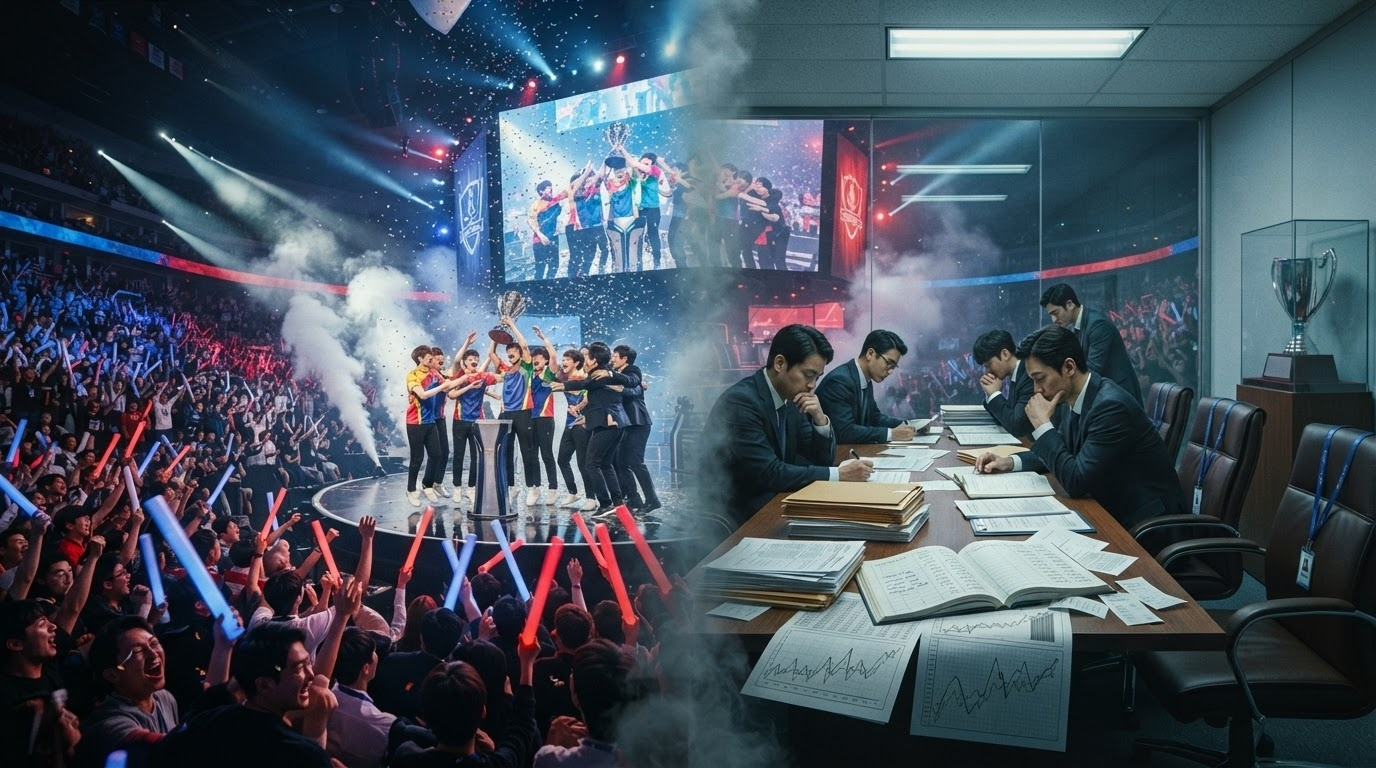
Korean eSports might look like a successful industry if you only consider international tournament results. In League of Legends, Korean players and teams have long demonstrated world-class competitiveness, and the LCK is one of the most-watched leagues globally. Names like T1 and Faker have become such strong brands that even people who don’t follow gaming are familiar with them.
But when you look at the industry’s balance sheets, a different story emerges. Despite global fandom, high viewership, and major international tournament wins, many Korean eSports teams operate at a loss. The performance is brilliant, but the revenue model for the teams themselves is fragile. The problem Korean eSports needs to solve is not about building stronger teams, but about creating an economic structure that allows strong teams to survive sustainably.
This contradiction becomes clearer when compared to traditional sports. In the US, for example, professional sports franchises have multiple revenue streams: ticket sales, broadcast rights, local business partnerships, merchandise, stadium concessions, and sponsorships. eSports teams also generate revenue through advertising, merchandise, content, fan meetings, and sponsorship deals, but they still have limited access to stable broadcast rights and in-person revenue that can be reliably shared between the league and teams.
Costs Have Grown Around Players, But Revenue Hasn’t Kept Up
According to data from ID Research, cited by Good Morning Economy, the average annual operating cost for domestic eSports teams ranges from 3.5 billion to 4.5 billion won, while revenue often falls below 1 billion won. In many cases, player salaries account for over 80% of the team’s budget. This data is based on a survey from a few years ago, but it is still frequently referenced in the industry to explain the structural problem. The more intense the competition to secure star players, the higher the labor costs, but the popularity of a single player does not directly translate into stable cash flow for the entire team.
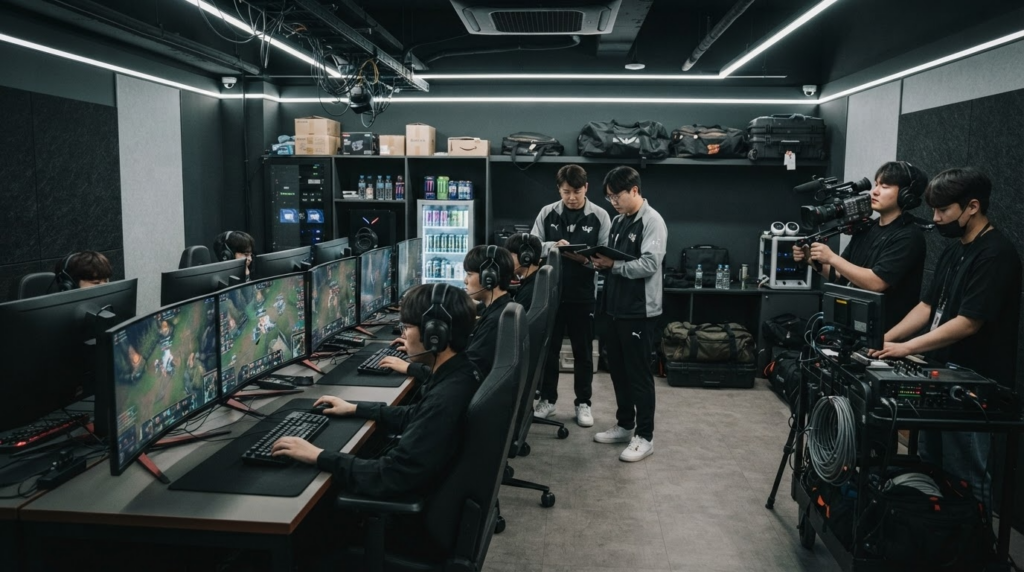
Beyond player and coaching staff salaries, teams also bear costs for training facilities, analytics personnel, content production, international tournament travel, accommodation, and marketing. More international events mean greater exposure, but also higher travel and operational expenses. Smaller teams, in particular, find it difficult to invest in staff and facilities at the same pace as popular teams backed by large corporations. This structure is why teams like Dplus KIA and Nongshim RedForce have been recording operating losses in the tens of billions of won each year.
Prize money is not a stable solution either. It is concentrated among a few teams based on performance and varies from season to season. While the rewards for winning teams are substantial, for mid- and lower-tier teams, prize money is not a predictable source of revenue. In an industry that requires long-term investment in player development and maintaining competitiveness, relying on income that fluctuates wildly based on results is risky.
T1’s First Profit: What the Exception Reveals
T1, which we touched on earlier, epitomizes this structural issue. Between 2019 and 2022, the team racked up annual deficits from tens of billions to over 200 billion won. However, in its 2025 fiscal results, T1 recorded 88.6 billion won in revenue and 2.5 billion won in operating income, marking its first-ever profit. Revenue jumped 80.8% year-over-year, with merchandise sales—including goods—accounting for 74.1 billion won and leading the overall growth.
But it’s premature to see this as a broader industry reversal. T1’s profitability is closer to an outcome achievable only when a globally popular team with top-tier brand power combines IP merchandise with an international fanbase. Even T1 saw its operating expenses climb 25.5% to 30.7 billion won, and despite turning a profit, its accumulated deficit reached 74.1 billion won with a debt ratio of 713%. The team had to conduct a separate capital increase to strengthen its finances. This underscores that smaller clubs with less brand recognition and appeal cannot replicate this model. Rather, T1’s story is the exception that proves the rule.
The Success of Free Viewing Became a Weakness for Broadcast Revenue
eSports was born and raised on digital platforms. The fact that anyone can easily tune into matches on services like YouTube, Chzzk, and SOOP was instrumental in growing the fanbase. Overseas fans can also watch the same games in real time with localized commentary. This ease of access helped eSports transcend geographic boundaries rapidly.
However, the free-to-watch structure makes it difficult to create large broadcast rights deals like those in traditional sports. In the US, sports leagues earn billions from exclusive broadcast contracts, but eSports has struggled to make this model work. Fans are already accustomed to free online streams, and game publishers often view the league as a tool for game promotion and user retention. As a result, it becomes unclear how much of the viewership value generated by the league flows back to the teams. The matches are produced by teams and players, but the game’s intellectual property (IP) is owned by the publisher.
Franchise Systems, IP Businesses, and the Limits of Government Support
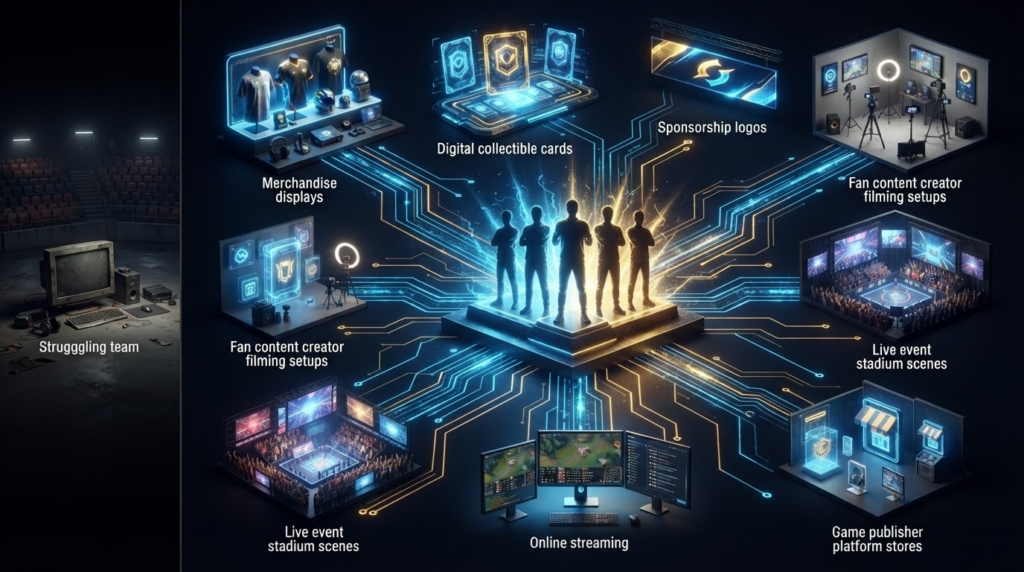
The franchise system was implemented to provide teams with long-term stability and to mitigate the risks of sudden promotion and relegation. It has brought more stability, but a franchise slot itself doesn’t equate to profitability. The latest focus in the industry is on merchandising that leverages player and team IP. Krafton, for instance, shares revenue from skins and merchandise that feature the branding and players of its Battlegrounds global partner teams. Similarly, the LCK has launched a service that distributes income from digital collectibles based on player IP to the clubs. That said, these initiatives are likely to benefit the most popular teams with the biggest fan followings.
The Ministry of Culture, Sports and Tourism has allocated 10.3 billion won for eSports promotion in 2026, a 30.4% increase from the previous year. While this signals an effort to strengthen the industry’s base, public funding is only a starting point. Research from the Korea Creative Content Agency has shown that even the revenue of domestic eSports event operators has declined in some years, suggesting that larger government budgets don’t automatically fix the profitability of individual teams. If clubs keep depending on annual infusions from parent companies and short-term sponsorship contracts, the industry’s self-reliance will stay fragile, no matter how much its popularity rises.
The remaining question for Korean eSports is not “Who is the best in the world?” It is more important whether players can work stably, whether small and medium-sized teams can prepare for the next season, and whether the value created by the fanbase is fairly distributed to the league and teams. The reputation of being the world’s strongest has already been earned. So the real question remains: Can Korean eSports, beyond T1’s singular profit, turn its world-beating reputation into a sustainable economy for the entire industry?
Sources: Kim Jae-hoon, Good Morning Economy, ‘Popular but in the Red: eSports… Plans for Securing Revenue’; Jeong Gil-jong, Z-Economy, ‘World’s Strongest Korean eSports, Why Is the Industry Poor?’, January 26, 2026; T1 2025 Audit Report, March 2026.