
Table of Contents
People Are Looking Up at Tiled Roofs Differently Now
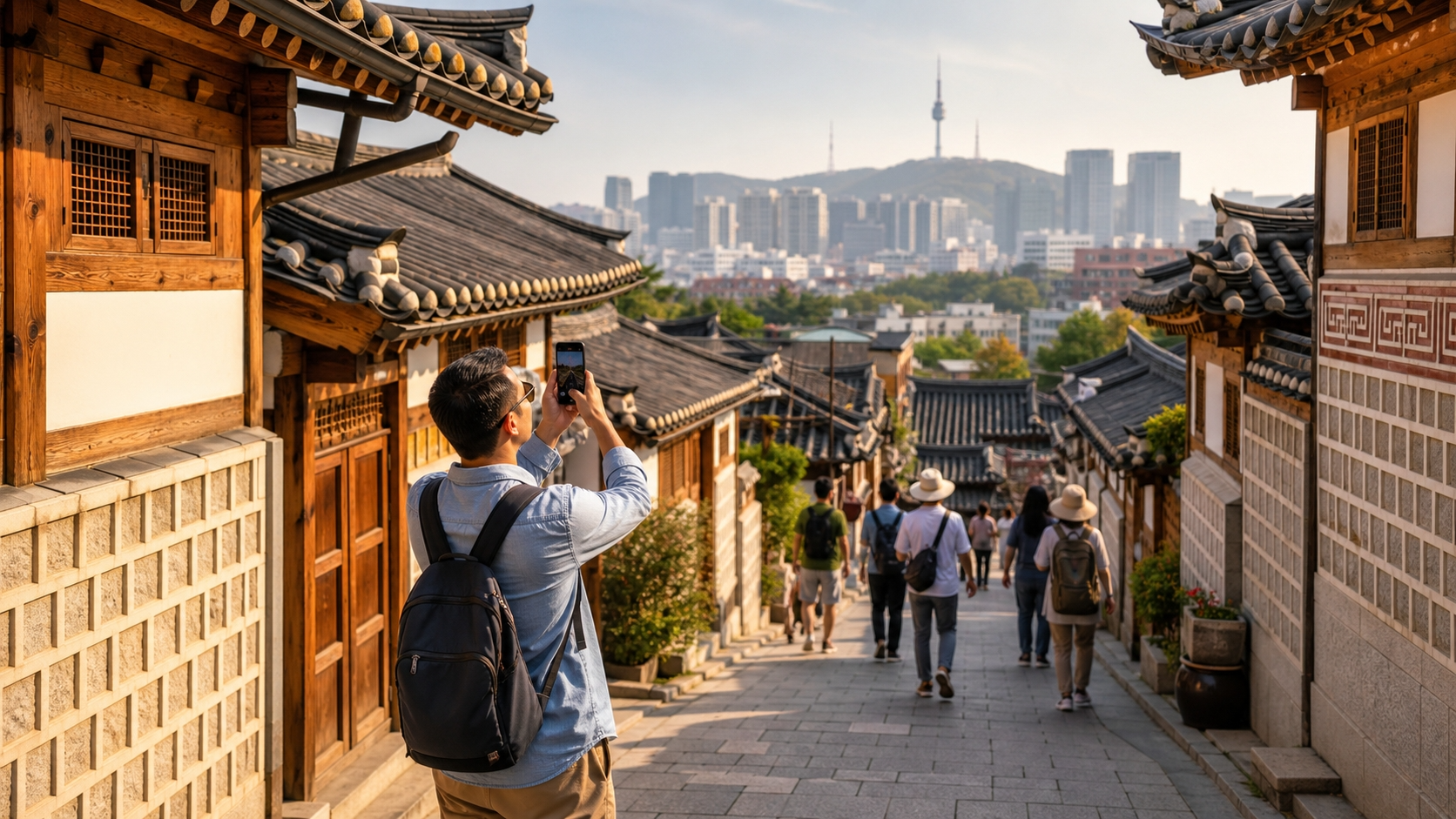
Stand in a Bukchon alley these days and the first thing you’ll notice is travelers tilting their phones up toward the curve of a tiled roof. Someone’s taking photos in hanbok, someone else is hunting for the exact angle that matches the Seoul they saw in an animated film. After KPop Demon Hunters — “Kedehun” here — became a global hit, the demand to see Korea’s traditional architecture and cityscape in person is drawing real attention too.
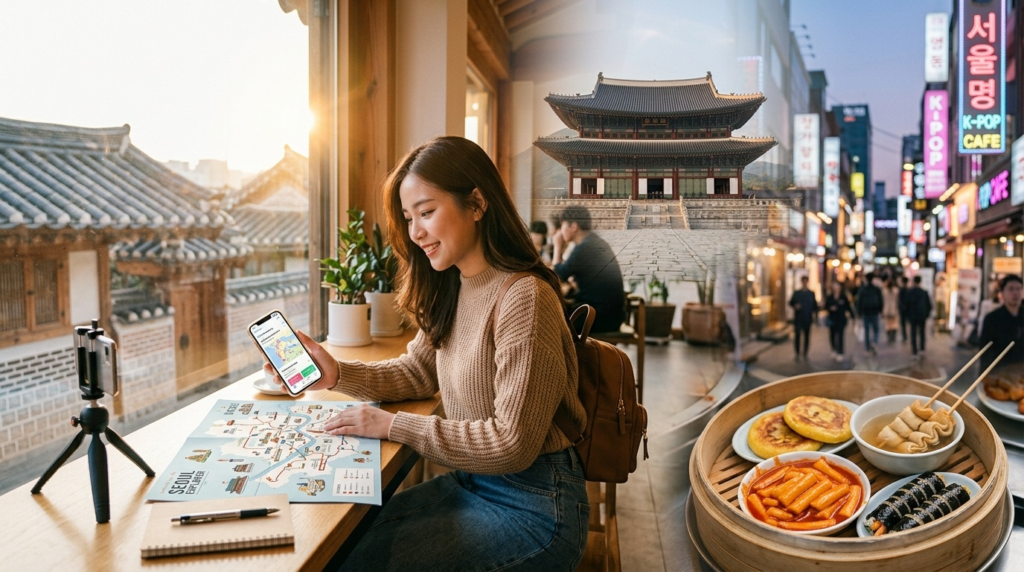
Traveling to a real place after watching it on screen is often called content tourism, or screen tourism. It’s not just about tracking down the exact filming location. It also covers wanting to experience the food, the music, and the mood of the streets a piece of content showed you. Because KPop Demon Hunters reconstructs a real-feeling Seoul rather than filming an actual location, it tends to send travelers looking less for one precise spot and more for the “Korean-ness” they felt on screen, in real space.
What Spain’s 146% and Germany’s 122% Actually Mean
According to data released by Trip.com, flight bookings from Spain to Korea between June 20 and August 31, 2025 rose 146% year over year. Germany was up 122%, Italy 107%, and the whole of Europe rose 79%. Bookings from Canada and Australia also climbed more than 50% and 20%, respectively.
These numbers come from a travel platform’s year-over-year booking data, not a tracked study of the same people before and after KPop Demon Hunters came out. So it’s a stretch to credit the entire increase to one animated film. Flight capacity, exchange rates, and seasonal demand can all move numbers like this too. Still, the release timing overlapped with the surge in European bookings, and the platform itself pointed to K-pop-themed animation and content-driven travel demand as a major factor behind it.
That Bukchon 118% Number Deserves a Careful Read
A content-tourism analysis released in July by K-EnterTech Hub reported that foreign visitors to Bukchon Hanok Village rose 118% after KPop Demon Hunters. The same report surveyed 105 foreign nationals from the U.S., U.K., Singapore, Japan, and the Philippines, finding that 72% of people who’d watched Korean content said they intended to visit Korea, versus 37% of non-viewers.
But the survey pool was foreign nationals already living in or having visited Korea, and the sample per country was small — just 15 to 40 people. The researchers themselves described it as descriptive statistics meant to show a directional trend, not something to generalize to entire countries. Bukchon’s 118% figure also came with the comparison period and how visitor numbers were actually measured left unclear in the published reporting. It’s an interesting signal, but it needs more data before you can read it as a settled cause-and-effect story.
There Are Seven Steps From Watching to Booking
The researchers described the process of content turning into travel as seven stages: exposure, interest, search, booking, visit, spending, and return visit. Of 100 viewers, 85 stayed through the search stage and 72 through intent-to-visit — but only 38 actually booked, 31 visited, and 26 spent money locally. Just 11 turned into long-term repeat visitors.
I’ve done this myself more times than I’d like to admit — watching a travel video, searching flight prices, then just closing the tab. There’s a real wall between interest and actually paying: flight time, hotel cost, language, transit. If content lights the spark for a trip, travel services are the ones who have to keep that spark from going out by connecting the dots — multilingual booking, filming-location info, local shops and experience programs all matter here.
If You Go to Bukchon, Walk After 10 A.M.
Bukchon isn’t a theme park — it’s a neighborhood where people actually live. Jongno-gu designated roughly 34,000 square meters around Bukchon-ro 11-gil as a “red zone” special management area, restricting tourist access from 5 p.m. to 10 a.m. the next day. Visitors can walk the area between 10 a.m. and 5 p.m. Break the restricted hours and you could face a fine of 100,000 won.
Please also keep your voice down while walking, and don’t photograph residents’ doors or windows. Rather than making Bukchon the whole trip, consider connecting it by public transit to places like the National Museum of Korea, Gyeongbokgung, or Myeongdong — spots that this kind of content has also boosted interest in. When a trip chasing the Korea you saw on screen doesn’t crowd out the daily life of the people who actually live there, content tourism can be more than one photo for proof of the trip — it can become an experience worth coming back for.
Source: K-EnterTech Hub “K-Content Tourism” survey, Digital Daily, July 5, 2026; Trip.com flight booking data, Sports Kyunghyang, September 12, 2025; Jongno-gu Office Bukchon special management zone notice, confirmed August 11, 2026.