
Table of Contents
The Disappearing Lines of Sunday Afternoon on Songridan-gil
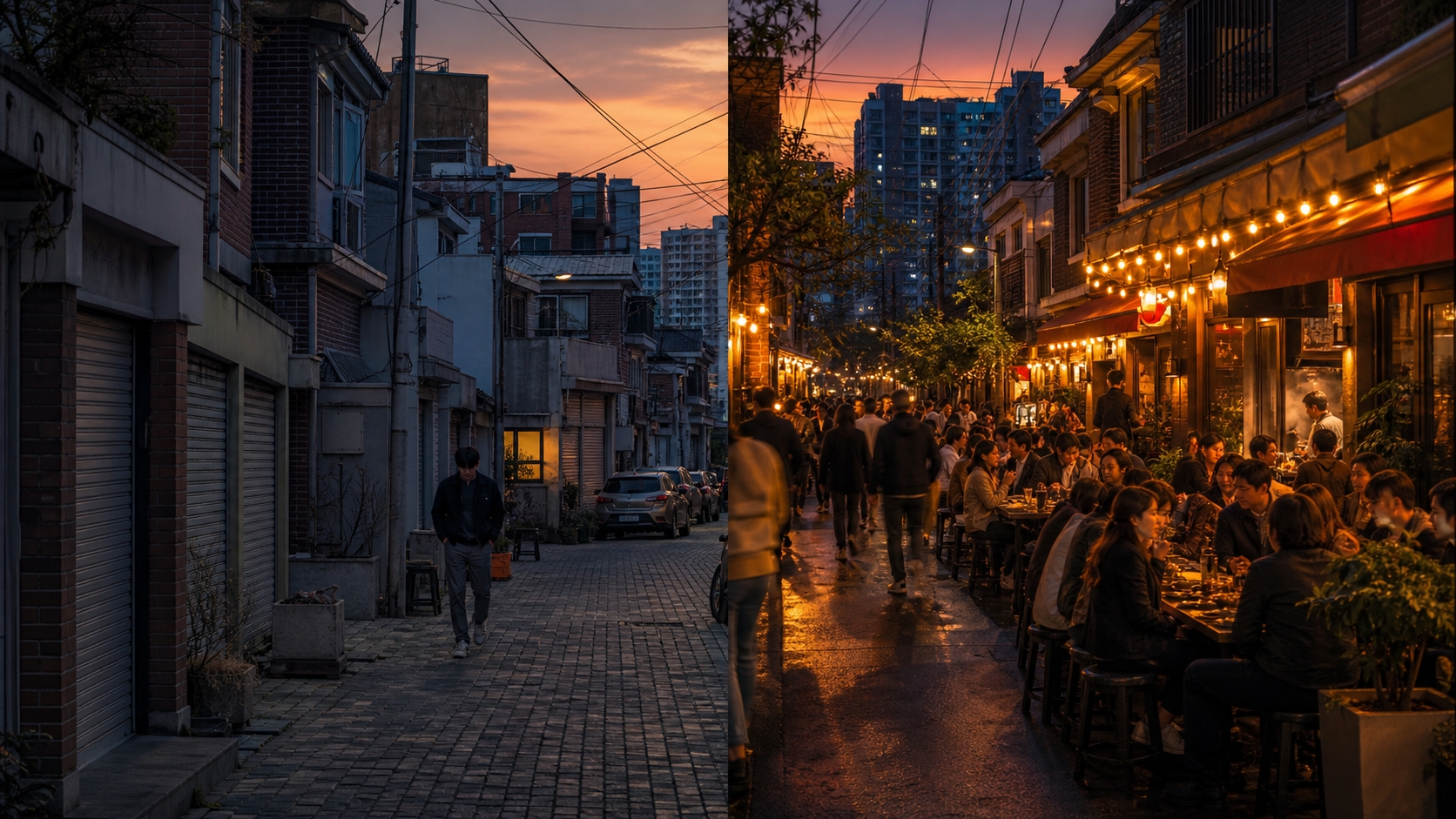
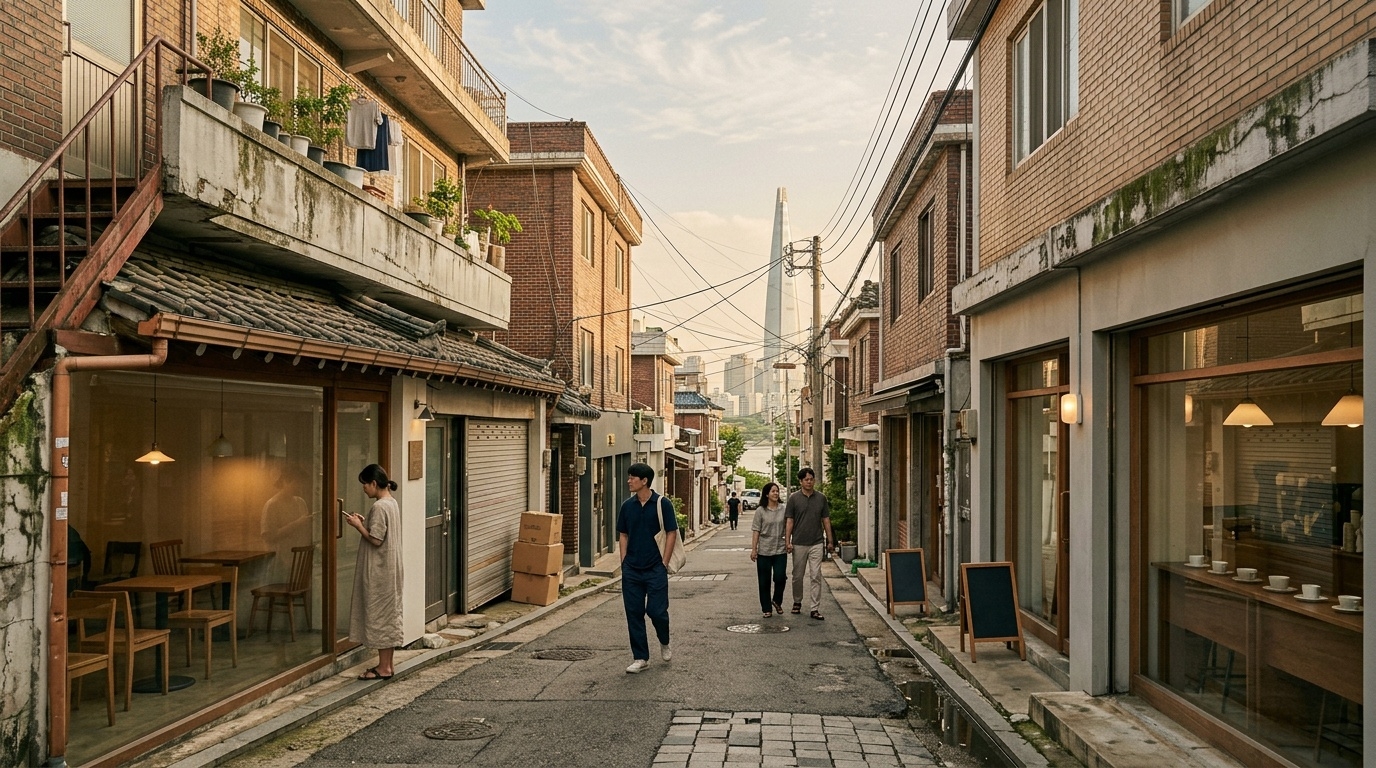
On the afternoon of Sunday, August 30, the long queues that once defined Songridan-gil in Seoul’s Songpa District were nowhere to be found. Foot traffic was sparse, and “for rent” signs hung in the windows of several local real estate agencies. The street felt a world away from its reputation as a bustling hotspot where people would eagerly wait outside trendy cafes and restaurants.
Songridan-gil made its name as a quirky collection of cafes and eateries tucked into the residential alleys just east of Seokchon Lake. Even its name is a nod to Gyeongridan-gil, one of Seoul’s original trendy neighborhoods. Because it grew organically—with independent shops popping up among everyday homes rather than as part of a master-planned shopping mall—the entire neighborhood is highly sensitive to shifting trends and the opening or closing of magnet stores.
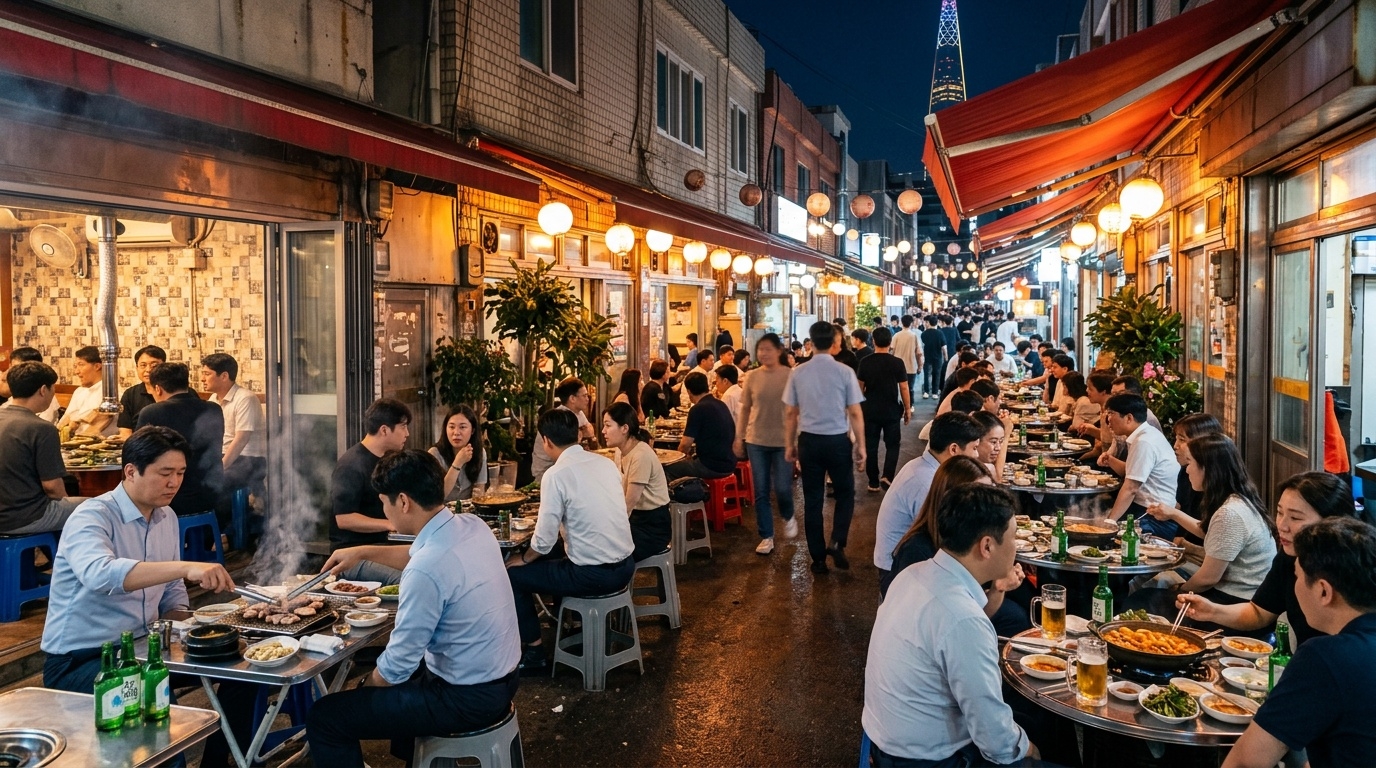
Just a ten-minute walk away, however, the Bangi-dong food alley painted a very different picture. As the sun began to set, neon signs flickered to life across the buildings, drawing in a growing crowd looking for dinner and drinks. Although both neighborhoods share the same Jamsil tourism zone anchored by Lotte World and Seokchon Lake, the way visitors spend their time—and the economic pulse of the storefronts—seem to be moving in entirely opposite directions.
Diverging Fortunes: Closure Rates Rise in Songpa 1-dong, Fall in Bangi 2-dong
This stark on-the-ground contrast is reflected in local business closure rates. According to Seoul’s commercial district analysis service, the closure rate for dining, retail, and service businesses in Songpa 1-dong—home to Songridan-gil—hit 2.8% in the second quarter of 2026. After dropping from 3.1% in 2024 to 2.6% in 2025, the rate has crept back up this year. These numbers suggest the recent quietness of the streets is more than just a sluggish Sunday afternoon.
Meanwhile, over in Bangi 2-dong, where the food alley is located, business closures have steadily declined for three consecutive years: 3.6% in 2024, 3.1% in 2025, and 2.4% in 2026. Back in 2024, Bangi 2-dong actually had a higher closure rate than Songpa 1-dong, but by 2026, the tables had completely turned. Two neighborhoods in the exact same Jamsil orbit are now heading down entirely different paths.
Closure rates simply measure the percentage of businesses that shut their doors over a given period; they don’t tell the whole story about sales, foot traffic, or individual profit margins. Yet, watching these numbers over a few years offers a clear window into whether a neighborhood is becoming a stable home for businesses or a revolving door of high pressure and turnover. The growing gap between Songpa 1-dong and Bangi 2-dong makes it clear that we can no longer treat Jamsil as a single, uniform commercial district.
2.8%: A High Figure Among Seoul’s Major Hubs
Songridan-gil’s 2.8% closure rate stands out even when placed alongside Seoul’s other major hotspots. During the same period, Hangangno-dong (home to Yongridan-gil) sat at 2.2%, while the bustling Gangnam Station area of Yeoksam 1-dong was at 2.1%. Euljiro-dong and Hapjeong-dong both recorded 1.9%, and Myeong-dong came in at just 1.4%. While every neighborhood has a different scale and mix of businesses, these numbers highlight a palpable sense of instability for shop owners on Songridan-gil.
Locals attribute this widening gap to the distinct vibes and purposes of the two neighborhoods. Cheon, a resident of Bangi-dong, noted that locals naturally gravitate toward the food alley with its deep roster of dining options. To him, Songridan-gil is a place for tourists, characterized by long wait times rather than everyday utility. His observation points to a hard truth: no matter how famous a street becomes on social media, failing to capture the repeat business of local residents leaves its economic foundation dangerously fragile.
Kim Soo-hyun, visiting from Jungnang District, felt that Songridan-gil lost its unique charm as copycat shops flooded in following its initial surge in popularity. While a wave of novel cafes and restaurants originally put the alley on the map, a neighborhood quickly loses its edge when every storefront begins to look and feel the same. A trendy reputation might linger online, but without a genuinely differentiated on-the-ground experience, those famous long lines and repeat visits inevitably fade.
Dwindling Crowds, Mounting Rent
For the merchants of Songridan-gil, the most crushing burden right now is rent. According to data from the Korea Real Estate Board, the converted monthly rent for first-floor commercial spaces in the area jumped 7.6%, from 142,900 won per 3.3 square meters in the second quarter of 2024 to 153,716 won in the same period of 2026. When foot traffic and revenue fail to keep pace with soaring rent, independent shops are quickly suffocated by fixed costs.
One merchant, who has run a Korean restaurant on Songridan-gil for nine years, shared that they recently had to pay around 50 million won in “key money” (a premium) just to relocate within the same alley. This premium—a sum paid by a new tenant to the previous one for the accumulated value of the space, including fixtures, clientele, and location perks—drastically inflates the initial cost of opening a business, making new entrepreneurs think twice before setting up shop here.
When rent and key money remain stubbornly high despite thinning crowds, breathing new life into a neighborhood becomes incredibly difficult. High overhead forces incoming business owners to play it safe with predictable, proven cafe and restaurant formats rather than experimenting with fresh concepts. This creates a vicious cycle: the street loses its distinctiveness, leading to a further drop in visitors.
Why Bangi-dong Holds Onto the Evening Crowd
The Bangi-dong food alley was never trying to be a chic cafe street; it was built with a clear, timeless purpose: dining and drinking. It offers a dense cluster of practical dining options that draw not just tourists, but nearby residents and office workers time and time again. Rather than relying on one-off visitors seeking the perfect photo for their social media feeds, its economic structure is anchored in the reliable, everyday rituals of post-work dinners and friendly get-togethers.
The contrasting scenes on August 30 perfectly captured this dynamic. While Songridan-gil sat surprisingly quiet on a Sunday afternoon, Bangi-dong only grew livelier as evening approached. The two neighborhoods operate on entirely different internal clocks. Bangi-dong’s establishments know exactly what they are offering, easily capturing the evening crowd looking for a hearty meal and a good drink.
Looking at the stark contrast between these two streets, it becomes clear that a famous name and viral social media exposure are no guarantee of longevity. If Songridan-gil’s original magic was the thrill of stumbling upon a quirky, undiscovered shop, the influx of generic storefronts has largely broken that spell. Bangi-dong, on the other hand, might not be at the cutting edge of modern trends, but it holds a massive advantage: everyone knows exactly why they are going there.
Can Expanding the Tourism Zone Revive the Alleys?
On August 27, the Seoul Metropolitan Government announced that Songridan-gil, Bangi Market, and Bangi Food Alley would be officially integrated into the Jamsil Special Tourist Zone. This expansion increases the zone’s area from 2.31 to 2.75 square kilometers. These designated zones benefit from focused administrative efforts to improve convenience and infrastructure, specifically aimed at attracting and retaining foreign tourists. It is a strategic move to stretch the gravitational pull of Lotte World and Seokchon Lake deeper into the surrounding local neighborhoods.
The city plans to design circular walking routes connecting major attractions with these smaller commercial alleys, while also improving links with the city’s public bicycle system. To make the local shops more accessible to international visitors, efforts will be made to expand mobile payment systems and multilingual menus. The strategy also includes leveraging existing local charm, such as organizing food-centric events tied to Bangi Market.
The ultimate goal isn’t just to bump up the raw number of tourists visiting Jamsil. The city wants to redraw the map of how visitors spend their time and money, coaxing those who came for Lotte World or the lake to wander into Songridan-gil and Bangi-dong for dinner and shopping. By demystifying the local geography for international tourists and smoothing over payment hurdles, the city hopes to tempt them out of the mega-complexes and into the streets.
A Reason to Stay Matters More Than Just Drawing a Crowd
Kim Yong-jin, a business professor at Sogang University, pointed out that Songridan-gil currently lacks unique content. He noted that instead of developing a vibrant pop-up culture like Hongdae that actively engages the youth, the street has plateaued as merely a place to eat and drink. Cha Nam-soo, the head of policy and public relations at the Korea Federation of Micro Enterprises, echoed this, emphasizing that the real key to revitalization is having a diverse mix of businesses and content that naturally connect with the surrounding area. Both experts agree: having a concrete reason to visit is far more vital than sheer foot traffic.
Being folded into the special tourist zone might open up new pathways for visitors to discover Songridan-gil, but an influx of tourists doesn’t automatically heal an ailing commercial district. Better signage and seamless payment options undoubtedly lower the barrier to entry. Yet, actually convincing people to walk deeper into the alleys and spend money at multiple shops is a job that only unique storefronts and compelling local culture can do. The neighborhood fundamentally needs an environment where distinctive, independent shops can actually survive the rent.
The contrast between the sleepy Sunday streets of Songridan-gil and the bustling evening energy of Bangi-dong is a perfect study in how differently consumer intentions play out, even within the same district of Jamsil. The real test moving forward is whether the expanded tourist zone will merely provide a temporary bump in visitors for Songridan-gil, or if it can help the street forge a lasting, compelling reason for both locals and tourists to return, just as Bangi-dong has. Stitching two neighborhoods ten minutes apart into a single tourist route is easy on paper; the far harder task is creating an ecosystem where both alleys maintain their distinct charms while sharing the flow of people and prosperity.
Sources: Edaily, September 2, 2026; Seoul Metropolitan Government Press Release, August 27, 2026; Korea Real Estate Board Commercial Real Estate Rental Trend Survey.