
Table of Contents
A Procession Born from Eight Days in 1795
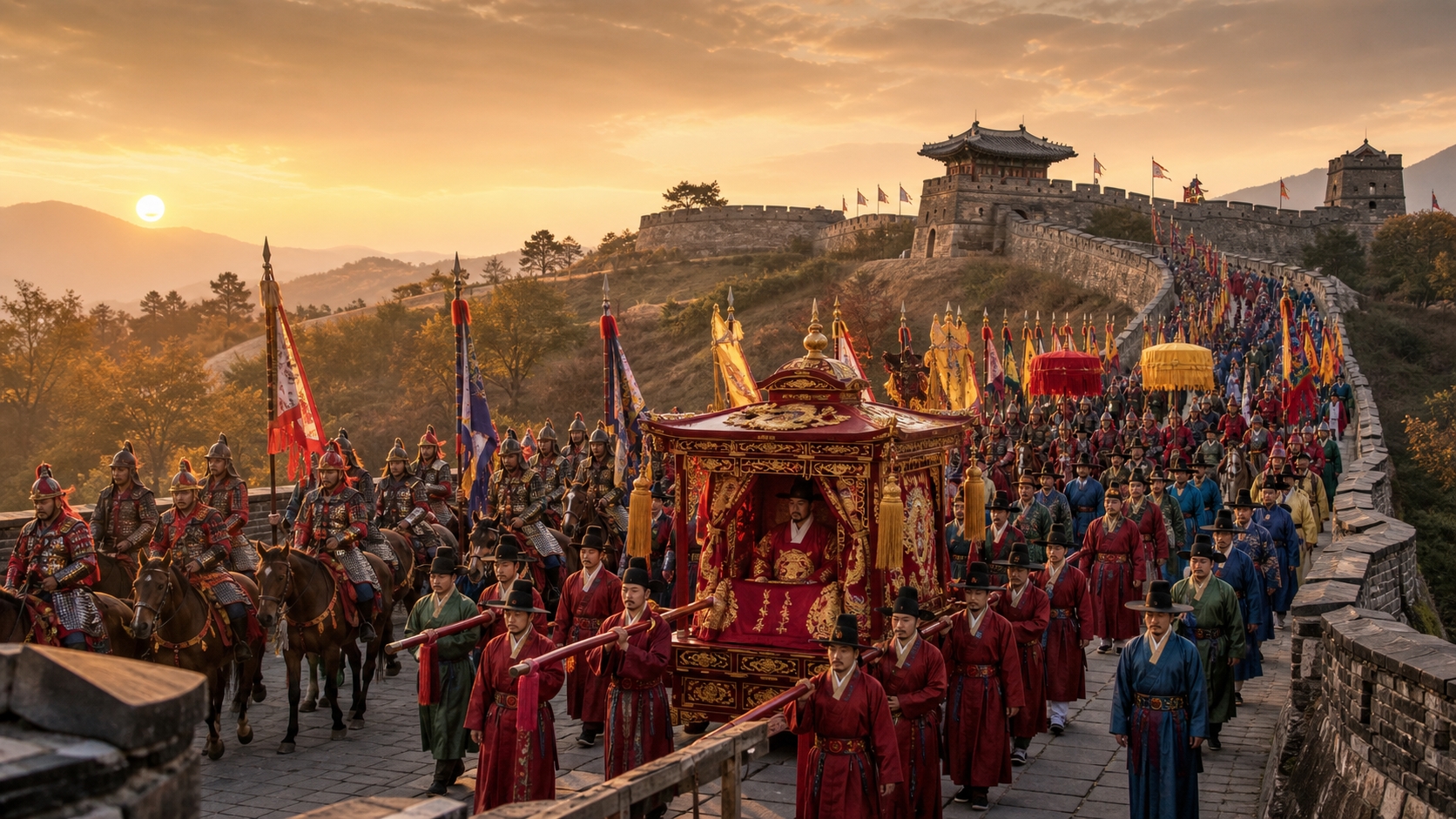
In the leap month of February 1795, King Jeongjo, the 22nd ruler of the Joseon Dynasty, departed Hanyang with his mother, Lady Hyegyeong. Their destination was Hyeollyungwon, the tomb of his father, Crown Prince Sado (a site known today as Yungneung in Hwaseong, Gyeonggi Province). Intended to celebrate Lady Hyegyeong’s 60th birthday and honor his parents, this journey was a monumental state event requiring massive personnel and resources. The movement of the royal family, the tomb visit, banquets, and various ceremonies were seamlessly woven into a single itinerary.
The royal procession spanned eight days, from the 9th to the 16th of the leap month. The composition of the entourage, the rituals, and the schedule were all meticulously documented, providing the foundation for modern reenactments of this royal procession. Now, 231 years later in 2026, the main sections of that very route will come alive again through a massive citizen parade.
The historical record capturing this journey is the Wonhaeng Eulmyo Jeongni Uigwe. An Uigwe is an official royal protocol book that details the procedures of major events and ceremonies through text and illustrations. Because it specifies exactly who participated, what their roles were, and the precise sequence of rituals, today’s royal procession is not merely a work of historical imagination, but a scene reconstructed from hard evidence. A piece of documentary heritage is effectively being reused as the blueprint for a modern street festival.
Coming Alive for a Day from Seoul to Hwaseong
On Sunday, October 4th, the cities of Seoul, Suwon, and Hwaseong, along with Gyeonggi Province, will jointly host the “2026 King Jeongjo Tomb Parade Reenactment.” This one-day event connects multiple sections from Seoul to Suwon and Hwaseong, stretching from Gyeongbokgung Palace to Yungneung Tomb for a total reenactment length of 31.8 kilometers. Approximately 4,000 citizens and performers, alongside 108 horses, will take part. This long procession of people and cavalry visually revives the sheer scale of the royal journey right in the middle of modern urban spaces.
Rather than attempting to move continuously over eight days like the 1795 original, local governments divide and recreate select sections and scenes. In Seoul, the parade kicks off with the departure ceremony at Gyeongbokgung Palace. Suwon hosts a grand parade centered around its fortress walls and Hwaseong Haenggung Palace, while the Hwaseong segment culminates in the ancestral rites at Yungneung. It is a wide-reaching historical and cultural event where multiple cities link arms to recreate a single historic journey.
The reason behind the joint hosting by four local governments is deeply tied to the spatial scope of the original march. King Jeongjo’s procession started at the palace, traversed multiple regions, and finally reached his father’s tomb. Today, that once-unified path is split across different administrative districts and urban landscapes. By stitching together the segments managed by each region, spectators experience a moving panorama of history unfolding section by section, rather than watching a stationary stage.
Seoul’s Royal Procession Met Through Bongsan Talchum and Gyeokjaeng
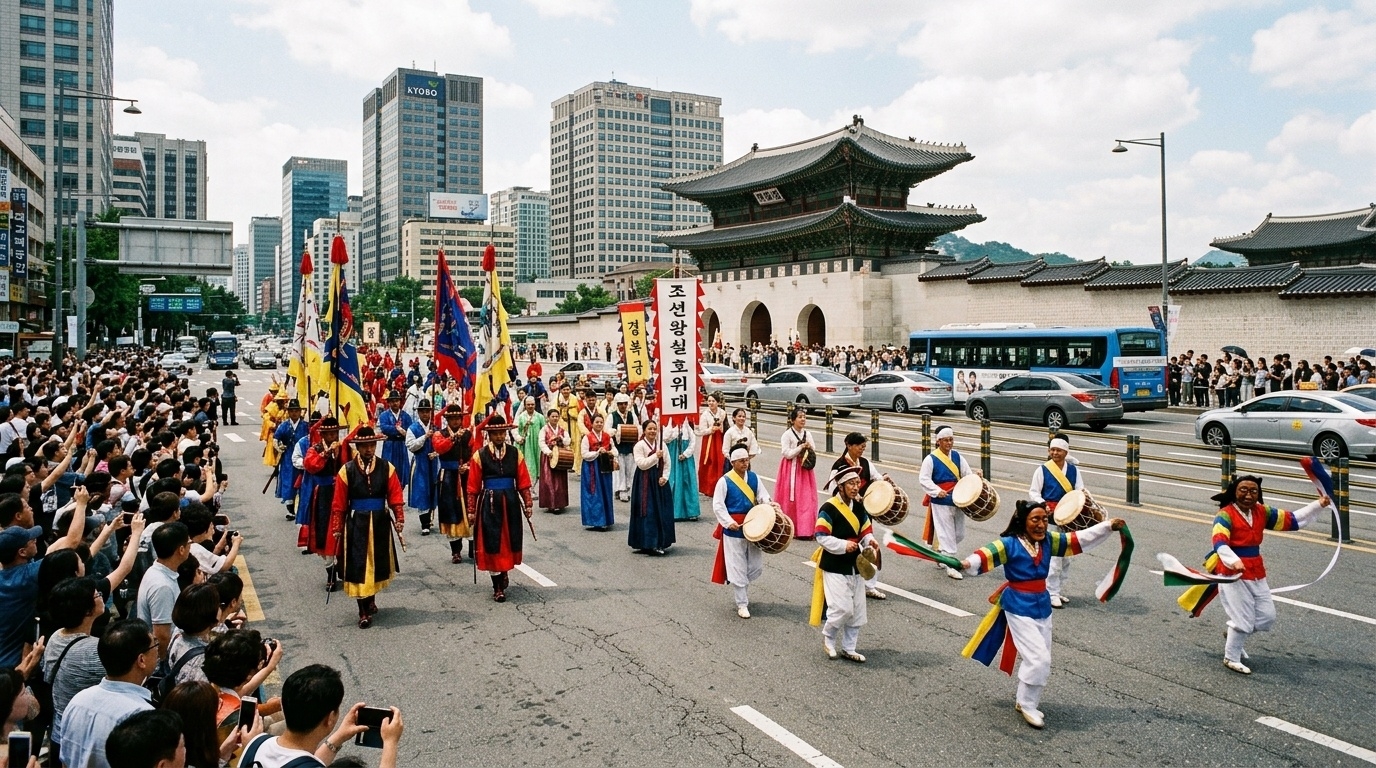
The Seoul section begins with the king’s departure ceremony at Gyeongbokgung Palace, weaving through the city center toward Nodeul Island and Nodeulnaru Park. While Gyeongbokgung holds the symbolic weight of the starting point, the downtown route overlays the royal movement of the past onto the daily spaces of modern citizens. With pre-registered citizens joining the march, the royal procession transforms from a mere spectacle into a shared, walking historical experience.
On the road from Sookmyung Women’s University Station to Yongsan Station, a Bongsan Talchum street performance takes place. Bongsan Talchum is a traditional Korean mask dance that blends dance with sharp satire, and Korean mask dance as a whole is inscribed as a UNESCO Intangible Cultural Heritage of Humanity. As the mask dance, brimming with grassroots humor, merges with the strict order and hierarchy of the royal procession, two distinctly different traditional cultures intersect on the very same street.
On Nodeul Island, performances and programs unfold to explore King Jeongjo’s historical background. Meanwhile, Nodeulnaru Park features the reenactment of Jeongjo offering rice gruel to Lady Hyegyeong, as well as a Gyeokjaeng scene. Gyeokjaeng was a system where commoners could strike a gong to halt the king’s procession and directly appeal their grievances. Nestling this moment of listening to the people’s voices within the royal parade highlights both Jeongjo’s filial piety and his deep devotion to his subjects.
Tradition and Modern Performance Intersect in Suwon
In the Suwon section, citizens and reenactors march past the Suwon Hwaseong Fortress and head toward the Hwaseong Haenggung Palace. Suwon Hwaseong is the heart of the planned city built by King Jeongjo, a space that encapsulates his political vision. While Seoul marks the beginning of the procession, Suwon portrays the moment the royal entourage enters the very city Jeongjo created. Because the parade moves against the backdrop of ancient fortress walls, gates, and the palace, the location itself serves as part of the historical narrative.
Here, the tomb procession joins a citizen parade, martial arts demonstrations from the Joseon era, and traditional percussion performances. The Haenggung Square program also introduces AI robot dances and contemporary stages. The finale will feature a blended performance of bands, dancing, and traditional communal games. Placing robots and modern pop culture performances right next to traditional costumes and equestrian parades is a deliberate attempt to reinterpret the historical original as a lively contemporary civic festival.
This fusion captures the dual nature of the tomb procession. On one hand, it is a historical reenactment that faithfully resurrects royal rituals and movement routes based on archival records; on the other, it is a local festival where citizens actively participate and enjoy modern performances. Rather than replicating every single element exactly as it was in 1795, the event maintains the historically grounded core of the procession while layering on programs that engage today’s audiences.
The Meaning of the Procession Returning to the Rites at Yungneung
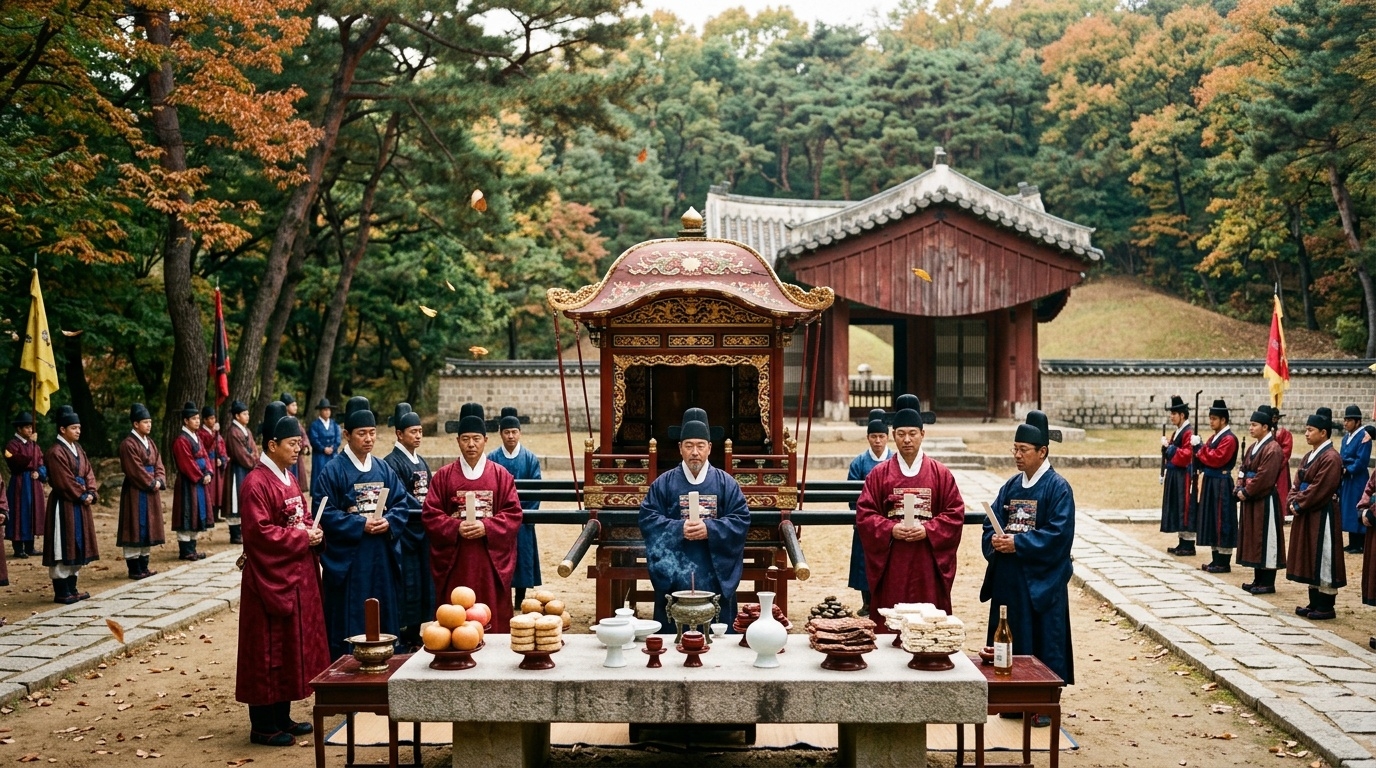
The final destination of the parade is Yungneung in Hwaseong. The journey that passed through the palaces of Seoul and the planned city of Suwon culminates at the very spot where King Jeongjo went to see his father. At Yungneung, the royal palanquin procession for the royal tomb rites and the ancestral memorial service at Hyeollyungwon are held. These memorial rites, honoring the deceased at their tomb, serve to reconnect the grand, colorful procession of the departure point back to its fundamental purpose.
After the rites conclude, eumbok rice cakes are shared with the citizens. Eumbok is the act of sharing the food offered during an ancestral rite after the ceremony is over. This closing gesture ensures that people don’t just watch the royal rites from a distance; they share in the event’s meaning together. Having left Gyeongbokgung, passed through mask dances, Gyeokjaeng, martial arts, and urban festivals, the procession finally arrives at the place where Jeongjo sought out his father.
The 2026 tomb procession is not a strict, carbon-copy restoration of the 1795 royal journey, but a festival that reimagines the recorded scenes to fit the spaces and culture of a modern city. Beyond the sheer scale of 4,000 people and 108 horses, the event allows Bongsan Talchum and Gyeokjaeng, martial arts and ancestral rites, and Haenggung Square’s robot dances and pop culture to coexist seamlessly. Gyeongbokgung marks the start, Suwon Hwaseong is Jeongjo’s city, and Yungneung is the final destination of that filial journey. It is a day spent tracing how a royal path from 231 years ago has transformed into a living historical and cultural experience for the citizens of today.
Source: Seoul Metropolitan Government Press Release, Yonhap News, Suwon Cultural Foundation, October 1, 2026.