
Table of Contents
A Treasure since 2008, now up for National Treasure status
The Korea Heritage Service has announced plans to designate the Gilt-bronze Buddhist Shrine of Cheoneunsa Temple in Gurye, the largest bulgam (Buddhist shrine) known to survive, as a National Treasure. The October 30 announcement comes 18 years after the shrine was designated a Treasure in 2008. The agency also gave notice that nine other pieces, including Buddhist paintings and statues, old books and architectural roof tiles, will be considered for Treasure status.
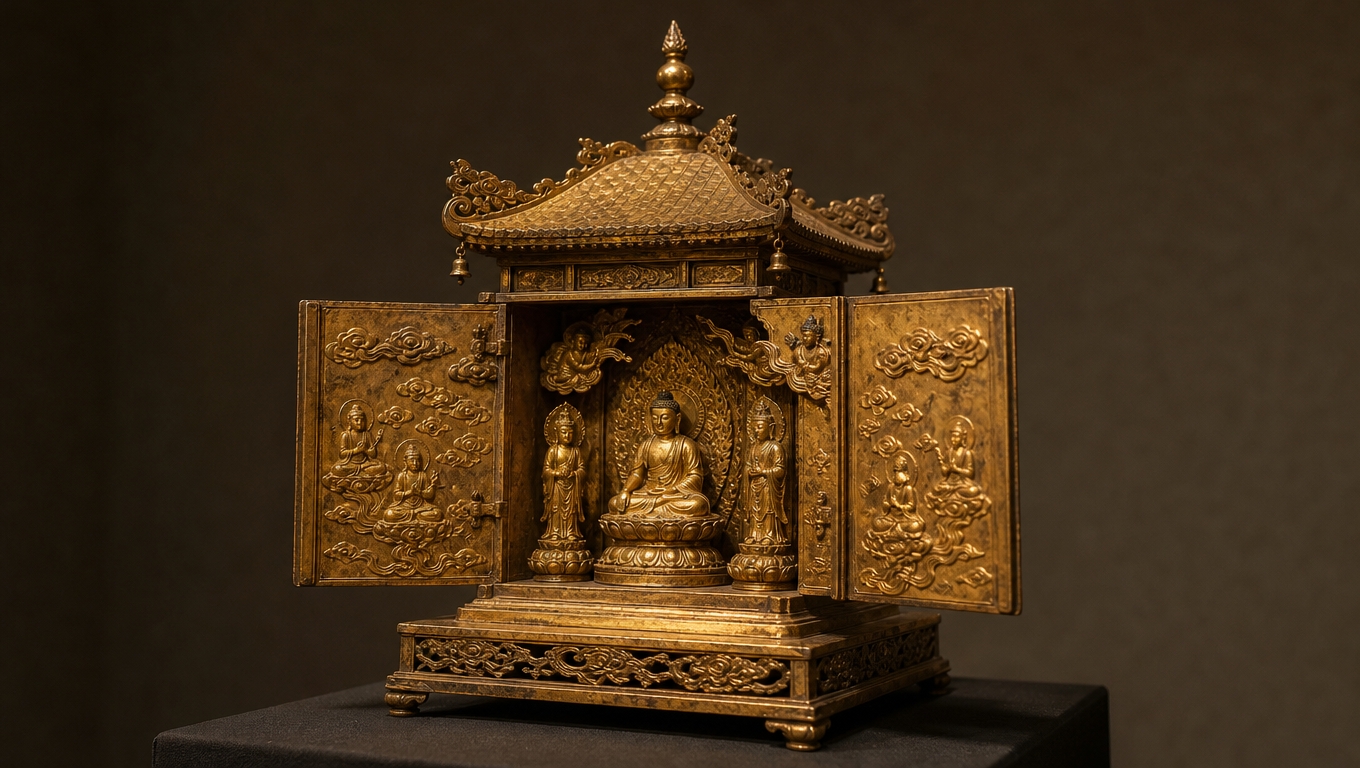
A bulgam is a small enclosure made to hold Buddhist statues. The Cheoneunsa shrine takes the form of a temple’s main worship hall shrunk down to the size of a small house. It is 43.3 centimeters tall, 38 centimeters wide and 21 centimeters deep. Open its doors and you find several Buddhist figures and scenes from the Buddhist world arranged inside the miniature building.
This is a notice of intent, not a final decision. The Korea Heritage Service will collect and review opinions for 30 days, and the National Heritage Committee will then decide whether to go ahead. The same process will weigh the shrine’s upgrade to National Treasure and the historical and artistic value of the nine proposed Treasures.
Goryeo metalwork inside a miniature building
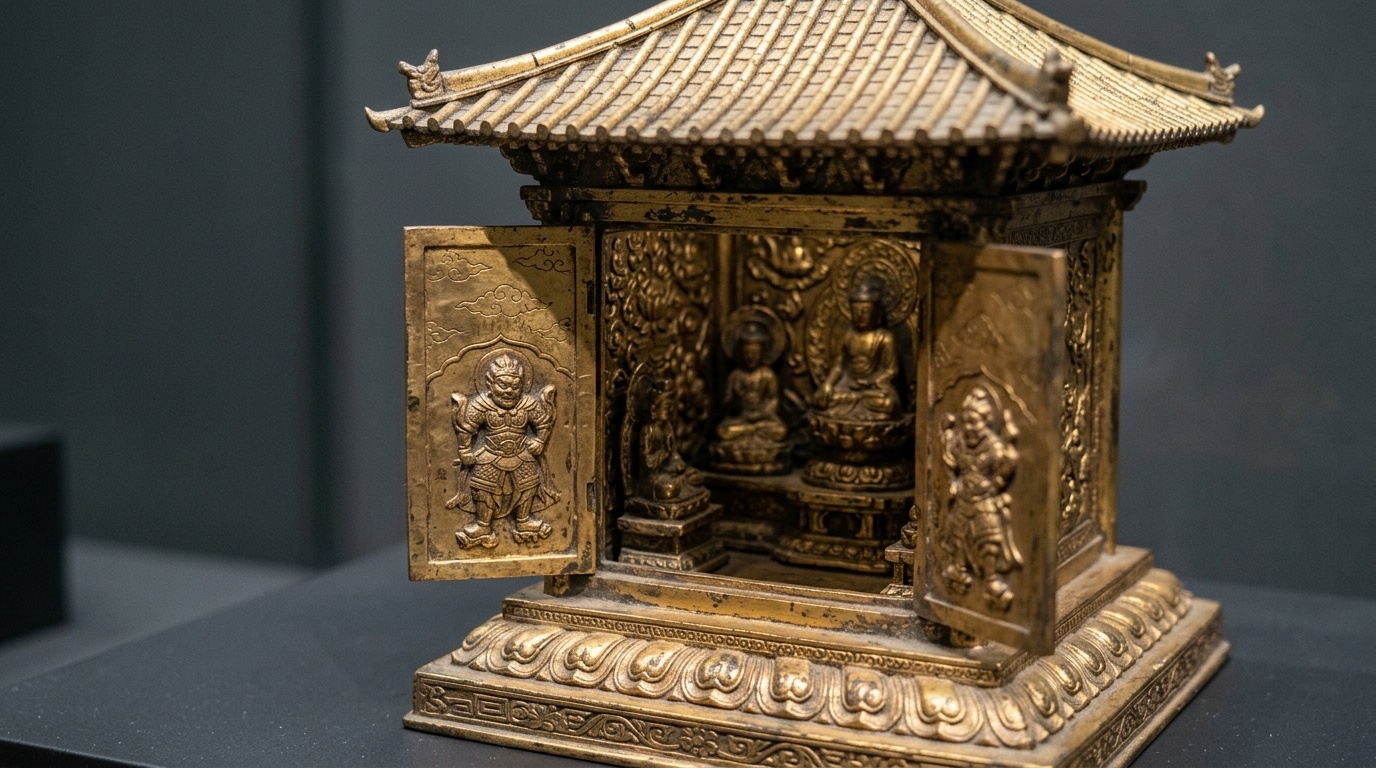
The shrine sits on a square base under a hipped roof, a style called ujingak in which the roof slopes down on all four sides. Cloud patterns decorate the outside of the front doors, and the inside of the doors shows Vajrapani, the guardian figures who protect the Buddhist teachings. The designs were made by repoussé, hammering a metal sheet to raise the pattern in relief.
On the back wall inside sit Vairocana Buddha with attendant bodhisattvas and the Ten Great Disciples. The left wall shows the Medicine Buddha (Bhaisajyaguru) with two attendants, and the right wall shows Amitabha Buddha with two attendants. Two of the separately made gilt-bronze statues that once stood inside still survive. The base has five mounting holes, so the shrine probably held five statues originally.
An inscription on the back names the craftsmen: Sinseung, who made the statues, and Gimchi, who made the shrine. It also lists the donors who paid for the work, among them a married couple surnamed Bak. The record tells us who built the piece and who commissioned it, not only what it looks like. The Korea Heritage Service pointed to this documentary value and to the shrine’s rarity, since few late Goryeo shrines in the shape of a building have survived.
Nine proposed Treasures, from a recovered painting to roof ornaments
The nine proposed Treasures are three Buddhist paintings, three Buddhist statues, two sets of old books and documents, and one set of architectural roof ornaments. Among them is the Vulture Peak Assembly painting inscribed with the name Yongyeonsa, which was stolen and recovered last year, in 2025. It shows Shakyamuni Buddha preaching the Lotus Sutra on Vulture Peak. Its inscription records that it was painted in 1731 by a team including the monk painter Seoljam and that it was first enshrined at Yongyeonsa Temple.
The other two paintings are the Amitabha Buddha Preaching and the Thousand-armed Avalokitesvara, both from Gounsa Temple in Uiseong. The statues are the Wooden Seated Shakyamuni Buddha Triad and Enshrined Objects from Yeonheungsa Temple in Yeonggwang, the Wooden Seated Shakyamuni Buddha Triad of Chiljangsa Temple in Anseong, and the Wooden Seated Ksitigarbha Bodhisattva of Yeongcheonsa Temple in Naju. Enshrined objects are the items sealed inside a statue when it is consecrated. Paintings and sculpture are being reviewed together in this round.
The books are Baktongsa and a collection of documents from Dosan Seowon. The roof ornaments are a chwidu and geompa excavated at Yangjam-ri in Taean. A chwidu is a large decorative tile set at each end of a roof’s highest ridge. A local resident reported the pieces in 2019, and they were recovered in 2021 and 2022. They are thought to date from the early Joseon period and to have been made by craftsmen of the Waseo, the government office in charge of making roof tiles.
What it means to move up to National Treasure
National Treasures and Treasures are both categories of heritage designated by the Korean state. Treasures are important tangible heritage items such as buildings, paintings, sculpture, crafts and books. National Treasures are chosen from among items that qualify as Treasures, when they have great value in terms of human culture and few or no equivalents.
So the proposal means the Cheoneunsa shrine, already protected as a Treasure, has been reassessed against the National Treasure standard. Besides its size, the agency cited the way a single object preserves an architectural form, Buddhist iconography, metalworking technique, and a written record of both its makers and its donors.
The Korea Heritage Service will move to final designation after the comment period and the committee review. For now the Cheoneunsa shrine remains a Treasure with a pending National Treasure designation, and the nine other items announced with it are awaiting their own Treasure reviews.
Sources: Korea Heritage Service press release, Oct. 30, 2026; News1, Oct. 30, 2026; ZDNet Korea, Oct. 30, 2026; Korea Heritage Service heritage portal.


