
Table of Contents
Three Century-Old Temple Restrooms Head Toward Heritage Status
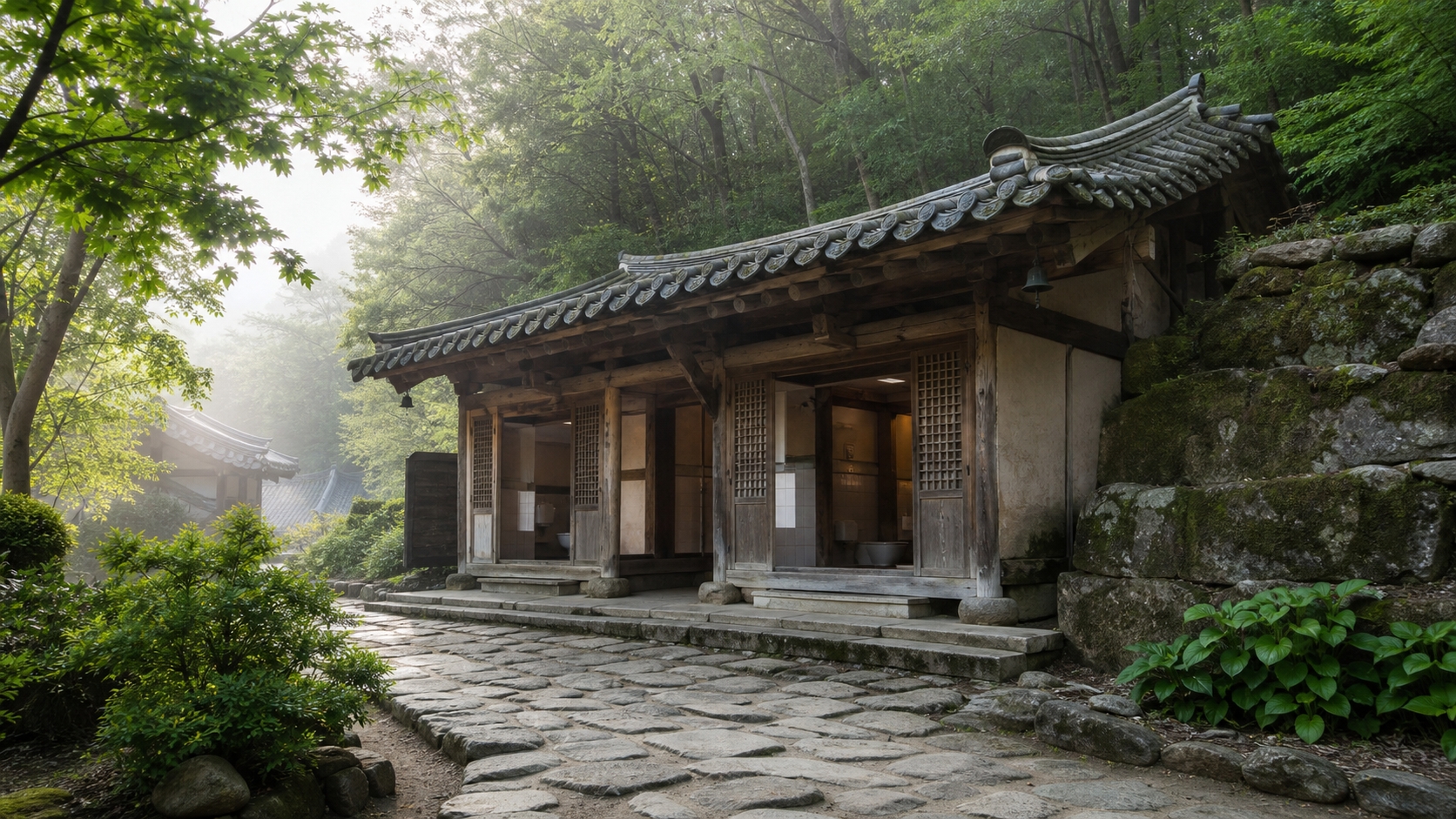
On August 4, 2026, the Korea Heritage Service announced plans to designate three Buddhist temple restrooms — the “cheukgan” at Seonamsa Temple in Suncheon, the “haeuso” at Bodeoksa Temple in Yeongwol, and the “haeuso” at Gukilam Hermitage of Haeinsa Temple in Hapcheon — as National Folk Cultural Heritage. It marks the first time temple restrooms have been designated as national folk heritage. All three buildings have kept their original location, architectural form, and function as working restrooms largely intact for more than a century.
The designation notice carries the significance of widening the scope of temple heritage beyond objects of religious devotion, such as halls, pagodas, and Buddhist statues, to include the everyday living spaces of monastic communities. The Korea Heritage Service plans to gather public comment for 30 days before the Cultural Heritage Committee reviews the case and makes a final decision. The current stage is a notice of intent to designate, not a completed designation.
The Meaning Behind the Name “Haeuso”
“Haeuso” is the term used for a restroom at a Korean Buddhist temple. Written with the Chinese characters for “resolve,” “worry,” and “place,” it translates literally as “a place that resolves one’s worries” — a name that reinterprets a space for physical relief as one for letting go of mental burdens and attachments as well.
According to the Korea Heritage Service, the term became widely used after the Korean War, when the monk Gyeongbong of Geungnakam Hermitage at Tongdosa Temple used it to mean “casting off all worry and anxiety.” In traditional Seon (Zen) temples, the restroom was a major communal space, so closely tied to practitioners’ daily lives that rules for its use were recorded in monastic precept texts — a sign that even the most mundane act was regarded as part of the order of spiritual practice.
Three Buildings With Confirmed Construction Dates and Original Form
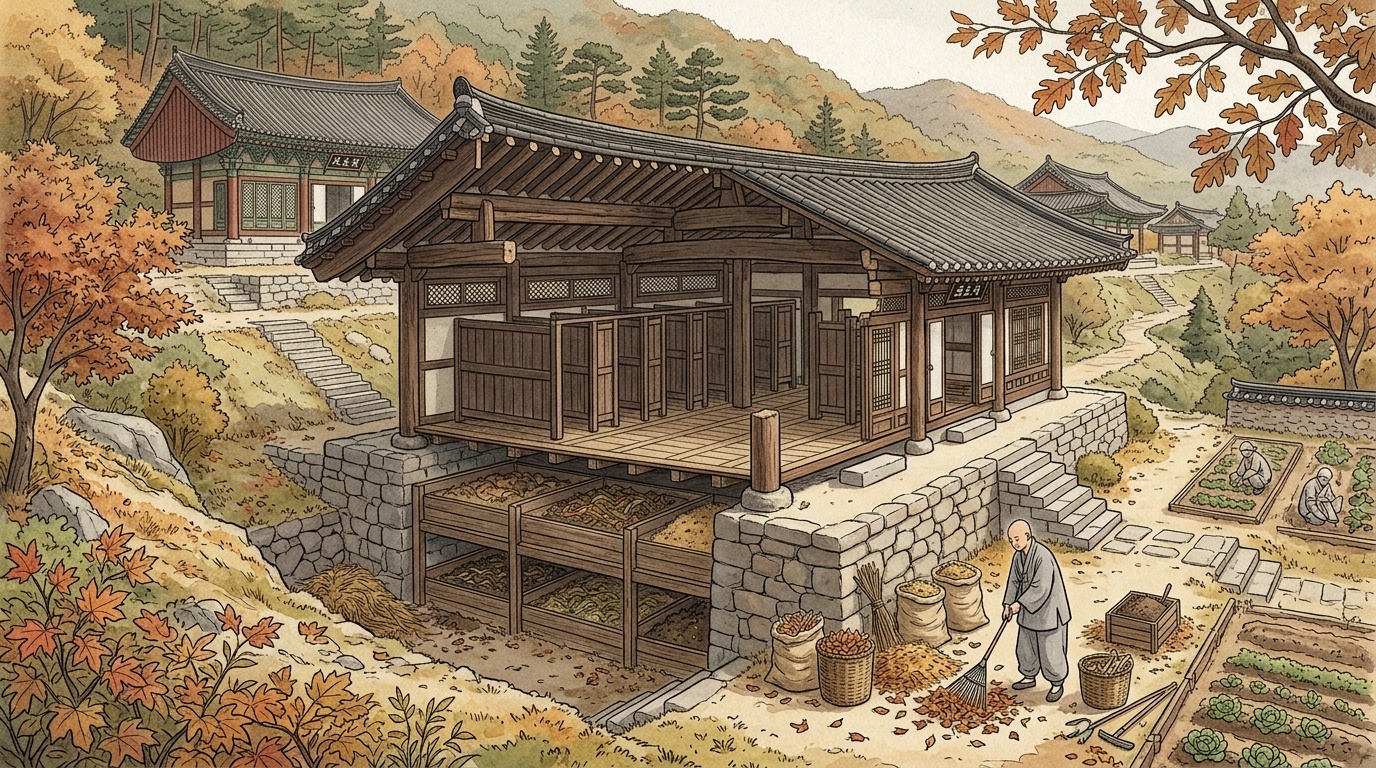
The haeuso at Bodeoksa Temple in Yeongwol is confirmed to have been built in 1882, based on an inscription found on a roof beam. It is a single-row building with three bays across the front and one bay deep, featuring a two-story structure that takes advantage of the sloped terrain and a space for storing waste. Along with being an old structure in its own right, it demonstrates how a traditional temple restroom actually functioned.
The haeuso at Gukilam Hermitage of Haeinsa Temple in Hapcheon is a single-row building with two bays across the front and one bay deep, built in 1910. It retains a two-story structure scaled to the layout of a small hermitage. The surrounding vegetable garden and the practice of using waste as compost also survive, together illustrating the monastic community’s daily life and its culture of recycling resources.
The cheukgan at Seonamsa Temple in Suncheon is confirmed, through a 1704 record, photographs from the Japanese colonial era, and an inscription from repair work in 1928, to have existed and evolved since before the 1920s. It is a pavilion-style building with six bays across the front and four bays deep, making it the largest surviving traditional temple restroom. Its layout is organized around a central corridor-style entrance so that multiple people can use it at once.
A Monastic Way of Life Preserved in a Restroom
All three buildings were designed using the sloped terrain so that they appear as a single story from the front and two stories from the rear. Rather than doors, chest-high partitions were installed, and latticed openings let in natural light and air — a design that divided up usable space while still securing ventilation and daylight within an otherwise open interior.
Waste was mixed with rice husks or fallen leaves, left to ferment, and then used as fertilizer in the fields. Rather than treating waste purely as something to be discarded, the temples returned it to their vegetable gardens and soil. The way the buildings, storage spaces, and surrounding farmland were all connected illustrates how temples recycled resources before the arrival of modern plumbing.
The value of these buildings as cultural heritage does not lie solely in old wooden construction. The way monks managed hygiene within their community and circulated resources remains embedded in the buildings’ location, structure, and continued use. It also matters that these are not restored exhibits but living heritage that still serves its original function today.
The notice of intent to designate these temple restrooms shows that even an ordinary living space can carry a period’s building techniques, communal norms, and attitude toward nature. The name “a place that resolves one’s worries” conveys a view within Korean temple culture that did not separate the needs of the body from the practice of the mind.
Source: Korea Heritage Service notice of intent to designate, August 4, 2026; Yonhap News Agency (English edition), August 4, 2026; Beopbo Newspaper, August 10, 2026.