Table of Contents
A festival’s ownership comes under legislative scrutiny
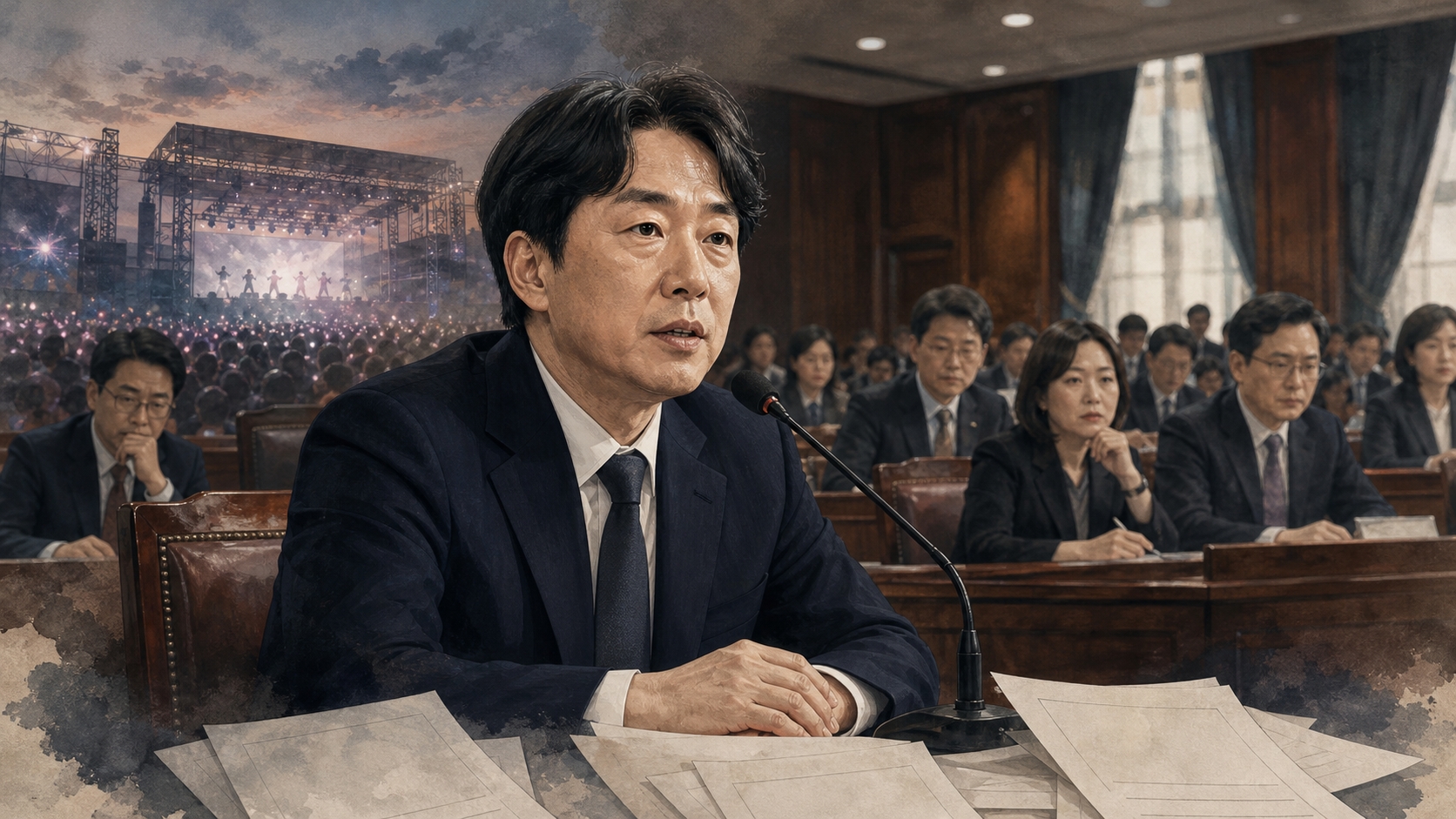
Park Jin-young, co-chair of the Presidential Committee on Popular Culture Exchange, appeared as a witness before the National Assembly’s Culture, Sports and Tourism Committee on October 7, 2026, and pushed back against allegations of favoritism surrounding the K-culture festival Fanomenon. The event, which brings together four major agencies (HYBE, JYP, SM and YG), is set to take place in Seoul’s Changdong and Goyang, Gyeonggi Province, in December 2027. A parliamentary audit is the National Assembly’s regular review of how government ministries carry out their work.
At the center of the dispute were the festival’s trademark and who runs the business. Domestic trademark rights are reportedly split evenly between the Ministry of Culture, Sports and Tourism and JYP, but some overseas trademarks were filed by JYP alone. The question became whether it was appropriate for one company involved in a government-backed event to secure those rights first.
According to an October 7 report by JoongAng Ilbo, Rep. Bae Hyun-jin of the People Power Party argued that the joint venture formed by the four agencies amounted to a monopoly built on inside information, and raised the possibility of favoritism. Park countered that the companies would earn more by holding individual concerts instead. That exchange didn’t settle whether favoritism occurred; it set the terms of a dispute between a lawmaker’s challenge and an executive’s defense.
From the committee’s launch to the joint venture
Understanding the dispute means going back to when the Committee on Popular Culture Exchange was formed, in October 2025. At the hearing, Park explained that he took the co-chair role after the government proposed working together while he and other industry figures were already searching for a way to help K-pop reach its next stage. In his account, the partnership between government and industry was a choice aimed at an industry-wide challenge that no single company could solve on its own.
Fanomenon is the large-scale event meant to give that partnership concrete form. Because it brings competing agencies into a single festival, it differs from each company simply holding its own artists’ concerts. But a joint event doesn’t automatically settle who holds operating authority or trademark rights. Which role the participating companies and the government each play remains a separate question.
Rep. Bae also questioned why the joint venture among the four agencies wasn’t pursued until six months after the committee launched. Culture Minister Choi Hwi-young said the delay reflected an internal review of whether the committee itself should hold the trademark. That detail raises a question not just about the pace of incorporating the venture, but about the order in which the business entity and the rights holder were decided.

Joint ownership at home, solo filing abroad
An October 7 report from Jayupress said Fanomenon’s domestic trademark is held 50-50 by the culture ministry and JYP, while some overseas trademarks belong to JYP alone. But handling overseas rights requires distinguishing between the fact of a solo filing and the final outcome of that filing: filing is the act of applying to register a trademark, not proof that registration is complete.
So the domestic arrangement of joint ownership and the overseas fact of a solo filing aren’t the same story. That the government and a company split rights at home doesn’t mean the identical structure automatically applies abroad. Nor is it accurate to assume, just because JYP filed first overseas, that the company has secured permanent exclusive control of the rights there. Understanding the controversy requires keeping these distinct stages separate.
For readers outside Korea, what matters is that the festival’s host city and the scope of the trademark dispute aren’t the same thing. Fanomenon’s first edition is set for Korea, but the controversy extends to the overseas filings as well. So the question isn’t only who runs the festival domestically; it also becomes a question of who can manage and use the name abroad, where the government and a private company are pursuing the project together.
A defense built on long-term payoff, not profit
Park responded to the favoritism accusation tied to the joint venture by pointing to the economics of the deal. According to JoongAng Ilbo, he said, “If we held individual concerts, we’d make two to three times more.” The argument was that having several companies share one joint event is less lucrative than each running its own show, a direct response to the suggestion that the companies joined the project chasing short-term profit.
He also said, “We may lose tens of billions of won in the near term, but we made this decision with the long-term benefit to the entire industry in mind.” Here, the scale of the loss is not a result that has already occurred but a possibility Park raised himself. The long-term industry impact, too, is a projection offered as a reason for joining the project, not a confirmed outcome ahead of the event.
Minister Choi also defended the companies, saying, “The four agencies didn’t come in chasing some kind of advantage.” Still, an explanation about giving up profit and a question about whether the process itself was handled properly are different matters. If the financial defense explains the companies’ motive for joining, the questions about the trademark and the joint venture call for an explanation of the operating structure. The two points are related, but one doesn’t substitute for the other.

Separating ‘unpaid’ from the support a public role receives
Apart from the trademark issue, Park’s description of his role as unpaid also drew criticism. On an MBC variety show, ‘Omniscient Interfering View,’ in August 2026, he said he receives no salary for the co-chair position. Afterward, reports surfaced that he receives roughly 2 million won a month in official expenses, along with travel costs and staff support. The dispute centered on the gap between what was said on air and the actual scope of that support.
According to an October 6 TV Chosun report, Park said ahead of the hearing that he “didn’t know” he was receiving the expense payments. So that remark wasn’t his first response on the subject at the October 7 hearing: the explanation had already surfaced before the hearing and then fed into the trademark controversy as a separate question about how a public role should be compensated.
A salary, official expenses, travel costs and staff support aren’t all the same category. Receiving no salary and receiving support to carry out the work can be two different facts. But because hearing the word “unpaid” can lead people to assume there’s no support at all, the remaining issue is making clear exactly what kind of support comes with a public position, and how much of it.
A process that still needs clarifying, separate from intent
Three questions overlap in this dispute: whether government and industry needed a joint event in the first place, what economic calculations the participating companies made, and whether the process for dividing rights and operating authority was appropriate. Park and Minister Choi’s explanations focused on the first two; Rep. Bae’s challenge centered on the third.
That makes it hard to conclude either that favoritism toward a specific company has been confirmed, or that the possibility of a loss alone resolves every question about the process. The breakdown of domestic trademark ownership, the current status of the overseas filings, and how the joint venture came together each still need to be confirmed separately. Support for a public role, too, needs to be explained apart from the festival’s business rights.
Fanomenon is scheduled for December 2027. What’s worth watching going forward isn’t just the scale of the festival, but how clearly the authority and responsibility of government and private companies get sorted out. Since the project is framed around long-term benefit to the entire industry, how clearly that goal is separated from each company’s individual role will be a measure of how much trust the public-private partnership earns.
Sources: JoongAng Ilbo, October 7, 2026 (https://www.joongang.co.kr/article/25467871); Jayupress, October 7, 2026 (https://www.jayupress.com/news/articleView.html?idxno=55453); TV Chosun, October 6, 2026 (https://news.tvchosun.com/site/data/html_dir/2026/10/06/2026100690065.html).