

Table of Contents
18.5% by episode four, and mixed reactions to a story that borrows from real life
SBS’s Friday-Saturday drama “Doctor X: Age of the White Mafia” drew a nationwide rating of 18.5 percent for its fourth episode on October 17, according to Nielsen Korea, with a minute-by-minute peak of 20.8 percent. A Japanese drama reworked for Korea’s medical reality is pulling in viewers fast. At the same time, some medical specialists and a viewer who identified as a practicing doctor have raised concerns about how the show depicts medical procedures and medical staff.
The question is how closely a story about a genius doctor fighting hospital power should be read against real life. The Korean version brings in issues such as the staff shortage caused by the doctors’ strike against expanding medical school admissions, and the legal requirement to install CCTV in operating rooms. Kookmin Ilbo said these settings make the main character’s arrival more convincing. Others worry the show could give viewers a distorted picture of medicine.
These different statements shouldn’t be lumped together as one backlash. Professor Namkoong In, who worked on set as a medical adviser, mentioned differences of opinion with the production team, but he also praised the hard work of the cast and crew and cheered the show on. A specialist’s criticism, an adviser’s account of the consulting process and the producers’ notice that the show is fiction each come from a different place. The debate only makes sense when they are kept apart.
A Japanese freelance surgeon steps into Korea’s medical conflict
The original is TV Asahi’s “Doctor-X: Surgeon Michiko Daimon,” starring Ryoko Yonekura. In the Korean version, Kim Ji-won plays Gye Su-jeong, a freelance genius surgeon. Lee Jung-eun plays Jang Hee-sook, who runs an agency that places doctors, and Son Hyun-joo plays Bu Seung-kwon, the new hospital director. The story turns on clashes between a surgeon who answers to no hospital and the power structure inside one.
The Korean version ties the need for so-called “mercenary doctors” to a shortage of physicians. For readers outside Korea, the medical school expansion refers to a government policy to raise the number of medical school admissions. The show uses a strike against that policy as the backdrop that opens a door for an outside doctor to come into the hospital. A real policy fight becomes the reason for the main character’s unusual way of working.
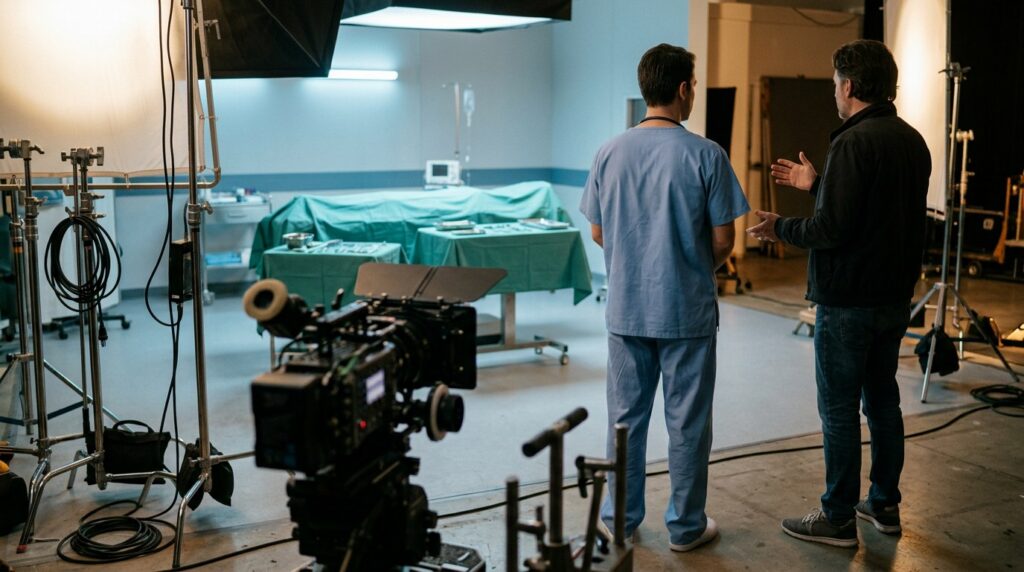
The production team did tell viewers, through the broadcast, that the drama is fiction and that some scenes differ from real medical settings for dramatic effect. In other words, the show borrows real issues without claiming to reproduce the facts. That notice explains the creative direction, but it doesn’t settle questions about whether individual scenes are accurate.

After the premiere, ratings at home and viewing abroad rose together
The October 9 premiere drew a nationwide rating of 11.4 percent, and the second episode 14.9 percent. Kookmin Ilbo pointed to Gye Su-jeong as a character who refuses to bow to hospital hierarchy and acts on the strength of her surgical skill. In that reading, her appeal lies in putting her own ability and judgment ahead of whatever status the hospital hands out. A familiar genre setup, the individual against the institution, sits on top of a Korean backdrop.
On Netflix’s official rankings, the show placed first among non-English TV shows worldwide for the week of October 5 to 11. It logged 4.6 million views and 9.9 million hours viewed in that period. Netflix calculates views by dividing total hours viewed by running time. So the figure shouldn’t be read as 4.6 million plays or 4.6 million different people.
Ratings at home and rankings abroad show early interest, but they don’t prove every viewer picked the show for the same reason. You can follow a story about a lead standing up to an organization without knowing anything about Korea’s medical disputes. And the overseas ranking alone doesn’t show that the Korean setting was what made the show a hit. What has been measured and what people think caused it need to be kept separate.
Namkoong In’s account and a specialist’s criticism are not the same thing
After the premiere, Professor Namkoong In said he had worked on the show as an on-set medical adviser. He explained, in effect, that if something medically wrong shows up, viewers can assume the adviser lost that argument while opinions were being worked out with the production team. He also described the passion of the actors and crew he saw during filming and wished the show success. Summing up his remarks as criticism of the drama changes what he said.
His account shows that having an adviser involved is not the same as every piece of advice making it to the screen. But no full record has been made public of which views were exchanged over which scenes. His words can’t be stretched into a claim that the producers ignored all medical advice, or that the adviser judged the show negatively.
In an interview with Star Today, emergency medicine specialist Jung Hyun-jung criticized the show for not showing enough of how medical teams work together or how uncertain treatment can be. The blunt line “I even thought it was close to porn about beating up doctors” is also hers. Separately, the article commented that it would be a different problem if medical staff were turned into one-sided targets of blame for the sake of dramatic thrills. The specialist’s assessment and the reporter’s hypothetical comment should be kept apart.
A review request over the depiction of rounds, with no official ruling confirmed
A social media user who said they were an orthopedic surgeon also said they had requested a broadcast review. Sports Kyunghyang reported on this on October 15 and 17. The user argued that the show depicts ward rounds as a pointless chore, reduces medical staff to incompetent villains and ignores the uncertainty of medical care. These are the requester’s concerns. They do not mean the review body has found the depictions in violation of any rule.
Rounds are when medical staff check on inpatients’ condition and progress. The heart of the criticism is whether the show separates the organizational habits the heroine rejects from the work that patient care actually requires. The teamwork and uncertainty the specialist pointed to belong to the same question. What is really being argued over is how the other medical staff are portrayed while the drama puts one genius in the spotlight.
The user also said they had passed their concerns to SBS and received a reply that the feedback would go to the relevant department for reference in production. That reply, however, comes secondhand from the requester. It can’t be treated as a detailed official statement from the producers or as the result of a review. The reports available show no final decision or sanction, so there is no basis yet to say either that the show was sanctioned or that it was cleared.
The more a show borrows from reality, the more it has to explain
The success of “Doctor X” and the controversy around it can be read as two effects of the same adaptation. Pulling in real medical conflicts makes the heroine’s battles feel concrete, but it also makes viewers think of real hospitals and real doctors. The notice that the show is fiction is a starting point for watching it, and the impressions that realistic-looking scenes leave behind are a separate question worth discussing.
A story that criticizes wrongdoing in medicine and questions about the accuracy of medical practice don’t have to be at odds. It’s possible to respect the creative freedom to criticize hospital power while still asking whether particular scenes are fair. And concerns from some specialists don’t mean the medical community as a whole opposes the show. Who is being criticized, and how far each statement goes, need to be spelled out.
What’s confirmed so far is the rise in ratings through episode four, a strong global showing in the first counted week and concerns raised by some medical professionals. It’s too early to predict where the story goes or what any review will decide. The thing to watch is not only how satisfyingly the heroine wins. Having used real issues to make its story persuasive, the show also owes viewers a fair picture of the people who work in medicine and how complicated that work is.
Sources: News1, October 18, 2026; Korea Economic Daily, October 12, 2026; Maeil Business Star Today, October 14, 2026; Sports Kyunghyang, October 15 and 17, 2026; Chungcheong Metro, October 16, 2026; Kookmin Ilbo, October 18, 2026; Netflix official global Top 10, October 5-11, 2026.


