
Table of Contents
The government backs AI for skin analysis and custom cosmetics
On October 14, the South Korean government announced a plan to grow AI-based skin diagnosis and personalized cosmetics services, called the “AI and Convergence K-Beauty Service Support Plan.” The Ministry of Economy and Finance presented the package, prepared jointly by several ministries, at an economic ministers’ meeting chaired by Deputy Prime Minister Lee Hyung-il. Two things sit at its center: reorganizing the data used for skin analysis, and funding research and rule changes so that AI and automated machines can be used when cosmetics are mixed and managed.
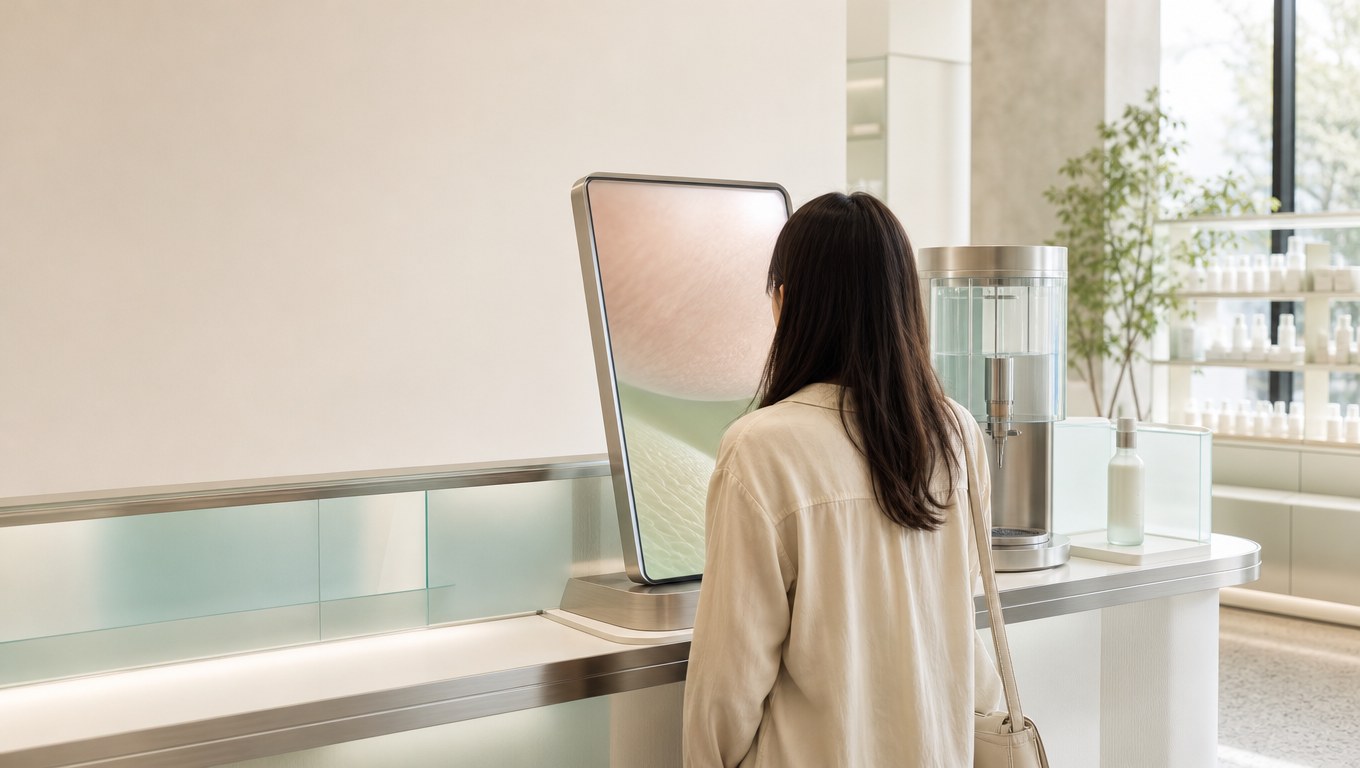
For foreign shoppers, the interesting part is that a shop where you buy Korean cosmetics could turn into a place that analyzes your skin and fits a product to it. Instead of picking one finished product off a shelf, the idea is to link the results of an analysis to how a product is mixed. The announcement is not a notice that every store will offer this right away, though.
The government is backing not only AI skin diagnosis but also technology that manages the quality and production process of personalized cosmetics. The plan targets both the analysis screen a customer sees and the way the actual product gets made. So it can’t be judged only by how many diagnostic devices end up in stores. What matters is how the analysis results connect to the mixing process and how that process is controlled.
Skin data from 18 countries, reorganized for AI
The government runs a skin data bank holding the skin characteristics of about 17,000 people from 18 countries. It plans to convert that data into “AI-ready” form suitable for training AI and to add more countries. AI-ready here means going beyond simply storing the data and organizing it so an AI system can learn from it.
That range matters in Korean stores, which see shoppers from many countries. The aim is to widen the base for taking different skin types into account. A longer list of countries does not by itself prove that individual analysis will be more accurate, however. The data plan and how well a real service performs are separate questions.
For AI agent technology that can be applied across quality and process management of personalized cosmetics, the government plans to support joint research by cosmetics companies worth a total of 7.2 billion won in 2026 and 2027. An AI agent in this context is technology built to carry out quality and process control tasks. In other words, analyzing skin and making a product consistently are being funded as two separate jobs.
One compounding manager for several stores
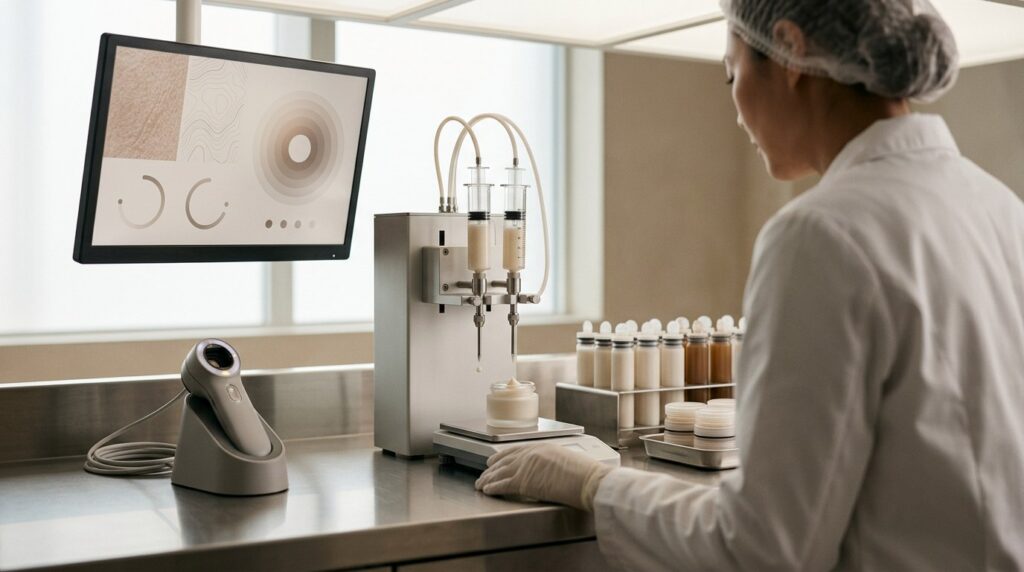
The most direct change for store operations involves the rule on customized cosmetics compounding managers, the licensed staff who mix personalized products. Today every store must have one such manager on site. The government intends to revise the rule so that one manager can oversee several stores when AI and automated equipment are used. At the time of the announcement this is a planned change, and the on-site requirement is still in place.
For businesses that want to expand personalized cosmetics services, this could change how each store is staffed. For consumers, the relationship between automated equipment and the people overseeing it becomes more important. The plan does not scrap the compounding manager. It widens the number of stores one manager can cover, on the condition that technology is used.
Safety is part of the package too. To help the cosmetics safety assessment system due in 2028 take hold, the government plans to build related databases and expand consulting for companies. Measures to grow personalized services were presented alongside groundwork for evaluating product safety. Still, research funding and preparations for a new system should not be read as a safety guarantee for any individual product.
More hands-on experiences and easier payment for tourists
The plan names K-beauty experience and promotion centers in Hongdae, Myeongdong and Busan as places where foreign visitors could meet these technologies. The government plans to offer AI skin diagnosis and virtual makeup trials there and link them to local shopping and tourism. It will also expand the number of shops with standard QR code payment, meant to make paying easier for foreigners, from 40,000 in 2026 to 80,000 in 2027.
K-beauty clusters in Gyeongju and Jeju and financial support for companies form the background for spreading these services. On the medical tourism side, the government is also pushing a K-Healthcare integrated hub that would connect consultation, booking, payment and follow-up care. But skin analysis and product mixing at a cosmetics store are different from treatment at a medical clinic. Appearing in the same policy package does not make them one service.
What the plan points to is a cosmetics counter that adds analysis, mixing and management to selling. When shoppers will notice the difference, and what exactly they will notice, depends on follow-up research, rule changes and whether stores actually adopt the tools. What has been confirmed so far is the direction of government support. It is not an announcement that the same personalized service is now available in stores nationwide.
Sources: Korea.kr policy briefing, joint ministries’ announcement of the “AI and Convergence K-Beauty Service Support Plan,” October 14, 2026.


