
Table of Contents
A standard for reading cosmetics by touch and by sound
On October 20, the Ministry of Food and Drug Safety (MFDS) issued its “Guidelines for Braille Labeling on Cosmetics.” The document is a guide for companies that want to add braille, or codes that convert label information into audio and sign language video, to cosmetic containers and packaging. It aims to give consumers who struggle to read product information by sight another way in, and to standardize labeling methods that until now varied from company to company. It does not impose new requirements. It sets a practical baseline for brands that choose to take part.
The guidelines cover the scope of application, braille specifications, placement, content and checking, as well as codes that link to audio and sign language video. Accessibility in cosmetics takes more than a few raised dots on a bottle. Users need to be able to tell products apart and get to the directions and warnings. That is why the guidelines treat tactile labels and digital links together. The MFDS also plans to find good examples and promote them to encourage wider use.
The move stands out more when set against how fast the industry is growing. CNC News, citing Ministry of Trade and Industry data, reported that cosmetics exports from January to September reached $11.14 billion, up 30.8% from a year earlier. September alone set a monthly record of $1.51 billion. How much sells abroad, though, is a different question from whether every consumer can check product information on their own. The new guidelines deal with that second question.
The problem starts with small, look-alike containers
Cosmetics come in containers of very different sizes and materials, and quite different products often come in bottles that look almost the same. For someone who can’t read the product name, even telling toner from lotion or shampoo can be a struggle. When Amorepacific introduced braille stickers in 2023, it said product names appear in different places and sizes, and that many containers share similar shapes. Accessibility problems often begin at this first step of simply identifying a product.
That year Amorepacific made braille stickers for 10 categories, including toner, lotion, shampoo and conditioner, and gave them away for free. An advisory group of visually impaired employees at its headquarters took part from the first planning stage through checking the samples. The stickers also carry raised letters and numbers so that people who don’t read braille can use them. The project is an example of users helping decide which labels are needed and testing whether they work. It took place before the new MFDS guidelines.
The case shows that stickers added to existing products can open another route to information. A sticker that says “lotion” is still a long way from detailed directions for a specific product, though. Going from knowing the product type to knowing exactly what the product is and how to use it requires more information. That is why the guidelines cover codes for audio and sign language video in addition to product names and braille.

A legal basis, then meetings and public comment
The legal basis is Article 10 of the Cosmetics Act. A revision that took effect in July 2025 allows braille, or audio and sign language conversion codes, to be added alongside the required label information on containers or packaging for visually and hearing impaired consumers. Paragraph 4 of the same article lets the MFDS minister give companies administrative and financial support when needed. One provision permits the labels, and another allows support for adding them.
At a meeting on July 7, the MFDS heard from companies about the difficulties of the labeling they already use and the need for a common standard. It released a draft guideline on August 7 and collected comments through the Korea Cosmetic Association until August 31. Once the law allowed the labels, the next step was working out how to put them on real containers. Because the law only says companies “may” add them, a separate practical standard was needed for questions such as where braille goes and which methods suit which materials.
In an August 10 CNC News report, industry representatives said that cosmetic containers vary so much in size that putting the guidelines into practice is hard. Some products have less label space than household goods, and one method doesn’t fit every product shape. Some also suggested e-labels, which deliver product information digitally. The discussion was about how to deliver accessibility as much as why. Deciding what information to give had to go together with deciding how to fit it on the package.
Braille methods that change with the container
The guidelines let companies choose the braille method that suits the container and packaging: molding, embossing, stickers or braille tags. Molding includes pressing, blow molding and injection molding. Plastic tubes, thin film pouches and film casings mainly use embossing and stickers. Braille tags are listed separately for products that are hard to tell apart because their containers look alike, such as shampoo and conditioner. Rather than favoring one production method, the guidelines weigh the packaging material together with how much a product needs to be told apart from others.
As a rule, braille goes in the same place as the printed text required by law. Companies can also pick a spot that is easier for consumers to find, as long as the braille sits at least 4 millimeters from the edges and does not overlap the printed text. The point is that the braille should be easy to find without covering the existing label. Arranging tactile information and printed text so each does its own job on the same container is part of making a product accessible.
For content, the product name comes first, with extra information such as directions considered after that. The order reflects how hard it is to fit everything in one format on a small container. The guidelines also cover checking braille specifications and print quality, and they recommend review by facilities that can publish braille or by certified braille proofreaders. Braille proofreaders are trained specialists who check text that has been transcribed into braille. The step connects making a label with confirming that people can actually read it.
Braille and digital codes do different jobs
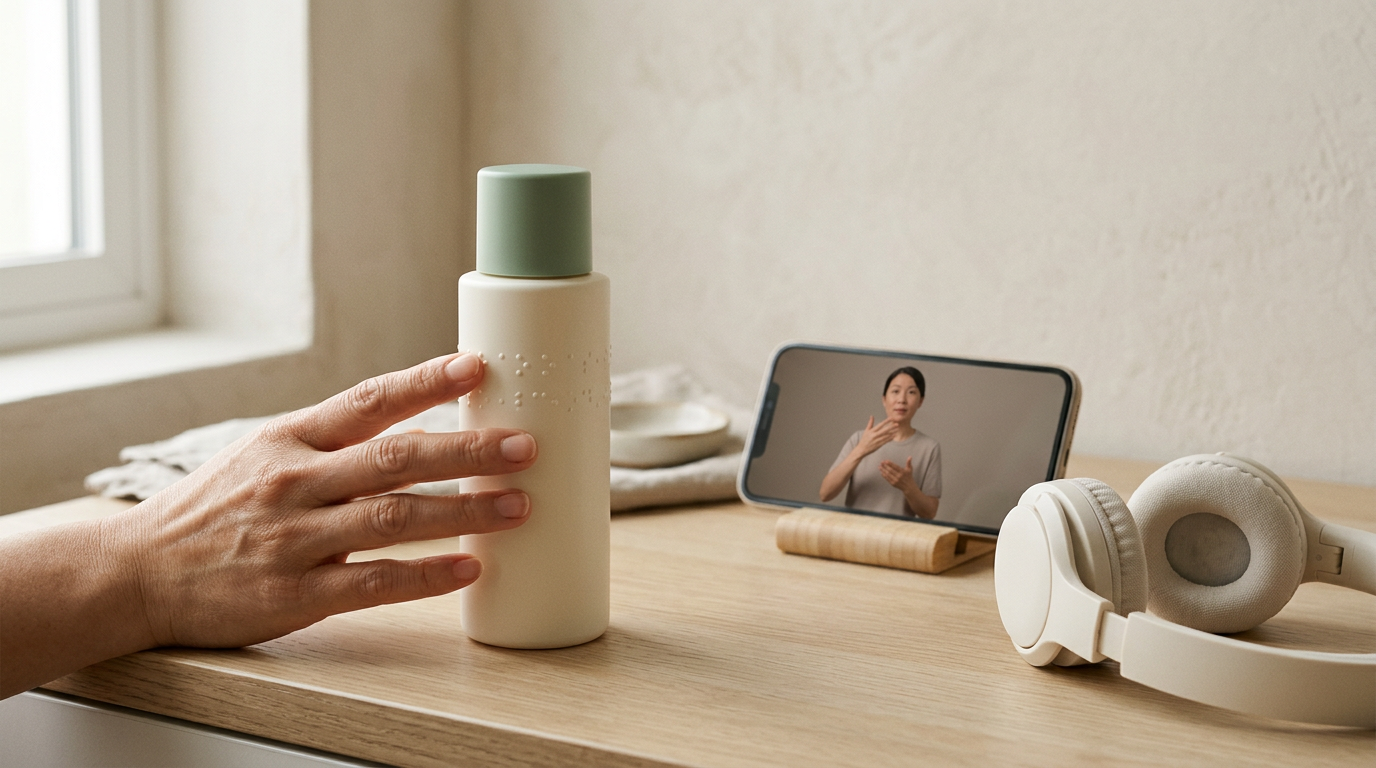
Audio and sign language conversion codes link to more than the product name. They can lead to the product type, directions and warnings, delivering content that won’t fit on a container’s small surface. Braille lets a user identify a product with their fingertips, and the code opens the more detailed description. Visually impaired users need audio, and hearing impaired users need sign language video, so each format matches a different way of accessing information. Companies need to check both that the code is there and that what it links to is useful.
So the checking goes beyond braille. For sign language video, the guidelines recommend review by sign language interpreters. When printed text is converted into another format, both the accuracy of the content and the way it is delivered matter. Directions and warnings are what people need when they actually use a product, after they have identified it. Accessibility, in this view, is less an extra packaging feature than a matter of information reaching the user at every step.
The e-labels that industry suggested fit into this digital side. Electronic labels can get around the space limits of small packages, but users still have to identify the product in their hand first. Tactile labels and digital codes therefore handle different stages of use. By covering both, the guidelines put the focus on the order in which consumers get information, rather than on picking one technology over another.
Whether guidance turns into real choices
The measure is voluntary because of how the current law is written. The Cosmetics Act says the labels “may be added alongside” the required text, and the guidelines give practical advice to companies that choose to do so. Products without braille face no new penalties. The cost of dealing with small containers and many materials is a real concern that industry has raised. That the labels are optional under the law and that they are technically hard to apply are two separate issues.
For consumers, what matters is not that a guideline exists but whether usable products and information are available. A company can add braille, but if it sits in a different place on every product or hasn’t been properly checked, accessibility barely improves. If users can find the product name easily and go straight on to detailed information, they gain more independence in choosing and using products. The MFDS plan to promote good examples will carry weight only if it shows clearly what kind of labeling helps in daily use.
The things to watch are how many companies take part and how usable the labels turn out to be. Earlier braille stickers can’t be counted as results of the new guidelines, and actual adoption and checking will have to be confirmed product by product. Record exports show how far Korean cosmetics have spread. Accessibility standards ask who can choose and use those products on their own. The next test is how much these voluntary standards change the containers and information people handle every day.
Sources: Ministry of Food and Drug Safety press release, October 20, 2026, https://www.mfds.go.kr/brd/m_99/view.do?seq=50422; Ministry of Food and Drug Safety, “Guidelines for Braille Labeling on Cosmetics” (guide for applicants), October 20, 2026, https://www.mfds.go.kr/law/board/boardDetail.do?menuKey=29&brdId=data0011&seq=15968; National Law Information Center, Cosmetics Act Article 10, current text, https://www.law.go.kr/LSW//lsLawLinkInfo.do?lsJoLnkSeq=900777009&lsId=002015&chrClsCd=010202&print=print; CMN, October 20, 2026, https://www.cmn.co.kr/sub/news/news_view.asp?flag=h&news_idx=51318; CNC News, August 10, 2026, https://www.cncnews.co.kr/news/article.html?no=11146; CNC News, October 1, 2026, https://www.cncnews.co.kr/news/article.html?no=11324; Amorepacific Newsroom, October 19, 2023, https://www.apgroup.com/int/ko/news/2023-10-19-3.html