
Table of Contents
80% Would Fly Long-Haul, While Guam and Saipan Passengers Fall 48%
Eighty percent of engaged and newly married couples in Korea say they would choose a long-haul honeymoon even if it costs more time and money than the trips they took while dating. In Booking.com’s first consumer survey on Korean honeymoons, released on October 27, Europe was the most popular destination at 35%. Meanwhile, total passenger traffic on routes to Guam and Saipan fell 48% in October from a year earlier. Weaker air demand for nearby resorts and a stronger pull toward faraway honeymoons are showing up at the same time.
The two sets of numbers measure different groups. The Booking.com survey, carried out by the research firm Embrain, covered 1,000 people: couples planning to marry within a year and newlyweds married within the past two years. The aviation figures, reported by Seoul Economic Daily on November 10, are total passenger counts from the Ministry of Land, Infrastructure and Transport’s aviation portal. The drop in Guam and Saipan passengers cannot be read as the number of couples who switched to Europe. One data set shows how couples choose a honeymoon; the other shows how overall air travel demand is changing.
Put side by side, they show how differently couples think about travel before and after marriage. While dating, they mostly traveled within Korea or to nearby countries. For the honeymoon, many said they would accept more distance and more cost. Distance is only part of it. The honeymoon also changes how much leave people take, how they plan the days and how they spend on lodging and experiences. At the center of these choices is the sense that a honeymoon is its own big event.
Dating Trips Center on Korea and Nearby Countries
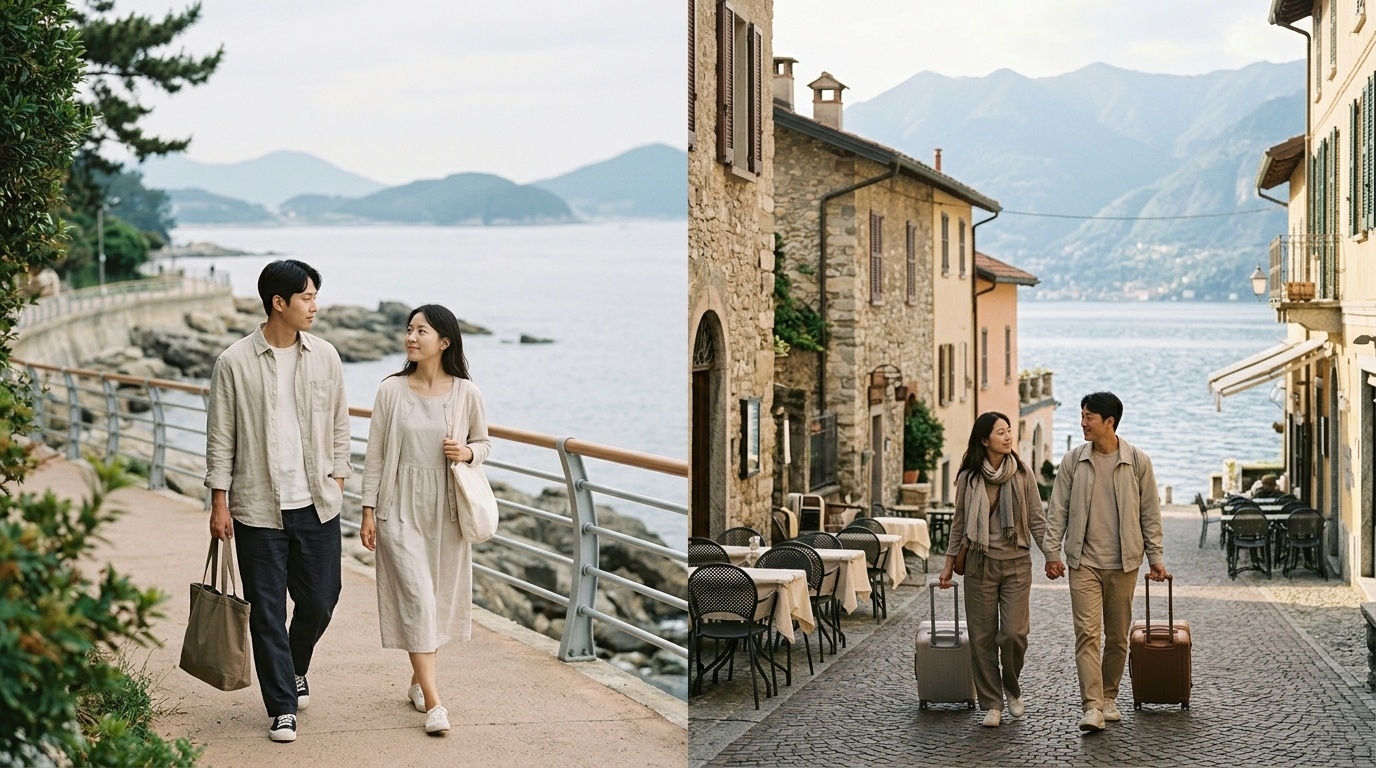
Asked where they traveled most often while dating, 93% of respondents named destinations in Korea, 57% Northeast Asia and 37% Southeast Asia. Europe’s top spot for honeymoons stands out against that. For the same couple, an everyday trip together and a trip to celebrate a wedding lead to very different maps. Comparing the two answers shows repeated short trips nearby on one side and one special long-haul journey on the other.
Vacation time helps explain the gap. Asked why they plan longer honeymoons, 66% said the honeymoon lets them take a longer break from work than usual. Another 43% said they want enough days to make the long flight and the airfare worth it. Once a couple picks a distant destination, the travel time and cost become part of the plan. How to use a hard-won block of leave decides both where they go and how long they stay.
On trip length, 35% chose up to two weeks, 30% up to 10 days and 22% up to a week. The willingness to fly far goes together with the wish to use a long break. Couples accept the effort of getting there but want plenty of time once they arrive. Rather than stretching a familiar short trip, they are building a new kind of trip around the wedding.
The October Survey: Fewer Stops, More Personal Plans
In the October 27 survey, Southeast Asia was the second choice at 19%, and Hawaii, Guam, Saipan and the Maldives together drew 13%. That last figure combines four destinations, so it does not show how popular Guam or Saipan is on its own. How couples travel mattered as much as how far. Seventy-one percent preferred staying in one or two places for longer over moving quickly through several. The figure was 74% for women and 67% for men.
Couples also want the trip to fit them. Seventy-three percent preferred a honeymoon shaped by their own tastes and interests over a standard luxury route, with 79% of women and 67% of men saying so. The weight has moved from following a well-known honeymoon course to deciding what the two of them want to enjoy together. That is why “Europe” says little about what a given trip will look like. Two couples in the same region can plan very different experiences.
As for how they plan to travel, 49% chose fully independent travel, arranging everything themselves. Custom private packages drew 18%, individual local tours 16% and combined packages 13%, while fully guided group tours got just 4%. Even couples who use a package tend to pick a schedule built for them or add only the local programs they need. The way they book shows the same habit of mixing set options with their own preferences.
A Big Investment, With the Money Going to Lodging and Experiences
Seventy-four percent saw the honeymoon as a special event worth spending time and money on without holding back, including 79% of women and 69% of men. Sixty-three percent set a combined budget of 8 million won or more, and the most common bracket was 8 million to under 12 million won, at 35%. The budget is the total for both partners, not per person. That level of spending sits behind decisions about long-haul flights and how to travel.
Lodging was where 79% said they were willing to spend more, and 76% said meaningful experiences matter to them. The top criteria for choosing a destination were rest and relaxation at 52%, natural scenery at 37%, cost and value at 36%, and food culture at 35%. Wanting to go far and wanting to rest go together. Couples look for what makes the trip special less in the number of places they see and more in where they rest and what they share.
Food tours and eating out topped the list of things couples want to do once they arrive, at 51%. Thirty percent want to rest with no set plans, and private beaches or pools and city or walking tours each drew 29%. In a survey where Europe came out on top, rest, food and unhurried time still mattered a great deal. Todd Lacey, Booking.com’s regional manager for Korea and Oceania, said the survey showed that for Koreans, how well a honeymoon suits the couple’s tastes matters more than how glamorous it is.
October Air Traffic Shows Short-Haul Travel Reshuffling
The air traffic figures reported on November 10 showed overall demand concentrating on Japan and China. International passengers in October totaled 9,073,655, up 10% from a year earlier. Japan routes rose 23.6% to 2,945,694 and China routes 23% to 1,892,610. The two countries’ combined share rose to 53.3% from 47.6% a year earlier. Seoul Economic Daily pointed to the weak yen and China’s visa-free policy.
Traffic to 10 Southeast Asian countries, by contrast, fell 10.6% to 1,775,959. Vietnam dropped 9.8% to 769,682, Thailand 22.1% to 285,029 and the Philippines 11.3% to 267,394. All routes other than Japan and China fell 2% combined, to 4,235,351. International travel grew overall, but destinations moved in opposite directions. Even within short-haul travel, Japan and China gained while long-familiar resort destinations lost ground.
Guam routes fell 43.6% to 40,453 passengers and Saipan 68.5% to 4,800, for a combined 45,253. The report cited worsening tourism infrastructure and changing travel tastes. In the airline industry, Guam flights are sometimes jokingly called “lie-down-conomy,” economy seats with empty rows on either side where passengers can stretch out. Last November, a 180-seat flight from Busan to Guam carried three passengers and six airline staff. Overall air demand for places that were once honeymoon staples has clearly weakened.
The Couple’s Own Way of Traveling Over Famous Resort Names
Japan routes, meanwhile, are expanding to smaller cities such as Aomori, Hakodate and Hiroshima. While nearby options for short trips widen, the honeymoon survey shows strong interest in going far. Everyday couple trips and wedding trips are being planned by different standards. Convenience for short trips and something special for the honeymoon now sit side by side.
Choosing by taste does not mean couples are giving up on a relaxing vacation. Rest and relaxation remained the top reason for picking a destination, and many want to spend heavily on lodging. What has changed is the mix. Flying far, staying in one or two places, eating well, walking around and adding only the programs they want is one version of it. The value of the trip is being judged less by the name of a famous honeymoon spot and more by whether it gives the couple the experience they want.
How these preferences will show up in actual bookings and spending is still to be seen. For now, the data shows a strong intention to travel far, itineraries shaped by personal taste, and a growing gap between destinations in overall air demand. When couples leave the nearby places they visited while dating and head far away for a honeymoon, the reasoning is simple: they have the time and the budget the wedding gives them, and they want to spend both in a way that suits the two of them.
Sources: Booking.com press release, October 27, 2026; Seoul Economic Daily, November 10, 2026.


