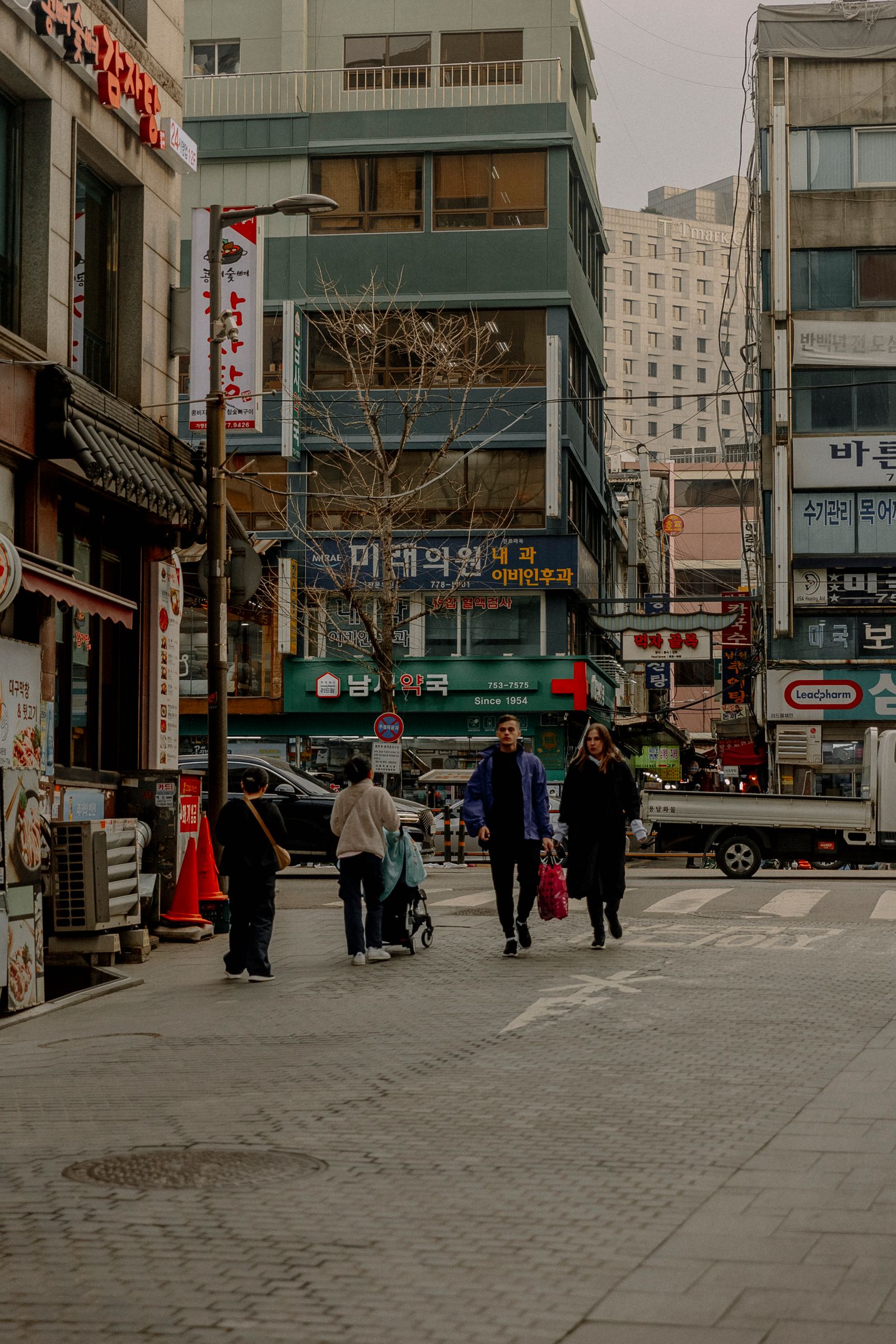
An elderly woman stopped Seoul-based travel writer Ji-Hoon Park outside Apgujeong-Rodeo Station’s Exit 4 with a question that says everything about this street’s history: “Is Rodeo Street still crowded these days?” Before he could answer, laughter spilled out of a nearby alley — a group of twenty-somethings taking selfies outside a brunch cafe, according to Park’s recent guide for LetSeoul (published Feb. 6, 2026, updated Apr. 2, 2026). “Still packed,” he told her. Just not for any of the reasons it used to be.
Apgujeong Rodeo Street opened in 1990, deliberately modeled on Beverly Hills’ Rodeo Drive, Park writes. Through the ’90s it was the address that defined Seoul’s so-called “Orange Tribe” — wealthy youth in imported cars, draped in designer shopping bags, treating the street as a stage for conspicuous consumption. Then came the 2000s, and the spotlight moved: Garosu-gil rose nearby in Sinsa-dong, Cheongdam-dong claimed the luxury-shopping crown, and Apgujeong’s storefronts emptied out one by one. When Park returned around 2015, he says the silence on a once-legendary street genuinely shocked him.
The turnaround started around 2020, when a “fair rent” policy brought rents down enough for young entrepreneurs to move in, Park reports. Independent cafes and shops with their own distinct personalities started filling the empty storefronts, and the Bundang Line subway station that opened at Apgujeong-Rodeo in 2012 made the area easy to reach without a car for the first time in its history. By Park’s 2025 return visit, the alleys were busy again on a weekend afternoon — but the crowd looked nothing like the original Orange Tribe. “Instead of designer shopping bags, people carried eco-bags,” he writes. “Instead of luxury cars, they’d arrived by subway and bus.”
What’s actually there now reads like a fairly ordinary, if well-curated, Seoul cafe crawl: brunch spot Bunker Company near the main street (₩15,000–20,000, busiest after noon), dessert cafe Dalmatian toward the Hyundai Department Store end, and the quieter Japanese-style Shoto tucked into the alleys toward Eonju-ro, per Park’s pricing and recommendations. He draws a clear line between Apgujeong and its neighborhood rivals: Cheongdam-dong stays polished and expensive, built around luxury brands and fine dining, while Seongsu-dong and Euljiro trade on an industrial-factory aesthetic that Apgujeong — always a commercial street, never a warehouse district — never had to begin with.
That distinction is really the point. Mangwon-dong’s comeback, a few subway lines away, is about a neighborhood that stayed exactly what it always was. Apgujeong’s is the opposite kind of story: the same street, the same address, the same Beverly Hills pretensions baked into its 1990 layout — just filled, this time, with people who got there on the subway. Seoul’s neighborhoods keep having the same conversation about who a place is for. Apgujeong just happens to be having it on the same blocks where the conversation started.
Sources: Ji-Hoon Park, “Apgujeong Rodeo Street Guide 2026: From Orange Tribe to K-Culture Hub,” LetSeoul (published Feb. 6, 2026, updated Apr. 2, 2026).