Table of Contents
For most of the past decade, the working assumption about K-beauty was fairly simple: it was a product story. Korean sheet masks, cushion foundations, and ten-step skincare routines sold through Sephora shelves and Amazon carts, pushed along by K-pop idols and, more recently, TikTok tutorials. The numbers coming out of Seoul this summer complicate that picture. Foreign tourist spending on beauty services in Korea reached 84.33 billion won in 2025, a 38 percent increase from the year before, according to figures cited by the Seoul Economic Daily. Spending at skin care and massage businesses by foreign visitors was up 153.9 percent year on year as of May, dermatology clinic spending rose 85.5 percent, and pharmacy spending climbed 206.1 percent, the fastest of the three. What used to be a suitcase full of skincare products is increasingly a plane ticket, a clinic appointment, and a multi-day itinerary built around looking, and feeling, a certain way.
Redefining K-Beauty: From Product to Experience
The shift did not happen overnight. K-pop, Korean dramas, and webtoons built a global fandom that, over time, became interested not just in Korean entertainment but in the specific aesthetic cultivated by Korean idols and actors. On social media, this has crystallized into what is now widely called the “glow-cation” trend, the idea that a trip to Korea can double as a beauty upgrade. Korea Tourism Organization president Park Sung-hyuk framed it directly, saying that as the “let’s go to Korea to become pretty” trend spreads on social media, Korea is being noticed as a glow-cation destination, and that the goal is to convert that online interest into actual visits and spending. The government’s response was the 2026 Korea Beauty Festival, held from June 24 through July 19 at HiKR Ground in Seoul’s Jung-gu district, under the slogan “All about Beauty: Curated by KBF.” The framing matters. This is not a trade show for exporting cosmetics abroad. It is an attempt to pull the entire experience, the makeover, the consultation, the treatment, onto Korean soil.
Inside the Festival: Scale and Programming
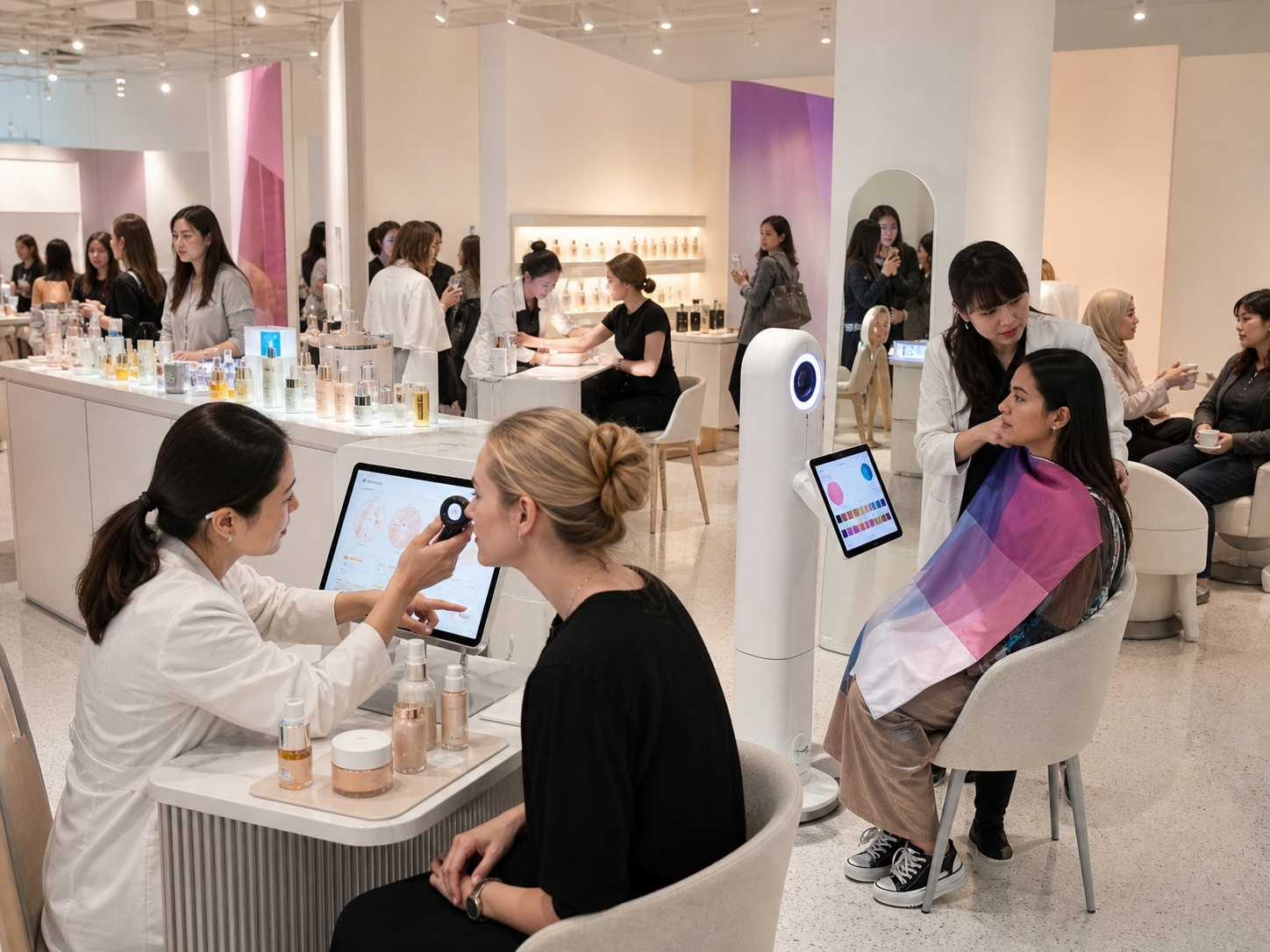
The scale of the event suggests this is more than a marketing exercise. Korea’s Ministry of Culture, Sports and Tourism invited 40 overseas travel agencies from 19 countries and 42 domestic beauty and medical companies to participate. The Korea Tourism Organization separately partnered with nine global online travel agencies, including Klook, Trip.com, and KKday, to distribute the resulting travel packages. More than 800 curated K-beauty tourism packages have been sold through the festival, with sales continuing through September 30. The programming itself was built around direct experience rather than passive viewing. On the fourth floor of HiKR Ground, visitors could try K-pop idol-style makeup, hair styling, scalp diagnostics, and personalized fashion styling. The fifth floor offered one-on-one personal color analysis, wedding makeup consultations, celebrity makeup masterclasses, and lectures on regional fashion trends, alongside AI-based automated skin diagnosis paired with customized skincare recommendations. The government’s stated targets are specific: roughly 100 K-beauty tourism products developed and about 2,000 visitors drawn through the festival’s mechanisms alone, a modest number in isolation but one meant to seed a much larger pipeline.
What the Numbers Show: Spending and Medical Tourism Data
The festival is a symptom of a larger trend rather than its cause, and the spending data bears that out. Total credit card spending by foreign tourists in Korea surpassed 2 trillion won in May, the highest monthly figure since January 2018. Within that broader spending pattern, beauty-adjacent categories are growing at rates that outpace general tourism spending by a wide margin, which is where the pharmacy and dermatology figures become notable. Medical tourism data tells a similar story from a different angle. Among foreign medical tourism patients, dermatology-related spending accounts for 55.7 percent of the total, far ahead of plastic surgery at 21.1 percent and internal medicine at 10.0 percent, and skin beauty procedures alone make up 60 percent of all medical tourism patients. Patients coming specifically for skin beauty treatment grew 195 percent year on year, the fastest-growing segment in Korean medical tourism. Korea drew 1.17 million foreign patients in 2024, more than double the roughly 500,000 recorded in 2019, and medical tourism patients spent an average of 2,408 dollars per person, well above what a typical tourist spends on a trip to Korea. Put together, the pattern looks less like a beauty trend and more like a shift in what international visitors expect a trip to Korea to include.
Government Strategy and Industry Momentum
What distinguishes this moment from prior K-beauty enthusiasm is the degree to which the Korean government has formalized it as policy rather than treating it as a byproduct of Hallyu fandom. Kang Jung-won, a tourism policy official at the Ministry of Culture, Sports and Tourism, described K-beauty as having evolved beyond the beauty industry itself into a cultural content category representing the country, language that signals a deliberate elevation in how officials think about the sector. During the festival, the government ran a rotating tour introducing beauty, wellness, and medical tourism destinations across Seoul, Jeju, Busan, and Gangwon, spreading the economic activity beyond the capital. The government has designated beauty tourism a national strategic industry and set a target of attracting 700,000 foreign patients annually by 2027. For comparison, the price advantage driving much of this is not incidental. Cosmetic and dermatological procedures in Korea typically run 30 to 50 percent cheaper than equivalent treatments in the United States or Europe, a gap that, combined with cultural fandom, gives Korea a dual pull that neither price nor culture alone would produce. American and European medical tourism markets, by contrast, have never had that second lever.
The Limits: Aftercare, Insurance, and Standardization Questions
None of this erases the practical problems that come with treating elective medical procedures as a tourism product. Patients who develop complications after returning home face real difficulty reaching the clinicians who treated them, and standard travel insurance generally does not cover complications arising from elective cosmetic procedures, leaving patients exposed to follow-up costs that can exceed the original treatment. Not every beauty clinic in Korea operates under the same international safety and accreditation standards, and language barriers along with differing cultural expectations around outcomes can affect how satisfied patients ultimately feel with their results. Some European and Australian regulators have already begun limiting cooperation with Korean medical institutions over these safety concerns, a friction point that the festival’s marketing does not address. Whether Korea builds the aftercare infrastructure, standardized accreditation, and insurance frameworks to match its 2027 patient target, or whether the gap between marketing and follow-through becomes a limiting factor, is likely to say more about the durability of this industry than any single festival attendance figure. That is probably the number worth watching next.
Source: Daniel Yoon, koreaupclose.com, July 21, 2026.