
Table of Contents
“Roots” Is Not the Memorization of a Past — It Is the Rewriting of a Language
For a Korean American child growing up in the United States, Korean often survives first as the language of the household — the name a parent or grandparent calls out, the short exchanges passed around a dinner table, the greeting repeated each year at a holiday, familiar in sound but rarely spoken among friends or in the hallways of school. To learn a heritage language, then — a language inherited from one’s own family and culture rather than acquired as something wholly foreign — is a different kind of undertaking than learning a foreign language for the first time. It is a process of meeting sounds already half-known in the form of written characters, of turning a dim memory into words one can finally call one’s own.
The “Roots Education” program run by the Korean Education Center in Los Angeles has, for years, provided an institutional home for precisely this kind of learning. The 2026 fall semester runs fifteen weeks, from August 22 through December 12. The Center has long offered Korean-language, cultural, and historical education not only to families in Southern California but to Korean American communities and youth across Nevada, Arizona, and New Mexico. Its starting point is not simply teaching students to read and write Hangeul, but helping them come to understand their own cultural background as Korean Americans through a range of different approaches.
Forty-Two Courses Don’t Teach a Single Version of Korean
This fall’s semester offers 22 Korean-language courses and 20 Korean-culture courses, 42 in total — six more than the spring semester carried. That growth in number reflects more than simply the addition of a few extra classes. It answers to a real circumstance: a child who has heard a little Korean at home, a student who still needs to learn the Hangeul alphabet from the beginning, and a teenager hoping to deepen speaking and reading skills already in place cannot all be taught the same way in the same room.
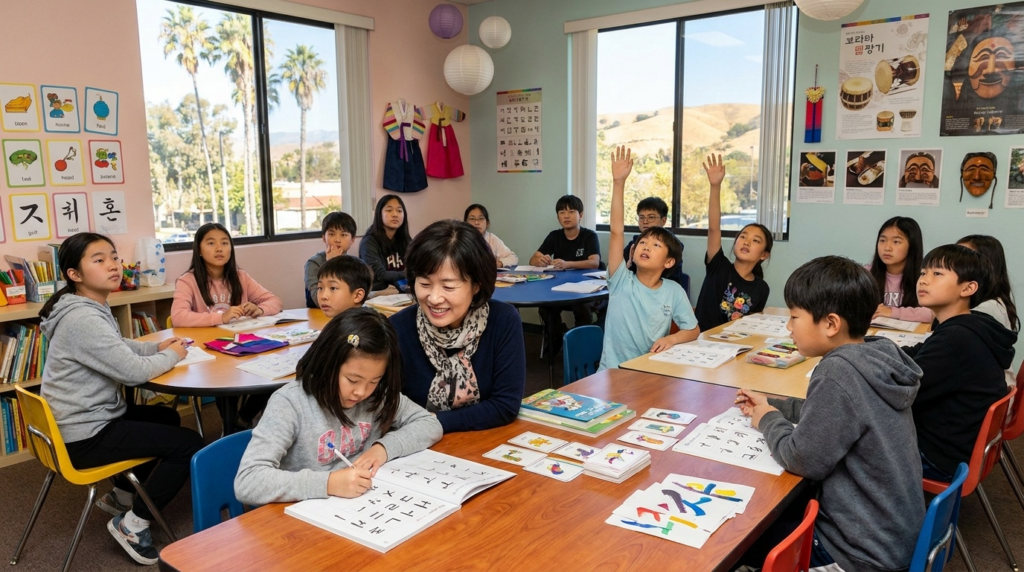
Korean is a language in which even a single word cannot be fully learned apart from the relationship and situation in which it is used. The phrase “Have you eaten?” can function as a literal question about a meal, or it can serve simply as a greeting extended to check on someone’s wellbeing. The word nunchi, likewise, does not merely mean glancing at another person’s eyes — it names a sensitivity to unspoken mood and circumstance. Nuance of this kind is difficult to convey fully through a grammar chart alone. This is likely why culture classes are built alongside language classes: so that children come to encounter Korean not as a subject to be tested, but as a way of understanding people and the relationships between them.
Weekday-Afternoon Online Classes Lower the Wall of the Schedule
One of the more notable changes this fall is the expansion of weekday-afternoon online Korean classes. No small number of students find it difficult to attend classes offered only on Saturday mornings, whether because of family schedules, sports commitments, or simple geographic distance. An online class cannot remove every barrier posed by scheduling, but it can, at the very least, loosen the constraint that Korean can only be learned at a particular time in a particular place. For families living far from the Center, this may prove a genuinely important option.
An online class cannot substitute for every advantage of an in-person one. Practicing pronunciation alongside a friend, picking up speech through a teacher’s gestures and expressions, or handling the strings of a gayageum or the raw materials of a craft project firsthand — these are experiences difficult to translate onto a screen. But what matters most in language education is not a single extraordinary experience so much as a rhythm one returns to again and again. It is when a student greets a teacher in Korean at the same set time each week, reads a short sentence, and reconfirms in the classroom what was once only half-heard at home that a language shifts, gradually, from memory into habit.
K-pop Can Be the Doorway, But It Isn’t Meant to Be Where the Classroom Ends
This semester introduces a new course titled “Korean Through K-pop.” For young people abroad, K-pop is among the most powerful cultural doorways through which Korean first becomes something worth approaching. The wish to read the title of a favorite song, to understand what a repeated chorus actually means, or to follow a phrase caught in a behind-the-scenes interview can move a learner faster than the opening page of any textbook. Because music carries pronunciation, rhythm, and emotion all at once, it also does real work in lowering a learner’s sense of unfamiliarity with the language itself.
Still, the goal of learning Korean through K-pop should not end with memorizing lyrics. The language inside a song is often poetic and compressed, and it can carry a register quite different from everyday conversation. A good class does not stop at explaining what a single line means — it goes further, connecting that expression to how it shifts in daily use, and to what it would sound like recast in honorific speech. K-pop can be the key that opens the door, but beyond that door lies a far wider world of language, one in which a student can write a letter to family, travel through Korea, and explain their own thoughts in their own words.
Why Korean and Coding, Craft and Fairy Tales, Meet Within a Single Semester
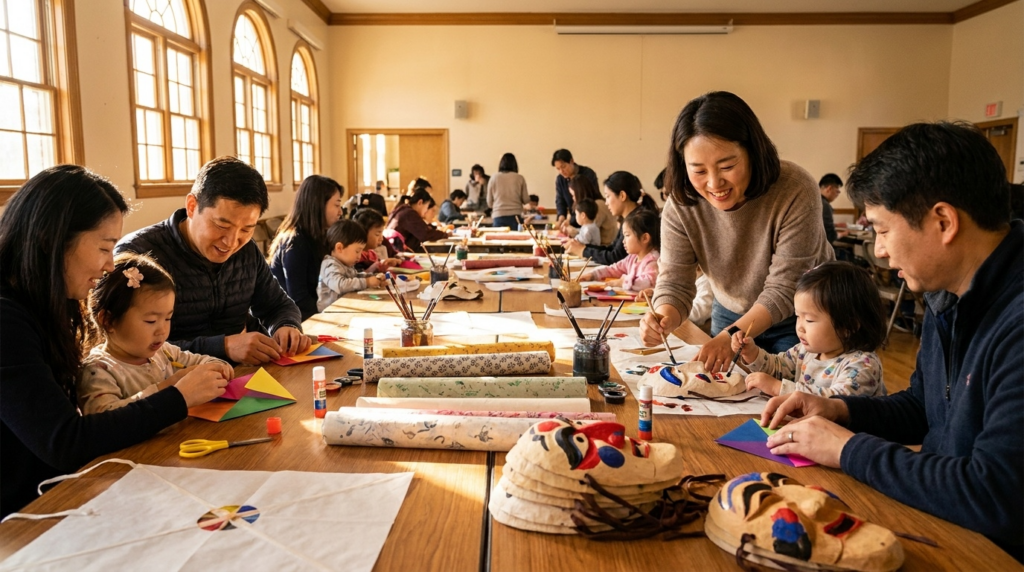
The fall semester’s new offerings include gifted coding, math and Korean through critical thinking, Korean through fairy tales, an accelerated Hangeul course, traditional crafts depicting scenes from folk stories, basic vocal training and choir, and folk paintings illustrating traditional tales. At first glance, some of these subjects might seem to have little to do with Korean-language education. But language is not a skill confined to a separate hour of the day. As children voice a character’s feelings while reading a folk tale, describe the materials and process of a craft, or work through a problem in a coding assignment, they are, all the while, encountering new vocabulary and new ways of thinking.
It is also worth noting the addition of a “Total Household Craft” course designed for parents. The time spent dropping off and waiting for a child can, in this way, become learning for the whole family. A heritage language is not a task left to a single child alone. What determines whether that learning endures is what language a parent speaks at home, how a grandparent and grandchild find their way into conversation with each other, and whether a family comes to see the language as an opportunity for connection rather than a burden. This fall, the Korean Education Center of Los Angeles’s Roots Education program is working to treat Korean not merely as a heritage to be preserved, but as a language the next generation might actually go on to use.
Source: Korean Education Center in Los Angeles, “2026 Roots Education Fall Semester” program guide; The Korea Times (Los Angeles edition), July 16, 2026; KNEWSLA, July 2026.