

Table of Contents
₩255 Million in Revenue Doesn’t Automatically Mean Breathing Room
Average revenue at Korean restaurants has gone up, but what owners actually get to keep after running the place has, if anything, gone down. According to the “2025 Restaurant Industry Management Survey” put out by the Ministry of Agriculture, Food and Rural Affairs and the Korea Rural Economic Institute, the average restaurant pulled in 255.26 million won in annual revenue in 2024.
That’s a 41.4% jump from 180.54 million won in 2021. On the surface, it looks like the restaurant industry has grown, crossing into the 250-million-won range. But you can’t really judge whether owners are actually doing better just from the fact that revenue went up. In this business, what you actually feel day to day has a lot more to do with how costs are moving, and with the operating margin — what’s left once you subtract costs from revenue.
And here’s the thing — the most recent year-over-year growth, from 2023 to 2024, was only 1.4%. That’s a sharp slowdown compared to the 41.4% figure you get looking at the longer stretch. You can raise prices to keep the top-line numbers looking fine, but if customer traffic and people’s actual ability to spend aren’t keeping pace, that revenue growth doesn’t hold up for long.
Costs Climbed Even Faster Than Revenue Did
The most direct reason profitability weakened is that operating costs grew faster than revenue. Per the survey, restaurant revenue rose 41.4% between 2020 and 2024 — but operating costs rose 46.7% over the same stretch. Even if you adjust prices to bring in more revenue, once your cost of goods and running costs climb even faster, what’s left in your pocket shrinks.
Labor and ingredient costs sit at the center of that rise. Ingredient costs specifically climbed from 36.3% to 40.7% of the total. In this industry, ingredient cost is tied directly to menu price, quality, and whether a customer comes back. That’s exactly why it’s hard to just quietly shrink portions or cut quality when costs rise — customers notice, and they stop returning.
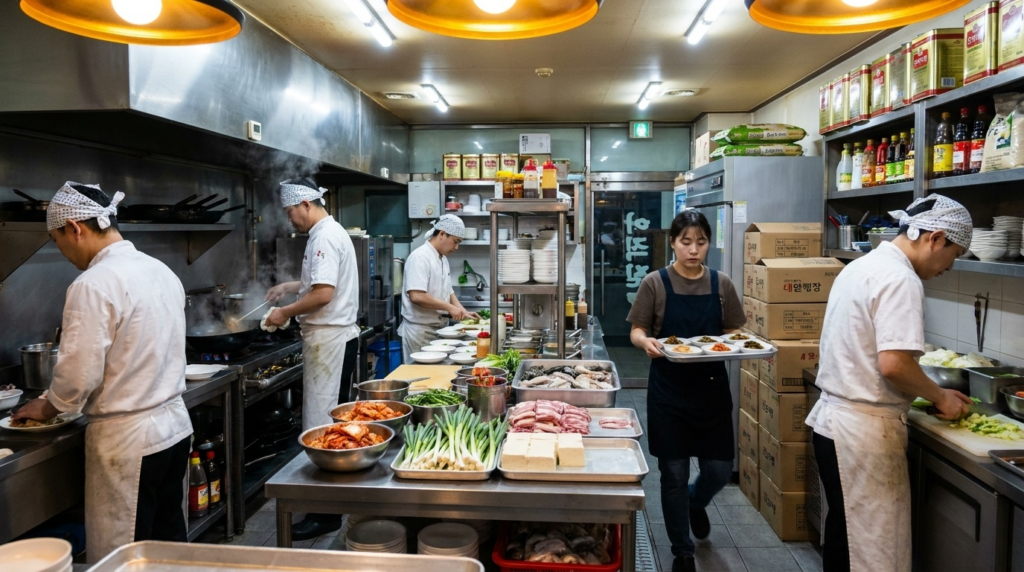
Labor isn’t an easy line item to trim either. You need people for the kitchen and the floor, for handling delivery and takeout orders, for sanitation and inventory management. With labor shortages and wage pressure both persisting, owners end up having to adjust hours, staffing, menu lineup, and ordering methods all at once. If the cost structure doesn’t shift along with a bigger revenue number, profitability can actually get worse, not better.
Operating Margin Slid From 12.1% to 8.7%
The number that shows the profitability shift most clearly is operating margin. It fell from 12.1% in 2020 to 8.9% in 2023, and slid further to 8.7% in 2024. In other words, for every 100 won in revenue, what’s actually left after running the business has gotten noticeably thinner over just a few years.
Survey officials described this as a slice of “recession-era growth” — revenue climbing while the underlying business gets weaker. Restaurants raised prices to offset rising costs, which pushed revenue figures up, but with high interest rates and high inflation eating into consumers’ real purchasing power, that revenue growth has recently stalled out.
Raising prices can work as an immediate way to defend revenue. But for a customer, eating out — unlike buying groceries — is exactly the kind of spending you can cut back on or swap out. Someone working with the same budget for a meal ends up hunting for a cheaper menu item, cutting how often they go out, or comparing delivery and takeout discounts instead. Price hikes alone just can’t absorb all the cost pressure.
The Gap Between Franchise and Independent Restaurants Grew Too
There’s also a real difference in how well businesses can defend revenue depending on how they’re structured. In 2024, franchise restaurants averaged 330 million won in annual revenue — about 1.5 times the 230 million won that independent, non-franchise restaurants pulled in. Over four years, the gap between the two groups widened from around 70 million won to more than 100 million won.
Franchises can lean on bulk-purchased ingredients, brand recognition, and centralized marketing, all of which help defend revenue during a downturn. Independent owners, on the other hand, are often stuck handling ingredient costs, promotion, menu development, and every operating decision entirely on their own. That said, franchise status alone doesn’t fully explain profitability — actual results still shift depending on location, business type, rent, and how a place is run.
There were differences by business type, too. Catering and mobile food services posted the strongest growth, up 101.2% from four years earlier, and kimbap and casual eateries grew 70.3%. Meanwhile, some categories — Chinese food, Western food, other foreign cuisines, bakeries, fried chicken restaurants — actually saw revenue drop from 2023 to 2024. That’s exactly why looking only at the overall average revenue figure makes it hard to judge what’s really happening in any individual business category.
Efficiency Upgrades Help, But They’re Not a Substitute for the Cost Problem
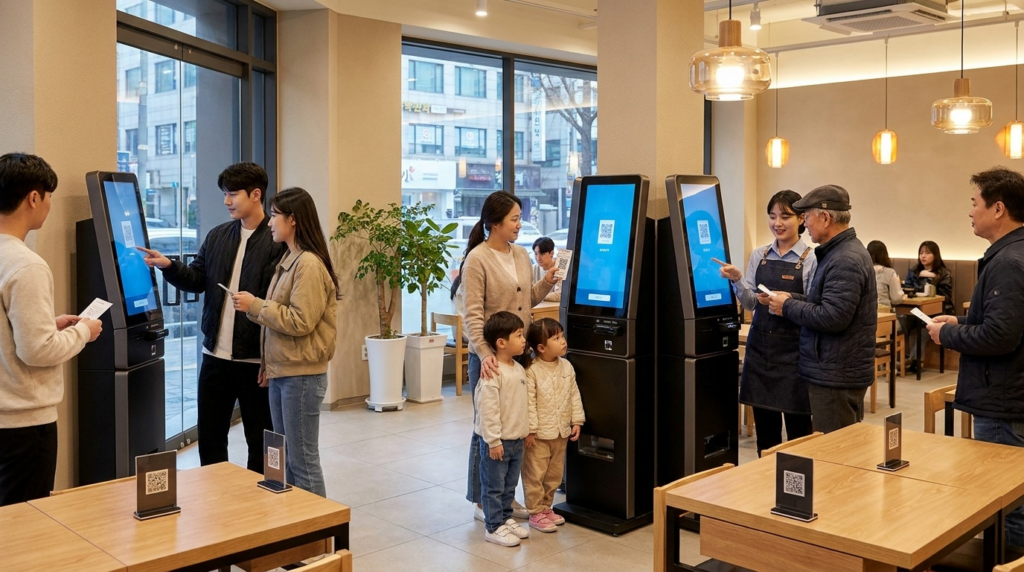
To deal with cost pressure, the restaurant industry is changing how it handles ordering, cooking, and ingredient purchasing. The rate of self-service kiosk adoption nearly tripled, from 4.5% in 2021 to 13.0% in 2025. Kiosks and table-ordering systems cut down on order-taking work and boost operational efficiency, but they also come with their own homework: upfront installation costs, equipment upkeep, and handling customers who need help using them.
There’s a shift happening in ingredient purchasing, too. The share of raw, unprocessed ingredients that need to be prepped in-house dropped from 73.3% in 2021 to 66.1% in 2025, while the share of pre-processed ingredients rose from 23.0% to 29.3%. It’s a choice aimed at cutting prep time and easing labor strain — but really, it’s less about eliminating cost and more about shifting what form that cost takes.
The real challenge for the restaurant industry is building a structure that can grow revenue while also managing rising costs at the same time. That’s exactly why stable ingredient supply, support for labor shortages, digital transformation, and better use of management data keep coming up in the same conversation. The average revenue figure of 255.26 million won is a sign of top-line growth — but an 8.7% operating margin shows that growth hasn’t directly translated into a more stable business.
Source: Ministry of Agriculture, Food and Rural Affairs and Korea Rural Economic Institute, “2025 Restaurant Industry Management Survey”; Yonhap News Agency, March 29, 2026; Asia Economy, March 29, 2026; ThinkFood.