
Table of Contents
The Prevalence Rate Is Down. The Patient Count Isn’t.
Korea’s dementia prevalence rate among older adults has edged down from the previous survey. Yet the total number of dementia patients is projected to cross one million for the first time in 2026. That sounds contradictory at first, but the two figures describe different things. Even if an individual’s odds of developing dementia go down slightly, the total patient count can still rise if the older population most at risk keeps growing fast enough.
According to the 2023 Dementia Epidemiological Survey released by the Ministry of Health and Welfare, the prevalence rate among Koreans 65 and older stood at 9.25 percent — down 0.25 percentage points from 9.50 percent in the 2016 survey. But when that same rate is combined with Statistics Korea’s population projections, the patient count still climbs, from roughly 970,759 in 2025 to 1,014,865 in 2026.
The One Million Figure Is a Projection, Not a Registry Count
Before accepting the headline number at face value, there’s something worth checking. The figure isn’t a simple tally of patients registered with hospitals or the nationwide network of Dementia Safety Centers. It’s an estimate — the prevalence rate calculated from a national sample, applied to the projected population aged 65 and older. It doesn’t mean that some official patient roster actually crossed one million on a specific day in 2026.
Still, the one-million threshold carries real social weight. Government projections show the patient count rising by about 44,100 in 2026 alone. The increase is expected to continue, reaching roughly 1.21 million by 2030 and about 2.01 million by 2044. That said, the pace is slower than what the 2016 survey had projected — one interpretation is that improved prevention, education, and healthier habits may already be having some effect.
The gap by age group is especially wide. The prevalence rate was 4.99 percent for those 65 to 69, rising to 10.70 percent for ages 75 to 79 and 21.18 percent for those 85 and older. What matters here is that Korea’s aging isn’t just increasing the share of older adults overall — it’s rapidly expanding the oldest-old segment, the group carrying the highest dementia risk.
The Pre-Dementia Population Is Growing Too
Looking only at the dementia patient count risks missing a bigger shift. The same survey found a 28.42 percent prevalence rate for mild cognitive impairment — a condition where memory or language decline shows up on testing, but a person still retains the ability to function in daily life, so it isn’t classified as dementia. That’s up 6.17 percentage points from 22.25 percent in 2016.
The mild cognitive impairment population is estimated at about 3.14 million in 2026. Part of that increase reflects wider early screening and more refined diagnostic criteria, which catch more people at the pre-dementia stage. That doesn’t necessarily mean dementia itself is rising at the same pace. What it does signal is a sharp increase in demand on the local public health system to connect people, after screening, to exercise programs, chronic disease management, and social engagement support.
Families Absorb Both the Time and the Cost
Dementia doesn’t stay contained to the patient’s own medical care. In the Ministry of Health and Welfare’s status survey, 45.8 percent of families caring for a community-dwelling dementia patient reported feeling burdened by caregiving. Even family members who lived separately from the patient spent an average of 18 hours a week on caregiving; time spent using outside care services averaged 10 hours a week. It’s a structure that eats into both a family member’s working hours and their rest.
The financial scale isn’t small either. The survey found the annual per-patient management cost at roughly 17.339 million won for those living in the community, and about 31.382 million won for those in institutions or hospitals. In both cases, care costs — long-term care and caregiving expenses — outweighed medical costs. That suggests simply expanding hospital capacity won’t be enough to ease the burden.
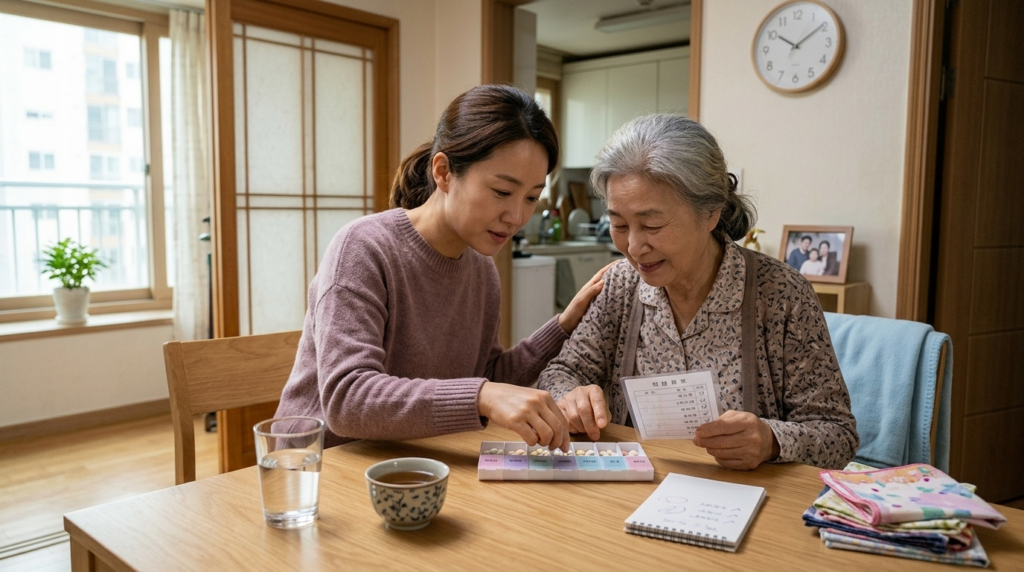
It’s also worth noting that 52.6 percent of patient households were single-person households. As more dementia patients live alone, the need grows for services that monitor daily life broadly — medication, meals, safety incidents, financial exploitation. The assumption that family will always be close enough to provide care is getting harder to sustain.

The Indicators That Matter After the Million Mark
The government has laid out plans to strengthen early detection and initial-stage management at Dementia Safety Centers, and to expand in-home long-term care services and dedicated dementia care units. The core question is how long patients can be supported to live safely in the community before they need to move into institutional care. Respite programs that give families a break from caregiving, along with in-home nursing and care services, sit in that same context.
Going forward, the patient count alone won’t be enough to watch. Participation rates in post-diagnosis management, hours of in-home service use, and changes in family caregiving burden and cost all need to be tracked alongside it. One million isn’t a sudden crisis — it’s the accumulated result of a long-running shift in Korea’s population structure. The more important indicator isn’t the moment the number first crosses a round threshold; it’s whether Korea’s health and care system can keep pace with how fast it keeps climbing.
Source: Ministry of Health and Welfare, “2023 Dementia Epidemiological Survey and Status Survey Results,” March 13, 2025.