
Table of Contents
260,000 Korean Textbooks for Overseas Schools
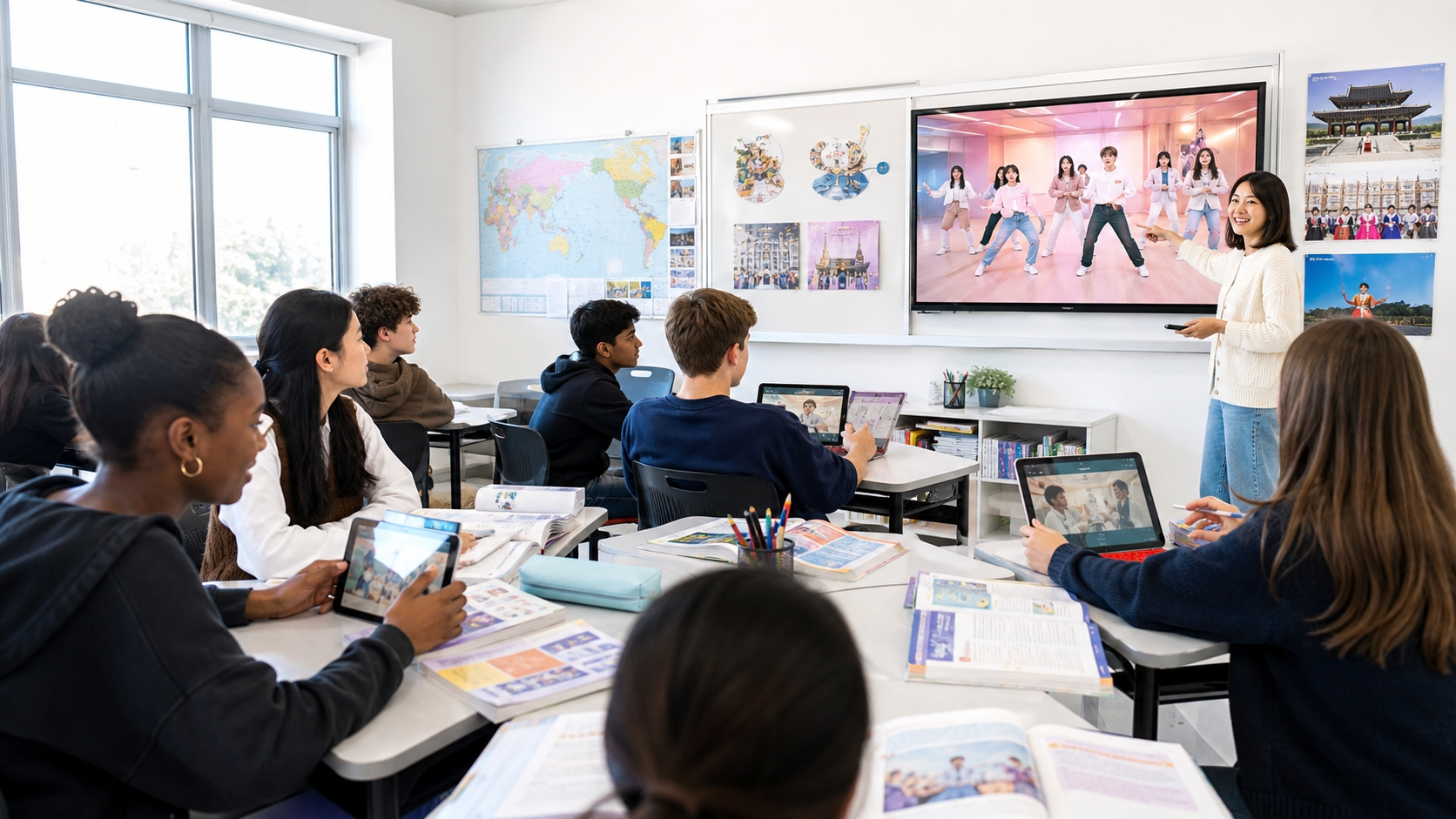
South Korea’s Ministry of Education will distribute roughly 260,000 Korean-language textbooks to regular elementary and secondary schools overseas in 2026, alongside nine newly developed titles built around Korean pop culture content and digital learning tools. The new lineup includes one BTS-themed supplementary textbook, one smart digital textbook for beginners, and seven country-specific textbooks tailored for six countries including India, the Philippines, and Vietnam.
The core idea behind the plan is moving Korean pop culture from something students encounter outside the classroom into actual material for regular Korean-language lessons. The ministry has developed Korean textbooks for overseas elementary and secondary schools since 2021, but this year’s plan is the first to combine K-pop, K-dramas, AI-linked learning, and local curriculum alignment within a single distribution framework.
Songs and Dramas as a Way Into Cultural Context
The BTS supplementary textbook isn’t an entirely new series so much as a repackaging of existing material. The ministry has developed and distributed eight BTS-related Korean supplementary textbooks since 2021, and this year’s plan is to condense the core content into a single combined volume. The goal is to channel students’ interest in K-pop into vocabulary and expression learning, while making material that had been scattered across multiple books easier to access.
A K-drama-based supplementary textbook developed last year will also begin distribution this year. Rather than simply introducing characters and dialogue from dramas, it uses the everyday Korean life shown on screen as learning context — family dynamics, school, mealtimes, the kind of living culture that a dictionary definition alone often can’t convey. Pairing cultural context with language instruction helps students understand when a given expression is used, and with whom.
Local Input and Smartphone Learning Expand the Program
For the seven country-specific textbooks, teachers and education officials based in each target country take part in writing and review, so the material reflects the curricula, languages, and cultural environments of all six countries, including India, the Philippines, and Vietnam. That’s a departure from distributing one identical, Korea-made textbook across multiple countries. It means explanations and difficulty levels can be adjusted to fit students’ native languages and their schools’ actual classroom conditions.
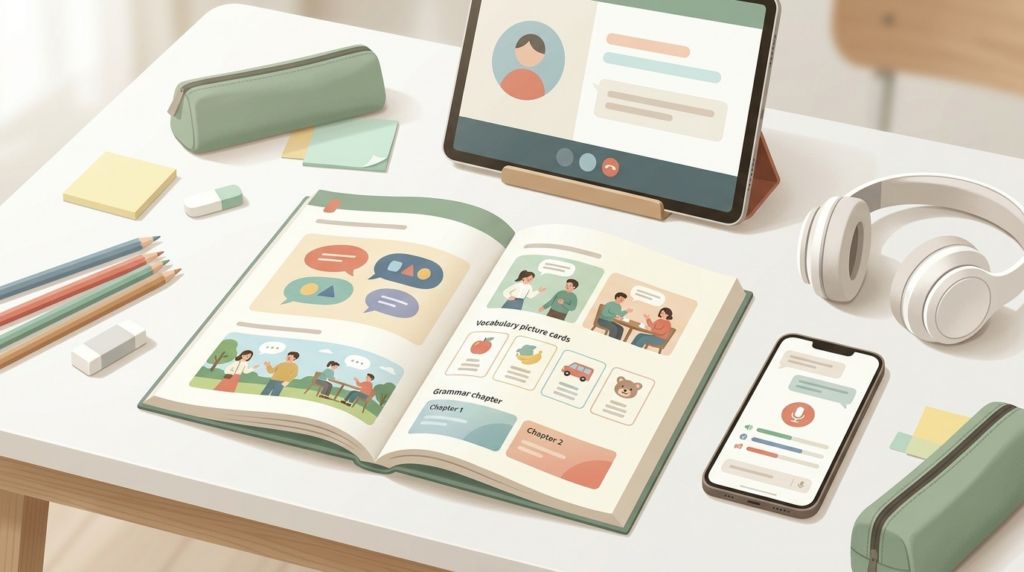
The smart digital textbook is being built for students in overseas Korean-language classes to access on their own smartphones. Where earlier digital textbooks were mostly about viewing material on a computer screen, the new version is expected to include AI-linked learning support features. The ministry also plans to use the learning data it collects for future research into Korean-language education abroad. How data privacy is handled, and how the system is adapted to different countries’ school environments, are questions that will only be answered once it’s actually rolled out.
From 1.04 Million Textbooks to a New Stage of Content Integration
Building on a Korean-language curriculum for overseas elementary and secondary schools that the Korea Institute for Curriculum and Evaluation established in 2021, the ministry has developed 80 textbook titles and distributed a cumulative 1.04 million copies to date. That curriculum follows the Common European Framework of Reference for Languages, an international standard for describing foreign-language proficiency by level. The point was to set a shared standard so that Korean could be taught in overseas schools as a leveled foreign-language subject, rather than a one-off cultural experience.
The 260,000 copies going out this year represent both a scaling-up of the existing program and a shift in how the content is put together. The role of these textbooks has expanded to use Korean pop culture as motivation, bring in local teachers as co-creators, and add smartphone-based features. What remains to be seen is whether well-known content does more than just grab students’ attention — whether it actually translates into sustained gains in reading, listening, and speaking.
Source: Ministry of Education press release, June 4, 2026; Chosun Edu, June 4, 2026; Money Today, June 4, 2026.