
Table of Contents
When London Bookstores Couldn’t Find Korean Books
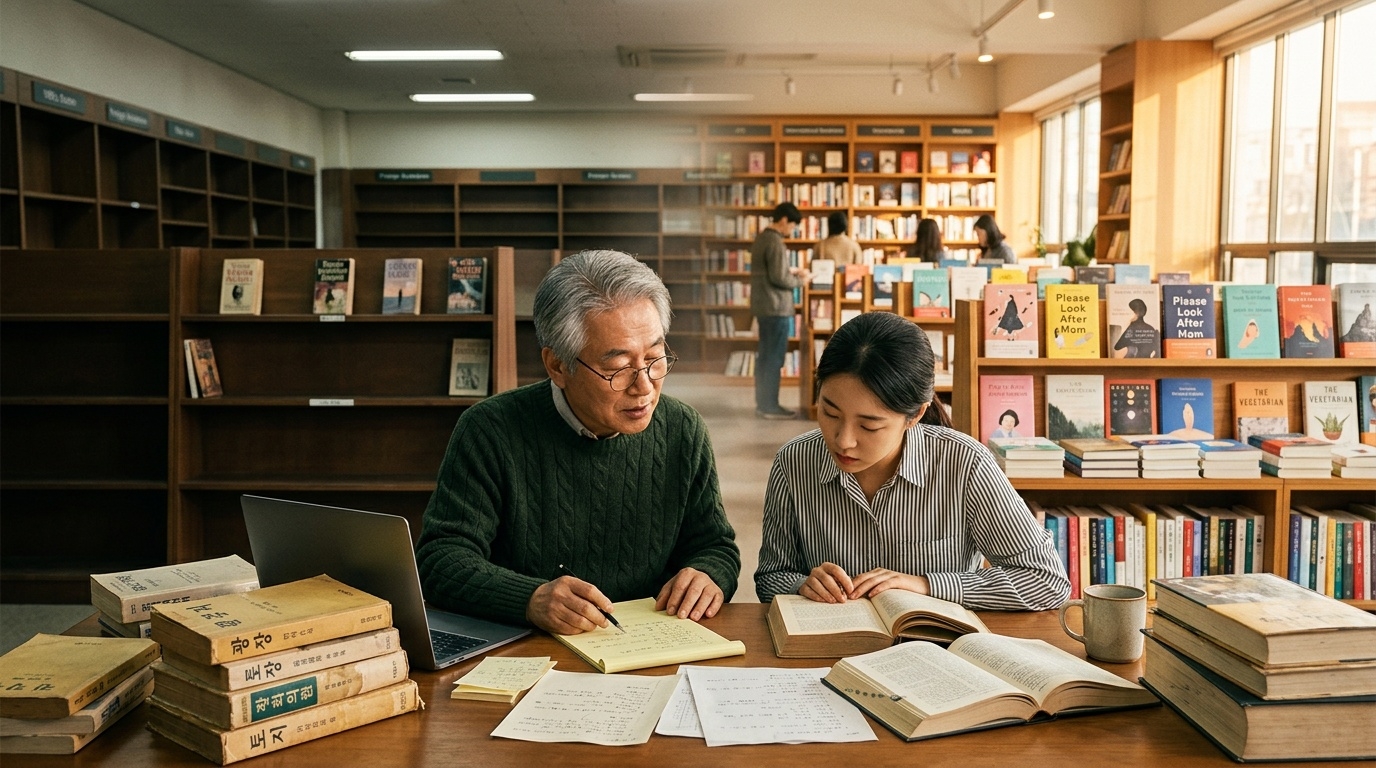
About 30 years ago, if you asked for a book about Korea at a major bookstore in London, you would often be pointed toward the Southeast Asia section. It was a time when global awareness of Korean literature was so low that people couldn’t even distinguish between Korea and Southeast Asia. Anders Karlsson, a professor of Korean Studies at SOAS University of London, shared this personal anecdote to illustrate exactly where the translation of Korean literature began.
Since the 1990s, Professor Karlsson has been translating works by Korean authors—including Yi Mun-yol, Hwang Sok-yong, and Han Kang—into Swedish alongside his co-translator Okkyoung Park. This collaborative effort was happening long before Korean literature secured its own dedicated shelves in overseas bookstores. Their track record clearly demonstrates that translation isn’t achieved through a single person’s linguistic skills alone. It’s a genuine collaboration of interpreting and bridging the cultural nuances of both the source and target languages.
Today, the landscape in London is completely different. Korean books are displayed in prime spots, and Korean authors are mentioned more frequently than ever in international literary awards and the global publishing market. Yet, while the visibility of Korean literature has soared, the diversity of what gets translated hasn’t quite caught up. Voices from within the translation community are starting to ask hard questions about what gets introduced to the world—and what gets left behind.
Looking Back at 30 Years of Progress at the World Translators Conference
To celebrate its 30th anniversary, the Literature Translation Institute of Korea (LTI Korea) hosted the “2026 World Translators Conference” at the Grand Mercure Imperial Palace in Gangnam, Seoul, on August 28, 2026. The two-day event offered a space to reflect on the accumulated achievements of Korean literary translation over the past three decades and to discuss the future roles that literary translation should play in the global cultural exchange landscape.
In his keynote speech titled “The Flow and Future of Translating Korean Literature and Culture in the World,” Professor Karlsson noted how significantly the status of Korean literature has risen. Han Kang’s International Booker Prize and Nobel Prize in Literature serve as landmarks of this transformation. Korean authors have begun to earn well-deserved recognition on the international stage, firmly placing Korean literature on the radar of global readers.
Compared to just 30 years ago when it was hard to even locate where Korean books were shelved, the leap is massive. The synergy of translation grants, translator training, interest from overseas publishers, and the widespread popularity of Korean pop culture has successfully broadened the readership. However, the surge of attention directed at Korean literature post-Han Kang has sparked a new dilemma: figuring out exactly which works to translate next.
Broader Genres, Narrower Timelines
After acknowledging the progress, Professor Karlsson shifted his focus to critique how translation subjects are currently selected. He pointed out that as attention quickly zeros in on the latest trends in Korean literature, our vision has broadened in one direction but narrowed in another. While the genres and range of authors in translated fiction are more diverse than before, the historical scope of the works being translated has actually shrunk.
He expressed particular concern about translation opportunities heavily favoring works that have already proven successful in the Korean publishing market. Domestic sales and buzz are convenient metrics for overseas publishers gauging a book’s potential. But relying solely on this standard makes it incredibly difficult for works outside the mainstream, important past classics, and stories capturing aspects of Korea hidden beneath contemporary pop culture to ever reach global readers.
The approach of rapidly translating recent hits is great for overseas publishers looking to minimize market risk, as domestic readers have already validated the book. On the flip side, older publications or works delving into the experiences of a specific era often get sidelined simply for being out of sync with current trends. If this pattern repeats, the timeline of Korean literature available to global readers will become overwhelmingly skewed toward the present day.
Translation shouldn’t just chase Korea’s latest publishing fads, Professor Karlsson stressed. He argued that beyond commercial viability and the likelihood of resonating with international audiences, we need to ask which works truly represent the broader Korean literary world. This means intentionally digging up works that shine a light on lesser-known facets of Korea, bringing historical depth to translated literature rather than just a breadth of genres.

To Erase or Explain “Saeng-gi-bu”?
The conference also shed light on the cultural clashes that happen during the local editing process after a work is translated. Irène Jeong, who translates Korean works into French, shared her experience working on Kim Sun-mi’s young adult novel “Biscuit.” A French editor asked her to remove a line where a character asks, “Aren’t you worried about what they’ll write in your saeng-gi-bu?” arguing that local readers wouldn’t understand the concept.
“Saeng-gi-bu” is the abbreviation for the student record book where Korean schools document not only academic grades but also attendance, extracurricular activities, and behavioral traits. For Korean teens, it’s a very real system that can make or break their college admissions and daily school life. Readers from cultures without a similar system might not immediately grasp the tension behind the dialogue. Deleting the line makes the text easier to read, but it also erases a piece of the intense educational environment that the characters genuinely fear.
The editor also requested the removal of a description about a mother gaining weight, citing it as fatphobic. Jeong noted that such demands were quite a shock for a translator trying to stay faithful to the source text, leading to intense negotiations to find a middle ground. This specific case shows that translation is far more than just swapping words from one language to another. It’s a delicate balancing act of deciding what to preserve between the cultural context of the original work and the sensibilities of the target society.
There are no easy answers when navigating the space between editing a work to make it accessible and translating in a way that preserves the original text’s unfamiliarity. Scrubbing away every foreign concept makes for a smoother read, but it strips away the specific social realities from which the story was born. Conversely, adding too many explanations can disrupt the pacing and tone of a novel. Translators and editors inevitably bump heads over exactly where to strike this balance.
The Choices Left After Success
The past 30 years of translating Korean literature have been all about building international awareness. The awards won by Han Kang and other authors, alongside the steady expansion of overseas publications, prove that these efforts have yielded tangible results. Now, the questions have fundamentally changed. We’ve moved beyond asking whether Korean literature is known globally, and it’s time to examine exactly what kind of Korean literature those global readers are engaging with.
Selecting works based heavily on their existing success minimizes risk for foreign publishers, but leaning entirely on this formula limits the image of Korea presented to the world. Blindly translating marginalized or older works doesn’t automatically guarantee meaningful diversity, either. What is needed is an editorial and support system that can look past short-term trends while carefully weighing a work’s literary merit, its translatability, and its potential connection with new readers.
On August 29, the second day of the conference, LTI Korea hosted a “Homecoming Day” where alumni of its Translation Academy gathered to share their experiences and insights. An Sonjae, professor emeritus at Sogang University, gave a special lecture on “The Value and Joy of Translation.” It was a valuable moment for those actually doing the groundwork of translation to reaffirm the meaning of their craft, even as they tackled the structural hurdles of book selection and local editing.
As the debate over “Biscuit” perfectly illustrates, the real work continues long after a book is chosen. The final translated product hinges on whether you explain a foreign concept so local readers understand it, trim it down for a smoother read, or preserve the cultural difference as an integral part of the original text. Now that Korean literature has secured prime real estate in bookstores around the world, the success of the next 30 years won’t just be about churning out more titles. The new question is figuring out which stories and cultural nuances we choose to preserve and pass on.
Source: Literature Translation Institute of Korea “2026 World Translators Conference,” August 28–29, 2026; Yonhap News, August 28, 2026; The Hankyoreh, August 2026.