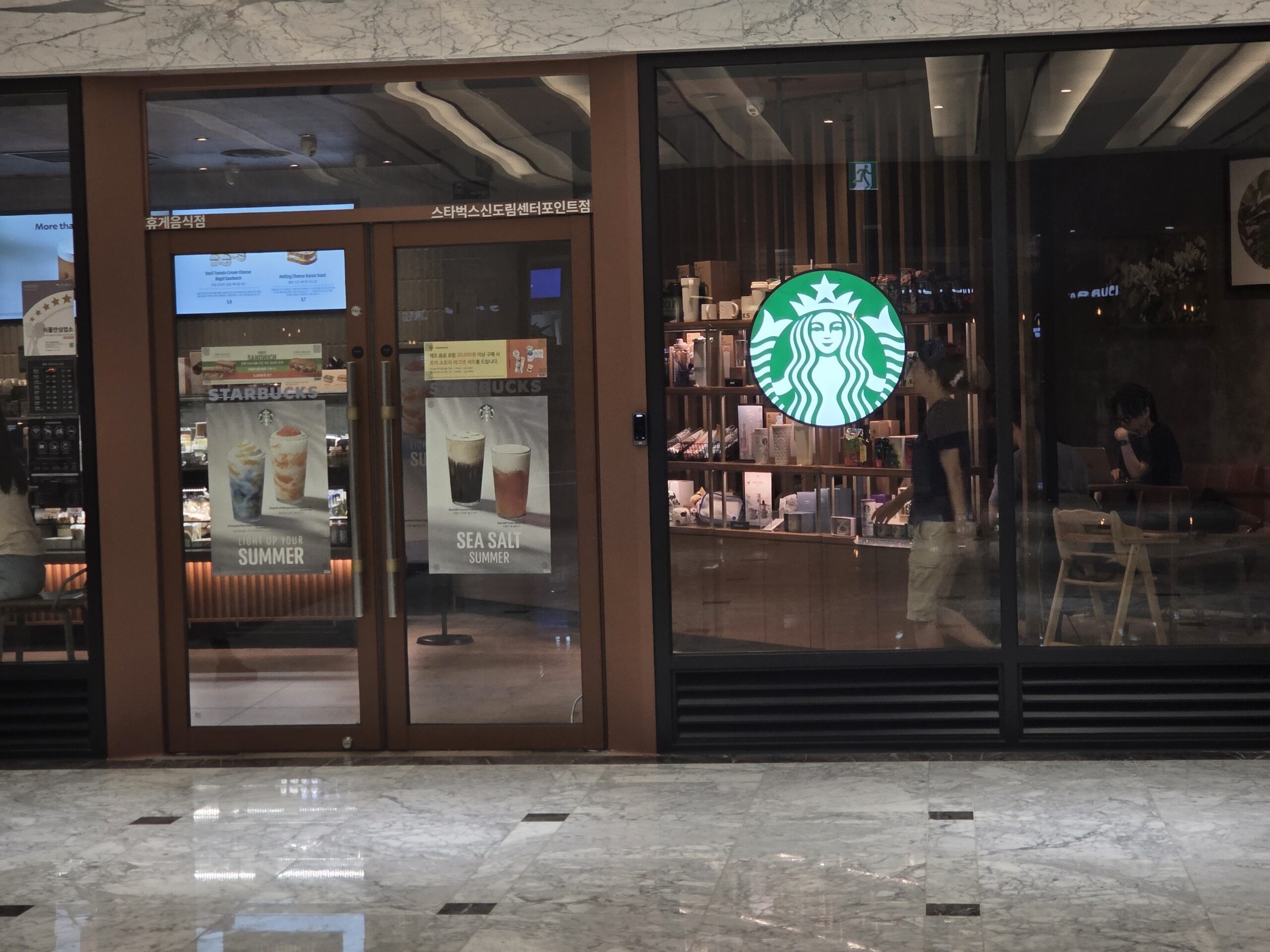
Starbucks Korea now runs 14 “special stores” nationwide, and each one is pulling roughly 1,200 visitors a day — a number a mid-size regional attraction would be happy with on a good weekend. According to an April 27 report from Etoday reporter Yeon Hee-jin, the stores split into three types: scenic “THE” locations built around a view, concept stores with a distinct visual theme, and urban “premium reserve” outlets in city centers. The flagship is the branch on Chuncheon’s Uiam Lake, nicknamed a “pungyeong matjip” (scenery hotspot) by customers, where the interior wraps around the lakefront, the menu includes a Chuncheon-style dak-galbi-and-potato ciabatta sandwich sold nowhere else, and a curated media-art show runs after sunset, timed differently every evening.
Ediya Coffee, the domestic chain best known for its low prices, is chasing the same “destination, not drive-by” logic through Korea’s museums instead of scenery. It already runs cafes inside the National Museum of Korea, the Gyeongju National Museum, and the Daegu National Museum, and a branch inside the National Palace Museum of Korea was set to open by the end of April. The National Museum of Korea location, named “Sayu-gonggan Chatjip” (Contemplation Space Teahouse), decorates its walls with images of the gilt-bronze Pensive Bodhisattva and the Baekje gilt-bronze incense burner, and sells a matching menu: “Sayu-ui Green Tea” (Green Tea of Contemplation) and “Jeongdam-ui Yulmu-cha” (Warm-Chat Job’s Tears Tea), alongside mugwort rice-cake waffles and five-color honey rice cakes. Ediya told Etoday it’s now looking at more of Korea’s cultural, tourism, and public spaces specifically to give foreign visitors “an experience that reflects Korean elements.”
Tim Hortons, meanwhile, is doing the opposite move — importing a foreign mood instead of a local one. Its “Vintage Canada” concept stores, which opened at Hanam Misa Station last December and at Seoul’s Samsung Station this April, recreate the coziness of a Canadian cabin using brick, raw wood, and check-pattern fabric, with a food lineup designed to match.
The reason all three chains are spending on atmosphere instead of just opening more locations: Korea’s coffee franchise market is saturated. Fair Trade Commission data on 2024 franchise operations puts the number of coffee franchise stores at 29,101, with a store opening rate of 16.5 percent — down 2.5 percentage points from the year before. An industry source told Etoday that coffee has become such a daily habit in Korea that chains are now competing to sell an experience “outside” that habit, where “location, menu, interior, lighting, and furniture all function as one piece of content” built to maximize how long a customer wants to stay.
For visitors, the practical takeaway is that a Starbucks or Ediya address is no longer a guarantee of a generic cafe. Checking which specific branch you’re heading to — and whether it’s a “special store” — increasingly determines whether you get a standard latte counter or a themed space built around a lake, a national treasure, or someone else’s country entirely.
Source: Yeon Hee-jin, Etoday, April 27, 2026; Ministry-linked Fair Trade Commission 2025 franchise disclosure data.